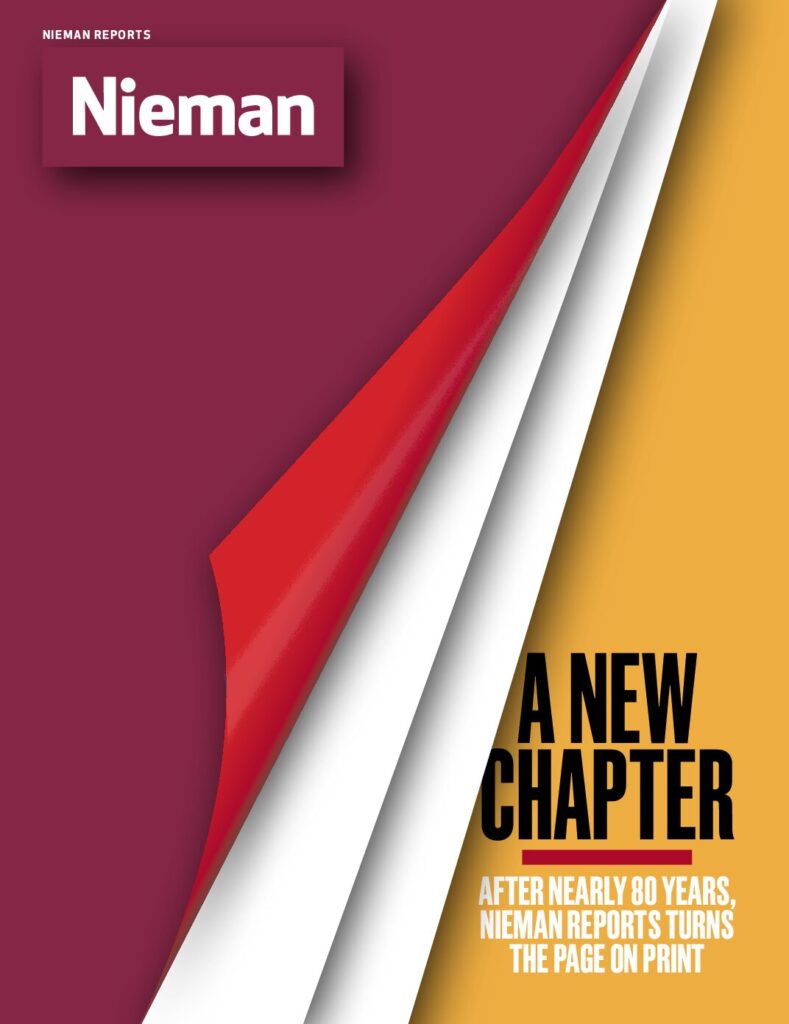
The Fall 2025/Winter 2026 edition of Nieman Reports represents the magazine’s final print issue as it transitions to an all-digital format. A combination of factors — many of which are affecting the wider media industry — has resulted in the move to online-only following a nearly 80-year run in print.
There’s much to think about and enjoy in this new print edition of Nieman Reports, and even more online. The issue examines challenges and trends in the news industry in the United States, France, Myanmar, Nepal, and Sudan, while our cover story looks at the evolution of Nieman Reports.
The same great journalism about journalism that readers have come to expect from the magazine will continue at niemanreports.org. In fact, it’s been appearing there for years already, including stories that don’t make it into print. Despite the changing format, our commitment to global media coverage remains as strong as ever.
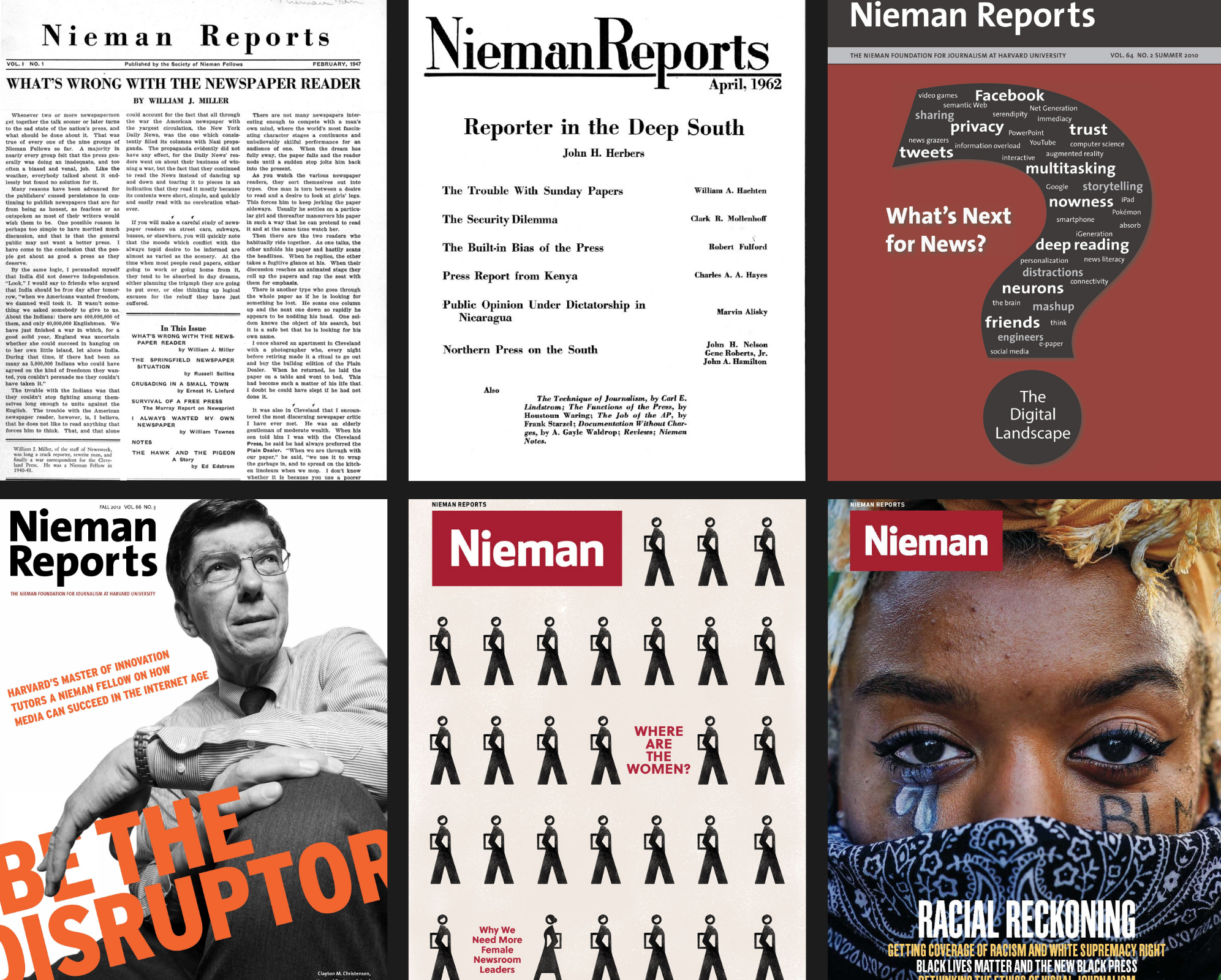
When the first issue of Nieman Reports rolled off the presses in 1947, it looked like a black-and-white bulletin, printed on heavy white butcher paper due to postwar shortages. The disruption rocking the news industry at the time was the advent of TV. “What’s Wrong With the Newspaper Reader,” blared the cover story in all caps — a polemic by William J. Miller (NF ’41) about how the public “prefers to be entertained” rather than to think.
The first issue made waves, eliciting detailed coverage in the New York Herald Tribune, including an editorial disagreeing with Miller’s piece. The magazine immediately drew about 300 subscribers, including a U.S. Supreme Court justice — and a slew of complaints about typos (“yargest,” “freedonm,” “payrool”).
Nieman Reports quickly stepped up its proofreading and evolved with the times as journalists navigated a cascade of changes that came to include portable TV cameras, the internet, social media, 24/7 news, and artificial intelligence.
Now, nearly 80 years after its inception, Nieman Reports is making another change: ending its print magazine edition and continuing only online.
“It’s a time of tough choices for the media industry, and Nieman Reports is not immune,” Editor Samantha Henry said by email.
“Although shifting away from print marks the end of an important chapter,” Henry said, “the significant resources required to produce a print magazine can now be refocused on deepening engagement with our alumni, reaching new and broader audiences, and giving us more flexibility to be creative, nimble, and responsive to the news."
This issue, the magazine’s final print edition, is mailed to about 1,100 readers, mostly Nieman Fellows. Nieman Reports will continue to publish stories focused on the news industry on its website, where it reaches a far broader audience — about 400,000 unique visitors per year. Nieman Reports already posts many more stories online than appear in print, and plans to further expand its online offerings, Henry said.
The magazine is also looking at reviving the Nieman Reports newsletter, engaging more directly with alumni, and experimenting with new storytelling formats across social media, where it has already moved into posting videos on several platforms, Henry said.
Now, nearly 80 years after its inception, Nieman Reports is making another change: ending its print magazine edition and continuing only online.
A bold beginning
Nieman Reports, one of the nation’s oldest magazines about journalism, sprang up from a reunion of Nieman fellows in 1946, eight years after the fellowship began. The Society of Nieman Fellows — which was formed at the event from the first 96 graduates of the fellowship program — published the first Nieman Reports issue the following February.
They called it “a quarterly about newspapering by newspapermen,” even though the fellowship had welcomed its first two women in 1945. It bore a simple design: three columns of text and no images. Subscribers received the first three issues for free; after that a subscription cost $2 per year.
The first edition experimented with form and tone, including a whimsical short story by Ed Edstrom (NF ’45) about a heavy-drinking reporter whose city editor, a “fat-jowled, big-bellied, rump-sprung sadist,” assigns him a story on a pigeon-killing hawk.
On the more serious side, it included several reports from Sen. James E. Murray of Montana warning that corporate giants were squeezing out small newspapers, threatening the “survival of an American free press.”
In the first three issues, Nieman Reports devoted a whopping 55 pages, or about 16,000 words, to printing government reports about the state of the media, including the Hutchins Commission’s report on “A Free and Responsible Press,” which found that freedom of the press was in danger, in part because the media was failing to uphold a moral duty to serve the public’s needs.
“Nowhere else was such comprehensive treatment given to these illuminating studies of the forces at work in the newspaper business,” reflected Nieman Foundation Curator Louis M. Lyons in an account of the time period, published in a book he edited “Reporting the News,” which was cited in an article in the magazine in 1978. Nieman Reports “filled a gap,” he wrote.
When the magazine started, it was U.S.-focused: Nieman Reports “has no pattern, formula or policy, except to seek to serve the purpose of the Nieman Foundation ‘to promote standards of journalism in America,'” a brief mission statement read. As the fellowship expanded to include international journalists, the scope of the magazine became more global.
From the outset, Nieman Reports relied on contributors’ pro bono work, so authors often wrote from their own experience instead of conducting extensive interviews.
Much of how the magazine looks today traces back to changes made by Ann Marie Lipinski (NF ’90). After Lipinski became curator of the Nieman Foundation in 2011, and, by extension, the magazine’s publisher, she pushed to start paying writers and to hire photographers and a designer to produce a more timely, visually compelling, in-depth report. The magazine broke away from a red-and-black Harvard aesthetic and began publishing dynamic cover images and color photographs.
James Geary (NF ’12), who edited Nieman Reports from 2013 to 2023, during Lipinski’s tenure as curator, said the redesign aimed to “make it feel more like a magazine in a journalistic sense, than something like a white paper” or an “academic treatment.”
Technological tumult
A stroll through the Nieman Reports archives finds stories about writers grappling with how to uphold journalistic standards in the face of the latest technological disruption of each decade. They meet these challenges with curiosity, worry, skepticism, joy — and an eagerness to share stories and reflections about their fast-changing field.
Lowell M. Limpus (NF ’41), a writer for the New York Daily News, “had never seen a television camera” when he was called in to a TV station to offer political commentary, he wrote in “The Newspaperman Meets Television” in 1949. Limpus was hired as a TV commentator at that year’s Republican National Convention — under the condition that he grow a Van Dyke-style beard, a mustache with a goatee. (He complied.)
For veteran newspaper writers, the role was “a performance, the like of which we had never anticipated in our cub days,” Limpus wrote. He outlined several problems print reporters could expect when asked to appear on TV.
“The moderator has to be continually on his toes, watching for libel and slander,” he wrote. “You must follow the discussion with hawk-like accuracy because you have no chance to eliminate the libelous matter on a galley proof, if it once takes form.”
In 1966, Otis Chandler, publisher of the Los Angeles Times, pondered the relevance and future of print newspapers at a moment when satellites and portable cameras were revolutionizing TV news.
"A new communications satellite now in orbit over the Pacific will permit live television coverage of the war in Viet Nam by next year. The Viet Nam conflict is the first major conflict in the world to have been covered by television at all. Shortly, television will bring it into your living room as it is happening,” he wrote, with apparent awe and wonder, in a piece headlined “Why a Newspaper in an Electronic Era?”
Chandler offered an imaginative prediction: “Even further in the future, you may receive information from electronic impulses projected directly into the mind perhaps during sleep. How a book or a magazine or a newspaper will be ultimately transmitted to its user is one of the great question marks in the future of communications.”
However, Chandler said he was not “fatalistic about the future of the printed word,” because of the quality of its content. “Neither television, nor any other electronic device, in my opinion, will deprive good newspapers or good magazines … of an expanding audience adequate in size to assure an important place in the American culture.”
The question Chandler posed — whether the latest technology spelled the death of print — would echo throughout the decades.
The dawn of the internet and the digital age has since posed the biggest challenge to Chandler’s optimism about the survival of print. In a 2006 issue titled “Goodbye Gutenberg,” writers explored how to adapt to changes that, one predicted, threatened to make print a “niche artifact.”
“Newspapers lacked the external vision necessary to see the vast range of opportunities created by the Internet,” bemoaned Chris Cobler (NF ’06).
Instead of investing in training staff on digital skills, “most large news media companies are slashing staff in a desperate bid to reduce expenses as profits plunge,” he wrote. “This death spiral makes me fear for the future of an industry I love.”
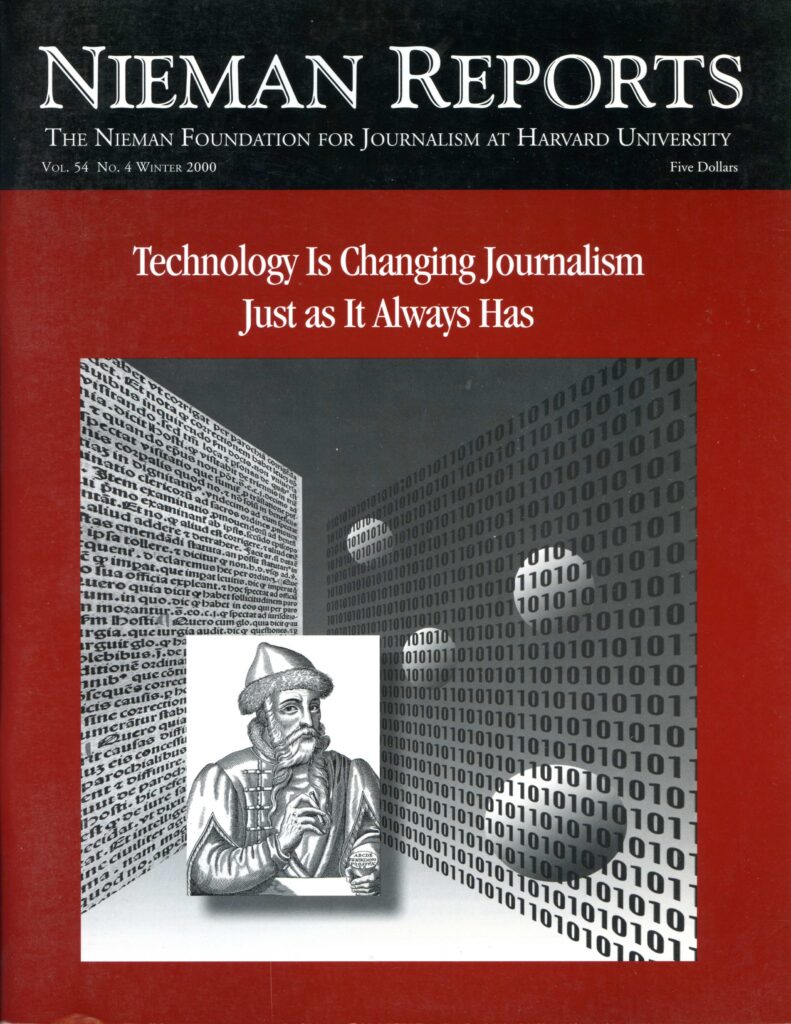
As a journalistic publication, Nieman Reports found itself having to adapt to the same industry upheaval it was covering. In the late 1990s, the magazine entered the online world, posting articles and PDFs of the magazine on the Nieman Foundation website, nieman.harvard.edu. The PDFs were black-and-white, except for a crimson red cover.
“The Journal for Serious Journalists,” read the tagline of the magazine on a 1998 version of the site, which featured a glaring white background with simple black text.
“The World Wide Web portion of the Internet may be the best place to begin for journalists writing on welfare reform,” wrote Barbara Burg in 1997, in one of the earliest articles posted online. To save her readers from sifting through an estimated 200,000 hits on the Alta Vista search engine on the topic, she offered a long list of hyperlinks to government websites.
Melissa Ludtke (NF ’92), who edited Nieman Reports from 1998 to 2011, said that initially, posting articles online was an “almost torturous process,” involving writing code. An editorial assistant would “spend days taking the whole issue and making it into a digital product,” she said.
“We did make as early an attempt as we could to share what we had done in the magazine digitally,” Ludtke said.
As a journalistic publication, Nieman Reports found itself having to adapt to the same industry upheaval it was covering.
In the early 2000s, articles were accessed in PDFs displayed online in yellow rectangles. Several website redesigns followed: 2008 brought clickable headlines under a thick, crimson-red banner; 2011 introduced color photographs at the top of stories.
In 2012, soon after becoming curator, Lipinski began to convert the print version of Nieman Reports from black-and-white to a color magazine, with much more dynamic graphic design.
“During the life of Nieman Reports, the way that publications used graphics, photography, art to communicate the importance of a story, the nuance of a story … had dramatically changed,” but the magazine hadn’t kept up, Lipinski recalled. It was time to “elevate the power of the stories and to enhance the reading experience,” she said.
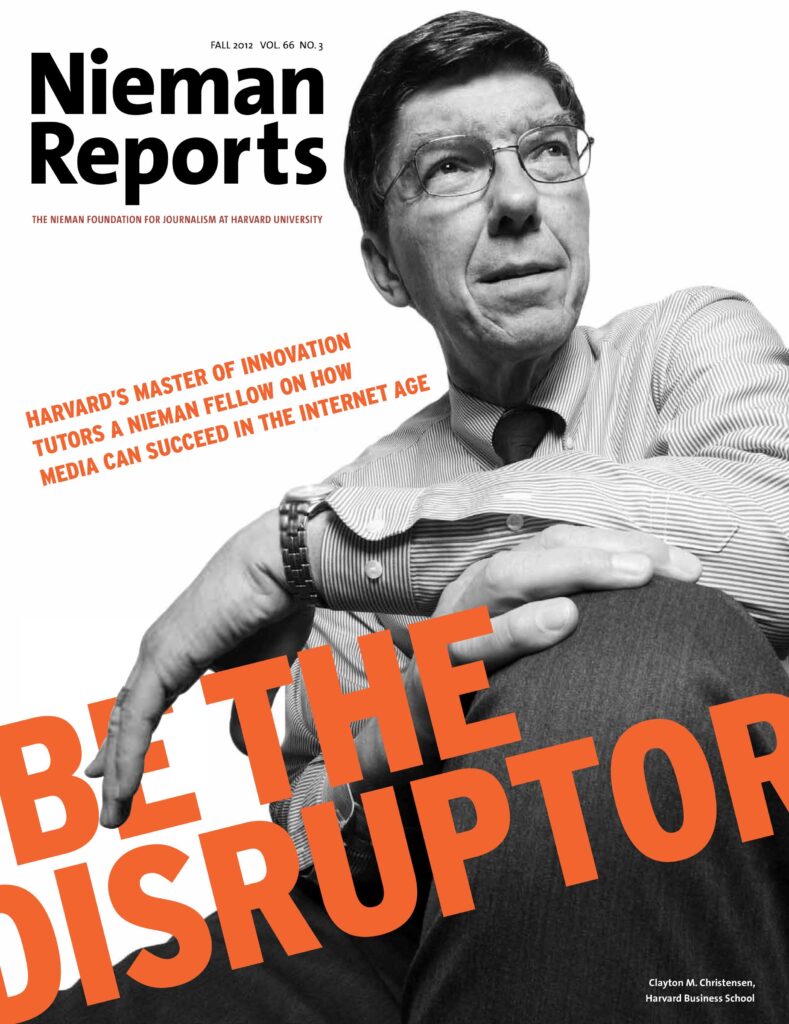
The 2012 issue “Be the Disruptor” marked “the start of what we were going to reimagine for the magazine,” Lipinski said. The cover broke from the academic aesthetic with slanted orange text and a full-page portrait of Clayton M. Christensen, a professor at Harvard Business School.
The story emerged from an unexpected collaboration between Christensen and David Skok (NF ’12). Skok, a Canadian journalist, was curious about Christensen’s theory of disruptive innovation. He spent his Nieman Fellowship year collaborating with Christensen on how to apply that theory to help newsrooms survive plummeting ad revenue and other existential threats.
In a 15-page story in Nieman Reports, Skok and Christensen offered provocative advice, encouraging news leaders to “aggressively experiment with new distribution efforts” and arguing that it’s better to “cannibalize” your own business than to let a competitor do so.
After publication, Lipinski heard from “a ton of industry leaders” about how they were using the findings to inform their work, she said — including John Henry, who had just bought The Boston Globe and subsequently hired Skok.
The issue marked “a new age for Nieman Reports,” Lipinski said — one that aimed to take what Nieman Fellows were learning on campus and share it with a broader audience. Lipinski also began publishing excerpts of Soundings, a hallmark of the Nieman Fellowship, in which fellows share intimate stories about the influences and inspirations that animate their work.
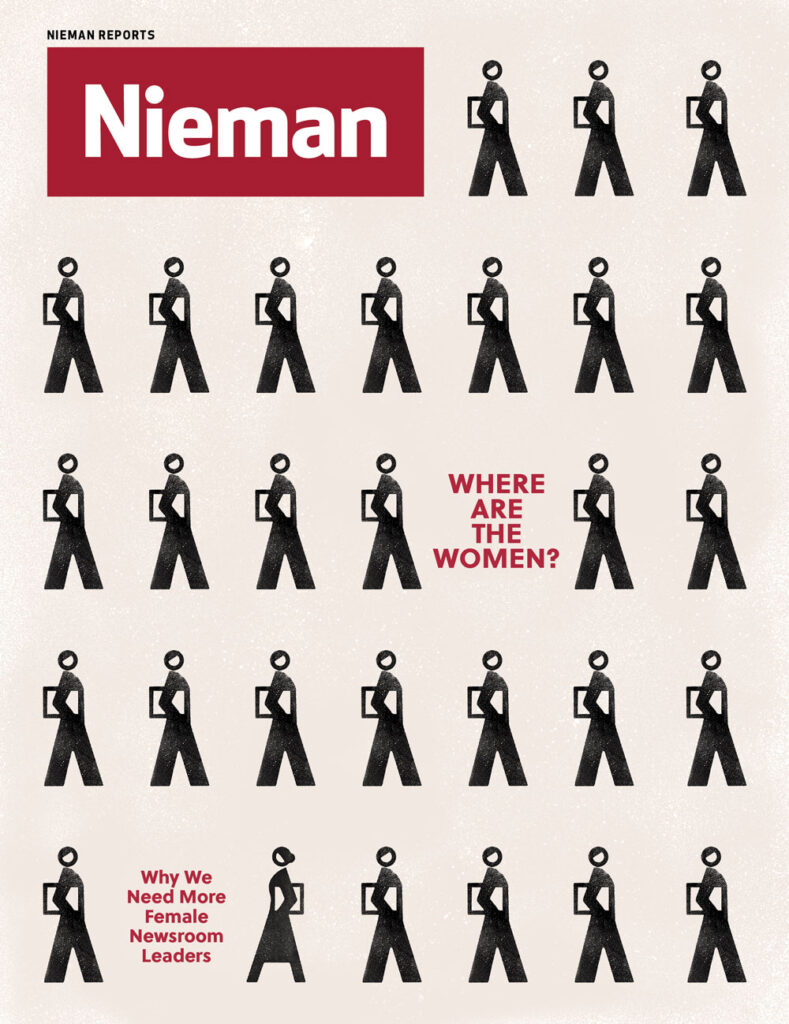
“Where Are the Women?” Despite earning the majority of communications degrees, women led only three of the nation’s top 25 newspapers at the time. The issue signaled Nieman Reports’ commitment to gender equity, a focus that continued with stories addressing sexual harassment and the #MeToo movement.
In addition to paying writers, Lipinski, Nieman’s first female curator, made the magazine more timely. In 2014, Lipinski oversaw the launch of a standalone website, niemanreports.org, featuring the magazine’s cover story, “Where Are the Women? Why we need more female newsroom leaders.” An illustration accompanying the story shows a lone woman walking against a tide of men in black suits.
Working with editors, Lipinski spearheaded packages such as “The Media Has a Sex Harassment Problem: #NowWhat” (2017) in response to the #MeToo movement, and “Dear America” (2024) featuring advice from international journalists on how to prepare for attacks on press freedom in the U.S. under the second Trump administration.
Long before artificial intelligence became commonplace in newsrooms, Nieman Reports came out ahead of the curve with coverage that framed the emerging technology as a powerful new part of the journalistic workflow. In a 2015 cover story “Automation in the Newsroom,” Celeste LeCompte (NF ’15) examined how journalists were using algorithms to dramatically boost the scale, efficiency, and customization of their reporting on finance, sports, and more.
“Automation is taking off,” LeCompte wrote, “in large part because of the growing volume of data available to newsrooms, including data about the areas they cover and the audiences they serve.” She highlighted promising examples — and examined algorithmic errors, transparency, and biases.
Serious examination of AI has continued, including during the tenure of Editor Laura Colarusso. She oversaw a 2023 cover story by Gabe Bullard (NF ’15), “Smart Ways Journalists Can Exploit Artificial Intelligence,” which showed how AI is “helping newsrooms connect with readers and reach new audiences.” The Nieman Foundation now has a policy limiting how generative AI can be used by Nieman Reports and its other publications.
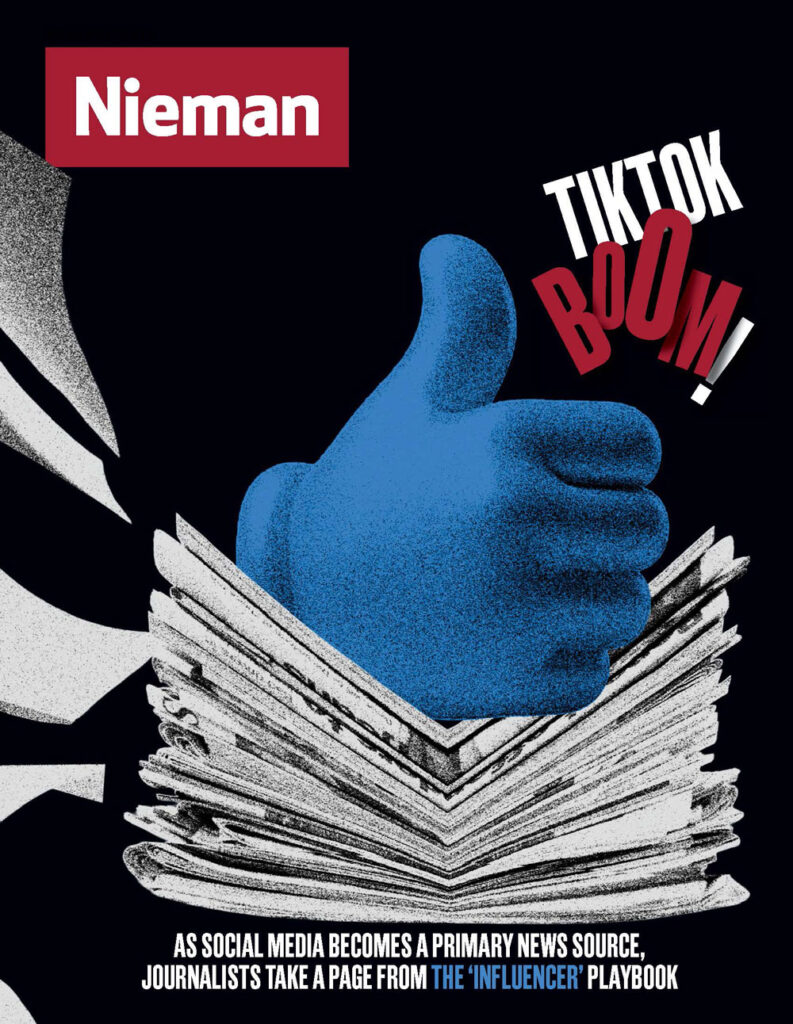
Nieman Reports has addressed and embraced social media, from a 2013 cover story on how journalists used Twitter to report on the Boston Marathon bombings, to a 2025 cover story (“TikTok Boom!”) on what journalists can learn from news influencers. The magazine now publishes Instagram videos accompanying some of its articles, including one on devastating cuts to the Corporation for Public Broadcasting’s budget and another on what legacy media missed with Nepal’s Gen Z protests.
Evolving awareness
As Nieman Reports adapted to changing technology, it also evolved dramatically in whose voices, perspectives, and ideas it gave space to. As technological advances promised to democratize the news, Nieman Reports contributors developed more precise journalistic tools to expose racial bias, and offered more robust solutions.
In Nieman Reports’ early years, most of the writers were white men. Over the decades, as the fellowship became more diverse, so did the contributors. The magazine’s coverage of the biases that infused how white-dominated media portrayed the world grew more nuanced.
A story by Gilbert W. Stewart Jr. (NF ’47) highlights a limited understanding of race at the magazine’s inception. Stewart called it an “experiment” in race relations when Fletcher P. Martin, city editor of the Louisville Defender, a Black-owned paper in Kentucky, joined his class as the first Black Nieman Fellow.
Stewart described progress in the white male fellows’ awareness: “Not one of us will act, or speak, or frame an opinion on a racial question without first thinking how it will affect our friend, Fletcher Martin,” he said.
The story and its headline, “He Erased the Color Line,” reflected the era’s assimilationist thinking and limited understanding of racial bias and equity.
Still, “the Nieman program under [Curator] Louis M. Lyons was eons ahead of the nation’s press when it came to race relations,” Simeon Booker recalled in Nieman Reports in 2013. When Booker became the second Black Nieman Fellow in 1950, “only a couple of dailies in the entire U.S. had ever hired Negro reporters,” he wrote.
Martin, a World War II correspondent, was one of the first Black voices in the magazine. At his classmates’ suggestion, he used the platform to speak out against segregation. In an article published in 1949, he described how two Black reporters at his paper were told to leave the main floor of a municipally owned auditorium and sit in a segregated balcony area while covering a rally by South Carolina Gov. Strom Thurmond. At the rally, leaflets circulated denouncing “communistic agitation for Negro-White mixing” with racist remarks about rape and robbery.
Americans overlook the fact that “segregation of any kind always means degradation and subjugation,” Martin wrote, quoting the mayor of Louisville, Charles Farnsley.
As there were very few Black Nieman Fellows in the magazine’s early years, Nieman Reports reached out beyond the fellowship to include Black voices, including Frank Stanley, publisher of the Louisville Defender. His 1947 article, “The Negro Press: A Challenge to Democracy,” called on journalists to “strike at the very root” of prejudices by “pointing out concrete examples of successful Negro and white relationships.”
“More important than anything else — openly and courageously expose all stumbling blocks to interracial progress,” urged Stanley, president of the Negro Newspaper Publishers' Association.
For Jet magazine, Booker covered the trial of two white men accused of killing Emmett Till, the Black 14-year-old whose brutal murder in Mississippi would shape the civil rights movement.
In one of the most fascinating early reports on racial issues in Nieman Reports, Booker described how Clark Porteous, a white Nieman Fellow in Martin’s Class of 1947, defied segregation orders and collaborated with Black reporters, not just on coverage of the trial, but also on the frantic manhunt to find witnesses for the prosecution.
“Although the trial still ended in acquittal, the murder and everything about it had a galvanizing and enduring impact on the civil rights movement, which in turn changed everything about life in America, including its journalism,” Booker later wrote.
Nieman Reports also highlighted reporting methods that aimed to address white reporters’ gaps in awareness about the nonwhite communities they covered.
In 1968, Philip Meyer (NF ’67) raised the concept of “unconscious racism” and introduced a new journalistic response. Most white Americans “don’t feel like racists,” he wrote in “A Newspaper’s Role Between the Riots.”
“Most of us believe in the basic brotherhood of man, and therefore we can’t be racists. Can we?”
“We can,” Meyer concluded. Meyer helped the Detroit Free Press staff cover their city’s five-day riot in 1967. In a newsroom conversation after the riot, “still nobody knew who the rioters were and why they had rioted,” he wrote. Meyer led a systematic survey of Black Detroit residents to determine the riot’s underlying causes — a move that would lead him to invent precision journalism, a precursor to today’s data journalism.
“A good newspaper does not turn its back on a problem,” he wrote. “The more the race problem is discussed, analyzed, dissected and turned upside down to find what’s there, the sooner there will be workable solutions.”
Representation of women and other minorities lagged significantly behind the magazine’s reporting on Black-white relations. For instance, the first cover story on women’s issues came in 1979. The first focused on the Latino experience in the U.S. came in 2001.
In Nieman Reports’ early years, foreign coverage was told predominantly through the lens of American men who had traveled abroad. For example, in 1959, “Report on Africa” came from a U.S. journalist who had spent a year there. The Nieman Foundation began accepting international fellows in 1951 — from New Zealand, Australia, and Canada — but it took longer to establish a truly global reach. The foundation accepted its first Latin American journalists in the class of 1981.
Nieman Reports now benefits from the perspectives of a broad network of international fellows. Instead of relying on U.S. correspondents to cover Africa, for instance, the magazine includes voices of people such as Hannane Ferdjani (NF ’20), who led a project providing better narratives about Africa, by Africans.
In recent years, Nieman Reports has produced dozens of stories about diversity in journalism, including workforce development and the impact of new roles such as audience engagement editors. Coverage of race has become more intersectional.
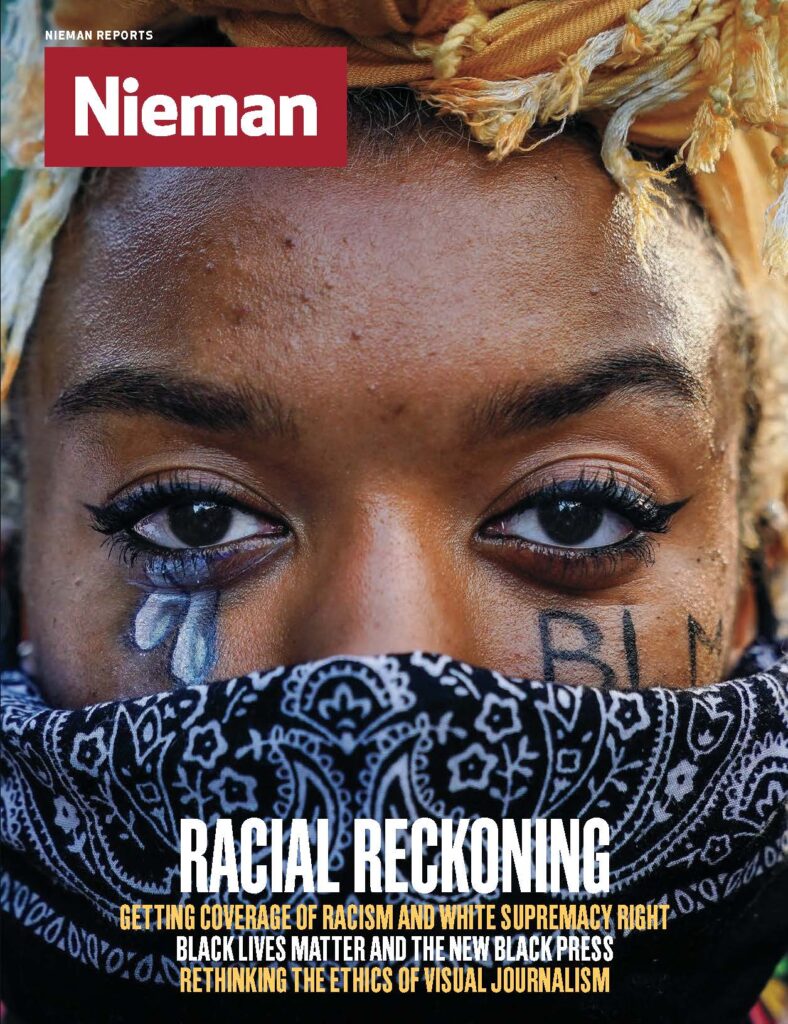
Under Lipinski, Geary, and Senior Editor Jan Gardner, Nieman Reports increased diversity and gender balance in the roster of contributing writers, photographers, and designers. They published packages such as “A New Focus: Why We Need More Visual Journalists and Editors of Color” (2017) and “Meet the New Black Press,” part of a 2020 package called “Racial Reckoning.”
Coverage of unconscious bias became much more nuanced, too.
“No one in the United States is immune to the influence of white supremacy, not even a black Southerner like me,” wrote Issac J. Bailey (NF ’14) in a deeply personal essay in the magazine in 2020.
Goodbye to print
Bailey, a communications professor at Davidson College, wrote a column about journalism ethics in Nieman Reports from 2015 to 2023, winning numerous awards. Bailey said he was disappointed to hear the print edition was going away.
“I will probably never fully adjust to not being able to hold a product like Nieman Reports in my hand,” he said via email.
“I understand that with the development of new technologies, these types of changes were inevitable,” he wrote. “I even have to adjust to them in my teaching. But that doesn’t make it any less sad.”
Bailey said he would continue to assign his students Nieman Reports’ digital articles on issues such as race and trauma-informed reporting.
Ludtke, the former Nieman Reports editor, said she saw the magazine as a way to stay connected to the global Nieman community. She said she appreciated that “the cover didn’t have to be something that would sell.” Nieman Reports has never taken advertisements, and is not available on newsstands. “I felt, and I still feel, that having that magazine plunked down in your mailbox four times a year was really a touchstone for you…back to your Nieman year,” she added.
Geary said the move online “makes strategic sense.”
“The print magazine is a treasure for Nieman alums and for people on the Harvard campus,” Geary said, “but the audience opportunity is online. That’s true of all of journalism and it’s certainly true of Nieman Reports. So I think it makes a lot of sense to forgo the print edition and to devote those resources to doing more stories and reaching a wider audience online, because that’s where Nieman and Nieman Reports can have its greatest impact.”
Whether it’s published on butcher paper, magazine stock, or Instagram, Nieman Reports retains the same standards of journalism, editor Henry said — and a commitment to serve both as a hub for Nieman alumni and as a public commons for discussing the most important innovations, societal pressures, and ethical questions shaping the future of the news.
Research contributed by Megan Cattel