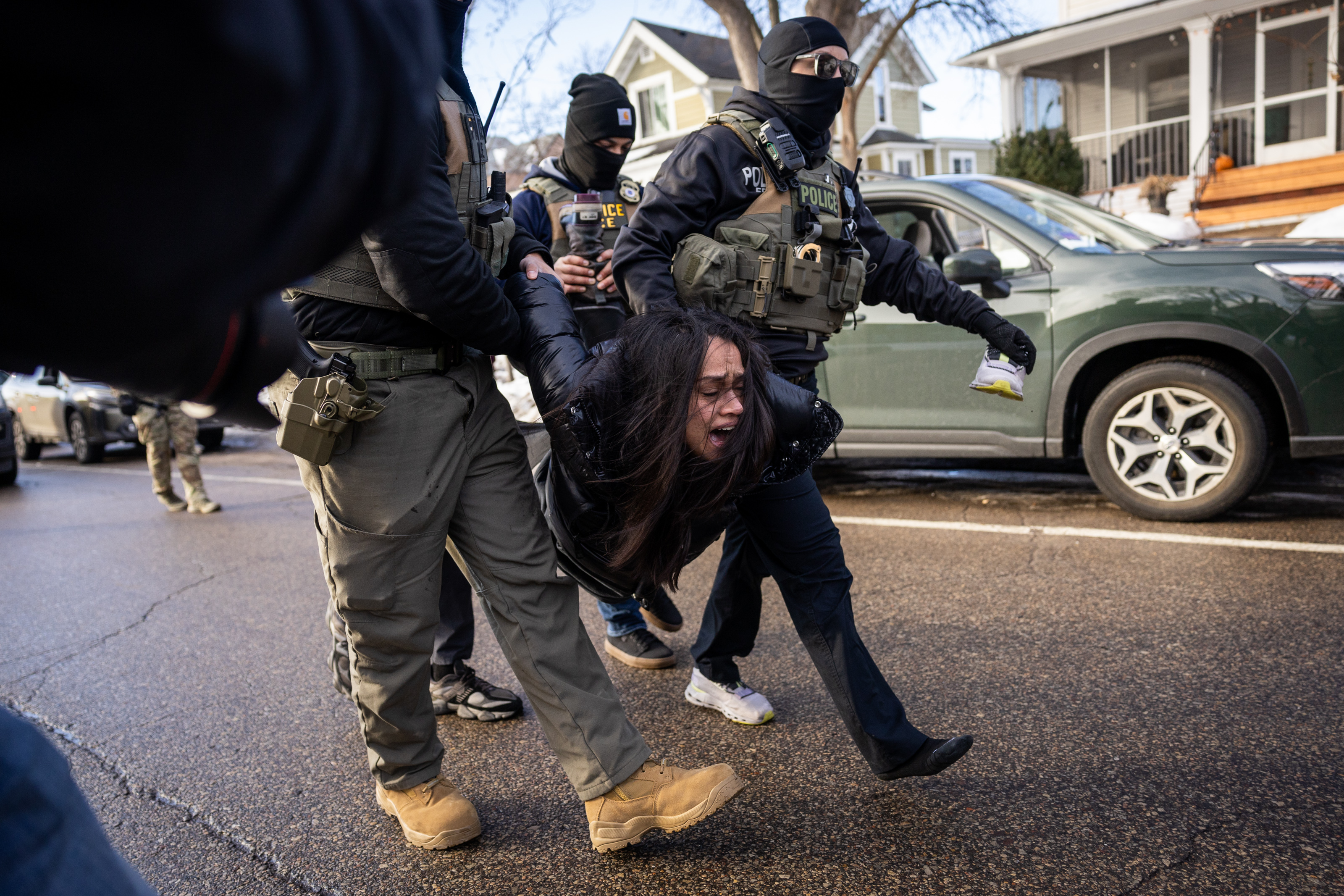
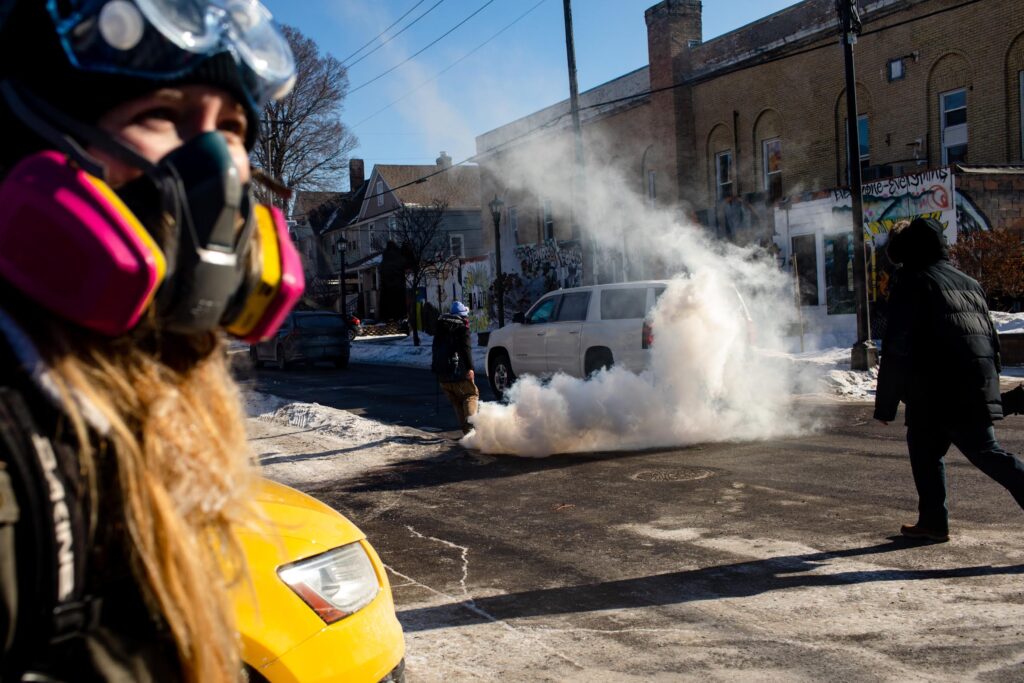
It was the largest immigration enforcement operation in U.S. history, according to government officials, with 3,000 federal agents flooding Minnesota. Starting in December 2025, for more than two months heavily armed agents from Immigration and Customs Enforcement (ICE) and U.S. Customs and Border Protection (CBP) spread out through the Twin Cities region — typically with masks covering their faces — surveilling neighborhoods on foot, following people in vans with tinted windows, and profiling drivers in parking lots, demanding proof of citizenship. They deployed tear gas, pepper balls, and flash-bang grenades along city streets lined with restaurants and homes. They pulled people from their cars, from houses, and bus stops. They shot three people, killing two of them.
Local photojournalists found themselves navigating unfamiliar, violent scenes at home: They responded to and documented those shootings, raids, and daily arrests of immigrants. They developed a road map for covering large-scale enforcement operations, connecting with bystanders and citizen observers who helped them follow events in real time. They made quick decisions about how to verify information, how to stay safe, and how to document the suffering of vulnerable sources ethically, commanding public attention while federal agents used brutal force.
Help from citizen observers
When ICE agent Jonathan Ross shot and killed Renee Good, a 37-year-old mother of three, in her car, the Trump administration claimed it was an act of self-defense. Bystanders disputed that claim, sharing what they had seen: Good smiling, speaking to the agent, and attempting to drive away, her last words recorded on video: “I’m not mad at you.”
Photojournalist Ben Hovland, who has worked at MPR News for four years, said that within five minutes of showing up at the scene where Good had been shot, he was approached by someone who said, “‘You’re with Minnesota Public Radio. Come with me. I witnessed it. And I want to tell you what happened.’”
“I think about how lucky I am, that we are trusted by people in the community,” Hovland said.
Hovland was previously a multimedia producer at the Minnesota-based nonprofit news site Sahan Journal and a contributor for national outlets. Since covering the local immigration crackdown, known as Operation Metro Surge, he has reflected on the role that observers filming with their phones play in coverage.
“Their videos actually just contradict the narrative that has been put out by some of these government sources,” Hovland said, adding that although journalists need to be careful about vetting and verifying user-generated videos, “It’s very clear that there’s a strong need and a great importance for witnesses who are filming these horrible, horrible events to come forward and say, ‘No — we have this video.’”
“Who is not an observer?” said Nicole Neri, a Minneapolis-based freelance photojournalist. “I’ve run into ICE when I’m going to the grocery store. ... All of us see them, they are everywhere. All of us are filming when we see them. We don’t know what they’re going to do, and we can’t trust that they’re going to be honest about it, because they obviously won’t.”
On Jan. 24, just weeks after Good’s killing, 37-year-old Alex Pretti was observing federal agents, recording with his phone, when he tried to help a woman whom the agents had knocked down. He was then shot and killed by two CBP agents.
Neri awoke that morning to bystander video of Pretti’s shooting death circulating on social media, and reached the scene just as federal agents were getting ready to leave. With sub-zero temperatures, so cold that Neri’s goggles fogged up and her gas mask froze, she had to remove her protective gear to photograph a grieving community in chaos, surrounded by clouds of tear gas.
Hovland and MPR News reporter Feven Gerezgiher also reached the scene of the shooting that morning, entering an apartment building to assess. They found a woman in a pink jacket, “clearly shaken up,” according to Hovland, who said she told them she had seen agents kill Alex Pretti — and had recorded it. When then-Secretary of Homeland Security Kristi Noem claimed Pretti was brandishing a gun at the scene, eyewitness accounts disputed that claim.
Aubrey Nagle, Director of Learning and Community at the Public Media Journalists Association, said ICE and the DHS have been documented lying to the public. Bystanders who record videos that show the truth are “adding to the historical record and to the journalistic record in a way that photojournalists could not do alone right now, because of the breadth of operations ICE is enacting.”
Photographing suffering while protecting vulnerable sources
On one January morning, Hovland witnessed federal agents dragging a woman out of her car.
“They handcuffed her, they tied her hands behind her back. And she was screaming, she was yelling for help,” Hovland said. “She was saying that she was on her way to a doctor’s appointment.”
Journalists had to consider the implications of photographing traumatic events, and people in pain. Images of “people being arrested, detained, thrown to the ground, or even killed” are newsworthy and vital documentation of government conduct, Nagle said. “We need records for accountability, for their families to find them, and find out what happened to them,” she added.
Sometimes documenting requires fast thinking about consent. For a Minnesota Reformer feature on rapid responders — groups of resident volunteers who follow federal agents — Neri’s guidelines were straightforward. Sources were willing to go on record, names and faces included. In a crowd, when she saw masked observers with whistles and couldn’t have a conversation, she read body language, making eye contact, holding up her camera, photographing when they didn’t wave her away.
Situational awareness extended to all aspects of the story, according to Neri — determining whom to photograph, and understanding the impact of reporting on everyone involved.
She spoke with a medic at Pow Wow Grounds, a native-owned coffee shop in Minneapolis that had turned into a mutual aid hub. “Tell your colleagues that every time somebody gets pepper-sprayed or tear-gassed, so many of you [journalists] flock to them so closely and so quickly that medics can’t get there. Can you tell them to stop doing that?” the medic said.
Neri had seen that happen. “If there are eight people crowding a person, you don’t need to add yourself to that,” she said. “It’s covered.”
Another challenge of this coverage was protecting vulnerable sources. Photojournalists had to convey their subjects’ presence without revealing who they were. Hovland photographed a family of Sudanese refugees he said had not left the house for weeks. He described keeping source anonymity in one image: “She’s holding up her 1-year-old niece … their faces are obscured, but their silhouettes are highlighted by this backlight from the window, and you can just see … the connection between the two of them.”
Safety for journalists — and the public
Some journalists were injured by agents and police, arrested, and threatened. They often traveled in pairs or small groups while tracking ICE and CBP activities, looking out for one another.
Hovland developed a safety plan with his wife. If he was detained on assignment, for example, he would call her so she could quickly consult a list they had compiled of key contacts who were ready to respond in an emergency.
Considerations included road safety, too. Hovland recalled tracking three Border Patrol vehicles one morning in North Minneapolis — seven or eight cars that included press and observers on patrol. Hovland said the journalists had to ask themselves if they wanted to remain in the convoy, “because it [was] starting to get a little bit dangerous.”
Neri shared information with her newsroom that she had learned from Hostile Environment and First Aid Training (HEFAT) for journalists, including how to identify different weapons that law enforcement officers might carry. “Once the rubber bullets come out, fall back, just fall back,” she said.
Neri had to anticipate ICE agents’ actions to stay safe — “they just blitz these areas,” she said, describing agents leaving after they smashed a car window to detain a 2-year-old and her dad. She photographed broken glass all over the floor of their empty car and the girl’s pink hat left on the dashboard.
Jaida Grey Eagle, an enrolled member of the Oglala Lakota tribe, is a freelance documentary photographer based in St. Paul. On assignment, she carried a first aid kit with Sudecon chemical decontamination wipes, which remove chemical agents like tear gas and pepper spray, bottles of water and snacks, a gas mask, a helmet, a ballistic vest, and Yaktrax cleats for traction on the ice. She brought her passport, her tribal ID, her state ID, multiple press passes and a letter from an editor.
Grey Eagle said she thought about risk daily, and she wants editors to prioritize safety when they ask photojournalists to cover dangerous scenes. “It’s important for editors to check in, to see what we’re willing to take on,” she said.
Support and community
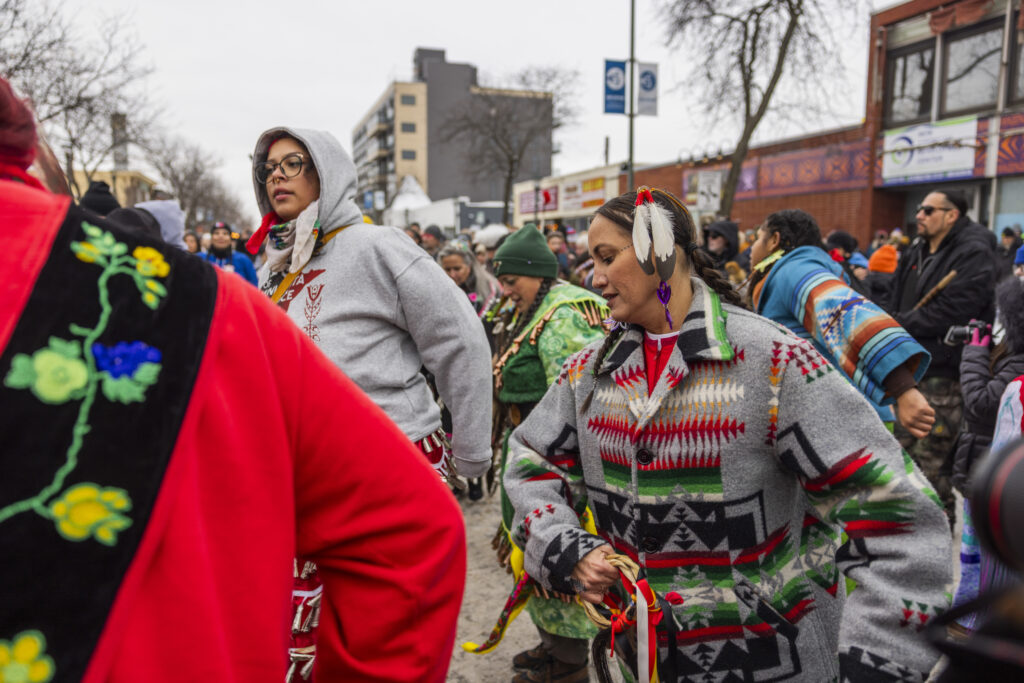
Hovland found free therapy through the Journalist Trauma Support Network, which he said has been helpful in processing what he witnessed. He found moments of joy in covering community resilience, like a rally where residents raced down a park slope in sleds decorated with anti-ICE art. Grey Eagle photographed a jingle dress ceremony on Feb. 1 at the memorial sites for Renee Good and Alex Pretti. Jingle dress — a native tradition intended to promote healing through dance and sound — originated in Minnesota, she said.
Neri photographed local businesses transformed into grocery delivery and donation hubs for families sheltering in place, and a rock band leading a nighttime noise protest outside of a hotel that housed ICE agents. She said the impact of that intense period of coverage is hitting her now, months later. “There’ve been tragedies on top of tragedies over this last year. … I’m just exhausted.”
City council member Jason Chavez recently shared a report on social media claiming agents had detained another south Minneapolis resident, Hovland said. “It’s really important that [journalists] report on … the continued immigration enforcement that’s happening here.”