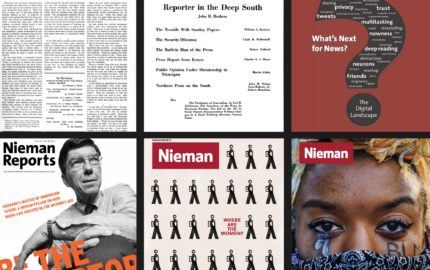
The Fall 2025/Winter 2026 edition of Nieman Reports represents the magazine’s final print issue as it transitions to an all-digital format. A combination of factors — many of which are affecting the wider media industry — has resulted in the move to online-only following a nearly 80-year run in print.
There’s much to think about and enjoy in this new print edition of Nieman Reports, and even more online. The issue examines challenges and trends in the news industry in the United States, France, Myanmar, Nepal, and Sudan, while our cover story looks at the evolution of Nieman Reports.
The same great journalism about journalism that readers have come to expect from the magazine will continue at niemanreports.org. In fact, it’s been appearing there for years already, including stories that don’t make it into print. Despite the changing format, our commitment to global media coverage remains as strong as ever.
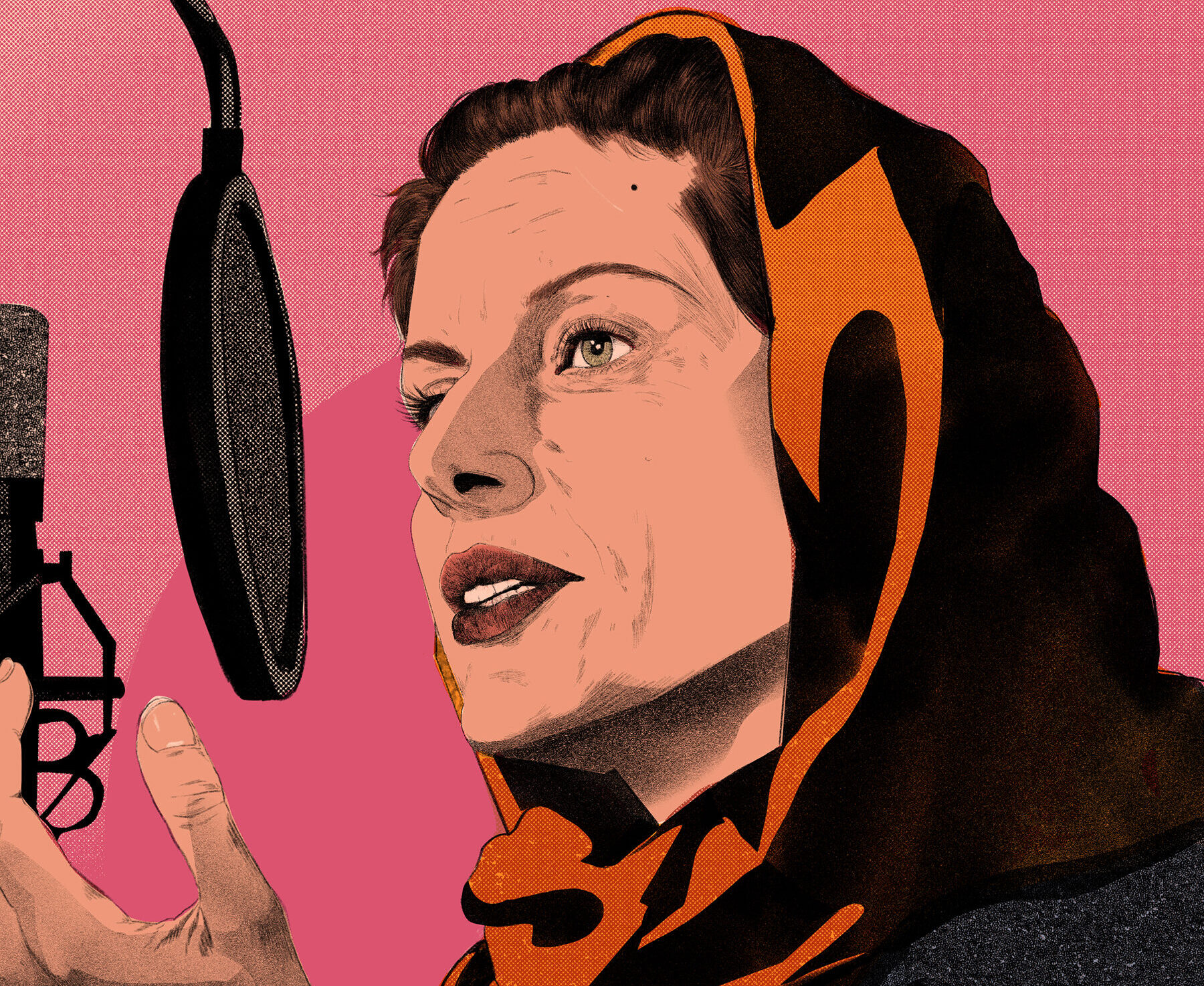
On March 8, 2021, a new radio station launched in Kabul: Radio Begum, run by women, for women. The timing was deliberate — the station opened on International Women’s Day, and just as the United States military was withdrawing from Afghanistan.
“I decided to launch this radio station in order to be ready for the day the Taliban takes power,” said Hamida Aman, the station’s founder. “We knew that as soon as they take power, it will be segregation, and again, it will be against women.”
Five months later, the Taliban retook Kabul and imposed new laws restricting women’s access to schools and their movements in public. Five years later, Radio Begum is still on the air. The station follows the letter of the law, even as restrictions tighten. It doesn’t cover politics or any subjects that are off-limits to public discussion among women under Taliban edicts. Instead, it focuses on health, religion, and providing educational programs to replace the schooling women are now prohibited from receiving.
“They banned schools, but not education,” Aman said.
Begum may be unique in Afghanistan, but its model is in practice around the world. It is one of many women-run radio stations — from rural India to the Peruvian Amazon — that, although not part of a formal network, share many attributes and goals.
Some of these stations, like Begum, are oases of information in areas where women are restricted in what they can access. Others, in countries where the government is less restrictive, provide an antidote to male-dominated media that ignore issues that affect women. And still other stations challenge cultural barriers and break the silence around topics that are rarely if ever discussed. Whatever their mission and wherever their location, what the stations have in common is the amplification — literally and metaphorically — of women’s voices to create a community that might not otherwise exist, on-air or off.
“There is no more public space for women, and it’s kind of a public space,” Aman said of her station.
Women have been working to create these kinds of spaces on-air since the earliest years of radio. In the 1920s, when the technology was new (and practically all stations were run by men), “radio for women” meant programs aimed at those who were at home during the day. The BBC’s “Woman’s Hour” show dates to the service’s first year broadcasting. Some early programs focused on entertainment, such as soap operas or music. Other shows covered domestic issues like housekeeping and cooking. At their most relevant, these shows discussed nutrition, labor, and events that dominated many women’s lives at the time, often with women hosting.
“Radio bridged, connected, and blurred the boundaries between the private and public spheres and by doing so, spoke to women as housewives, workers, consumers and citizens,” says a UNESCO report on radio’s position in the world.
Modern women-run radio stations have seized on this potential to blur boundaries and adapted it to changing times and to specific locations and audience needs.
“If given the opportunity, radio becomes a really important agent of change for women, in particular, especially in cultures where to speak out and to be open and to have an opinion, to have a say, can kill you,” said Monica De La Torre, a media professor at Arizona State University and author of the book Feminista Frequencies. “We’re able to take this medium and create moments of intimacy and of sharing, and I don’t think we have enough spaces as women to do that.”
Even as advancing technology has led to new independent media outlets and expanded ways of sharing and accessing information, radio remains a powerful medium for breaking barriers, broaching taboo subjects, and speaking directly to oppressed or obscured groups in society. The nonprofit that runs Begum, for example, also operates a TV station that broadcasts via satellite from France (where Aman is now based), and it has a smartphone platform as well. Because it’s not within Afghanistan’s borders, the television channel can be more open in its programming, but for Aman, radio will always have a place. “It’s cheap and everybody can have access,” she said.
“If given the opportunity, radio becomes a really important agent of change for women, in particular, especially in cultures where to speak out and to be open and to have an opinion, to have a say, can kill you."
— Monica De La Torre, media professor at Arizona State University
Radio remains accessible and portable, even without an internet connection, electricity, or the ability to read. The fact that broadcasts generally come from a local tower gives radio a geographic connection that isn’t inherent to most other media. And through call-in programs, broadcasts aren’t limited to one-way conversations.
For Begum, this means women can — within the parameters of government restrictions — ask questions they may not be able to ask elsewhere, as the station’s programs center around life issues, and are interactive, Aman said. Listeners “can call us at any time, to talk with our doctors, to talk with our psychologists, to talk with our spiritual counselor to get information about religion,” she added.
Even when women don’t have specific questions, there’s value in hearing other women’s voices on these programs, according to Saba Chaman, who was the first director of Radio Begum and has worked for Begum TV since 2024. “It provides them with an opportunity to listen to other women, to listen to the way they talk, to listen to the way they start and finish their sentences,” Chaman said.
Operations haven’t been entirely smooth for Begum, however. In February 2025, Taliban officials alleging violations of the law raided the station, arrested two employees, confiscated hard drives, phones, and documents, and shut down the broadcast. The station was back on the air in a few weeks, and the employees were released in a few months.
“It hurt us a lot. It was really a painful year for us,” Aman said. “But despite all these challenges, we continue our activities.”
Radio also offers another key benefit to its audience: anonymity. Listeners can tune in privately and there’s no record of their activity once they switch off the receiver. Nobody knows who is listening, who is speaking on-air, or who is calling in. The ability to anonymously call a station comes up often in conversations about women’s radio, usually with a similar narrative.
Station managers have stories of women who call in to share experiences they can’t talk about with the people around them. Other women hearing the stories then realize they’ve had similar experiences. They call, too, and the process repeats, with more women calling in anonymously.
“You could call in and maybe disguise your voice a little bit, or maybe share something so intimate and personal because of the medium,” said De La Torre, the Arizona State University media professor. Because a station is local, a caller knows they will be heard by their community when they dial in to share a story. A listener knows they’re hearing their neighbor’s voice. Each broadcast chips away at a culture of silence.
De La Torre’s book Feminista Frequencies focuses largely on KDNA, a radio station in the Yakima Valley of Washington state. Although KDNA wasn’t founded specifically for women, through its leadership and programming decisions, it had a particularly strong effect on its female listening audience.
Because a station is local, a caller knows they will be heard by their community when they dial in to share a story. A listener knows they’re hearing their neighbor’s voice. Each broadcast chips away at a culture of silence.
Founded in the late 1970s to provide media to farmworkers, KDNA was one of the few Spanish-language stations in the U.S. at the time — several historians say it’s the first such noncommercial station in the country. It was also one of the few stations with women in leadership.
Rosa Ramon, a co-founder of KDNA and its first station manager, recalled speaking at a conference of Spanish-language radio station managers around 1980.
“When I walked into the room to make my presentation, I was the only woman in the whole conference,” Ramon said. She didn’t feel so alone at KDNA, though. The head of the newsroom at the time was also a woman, as was the station’s music coordinator.
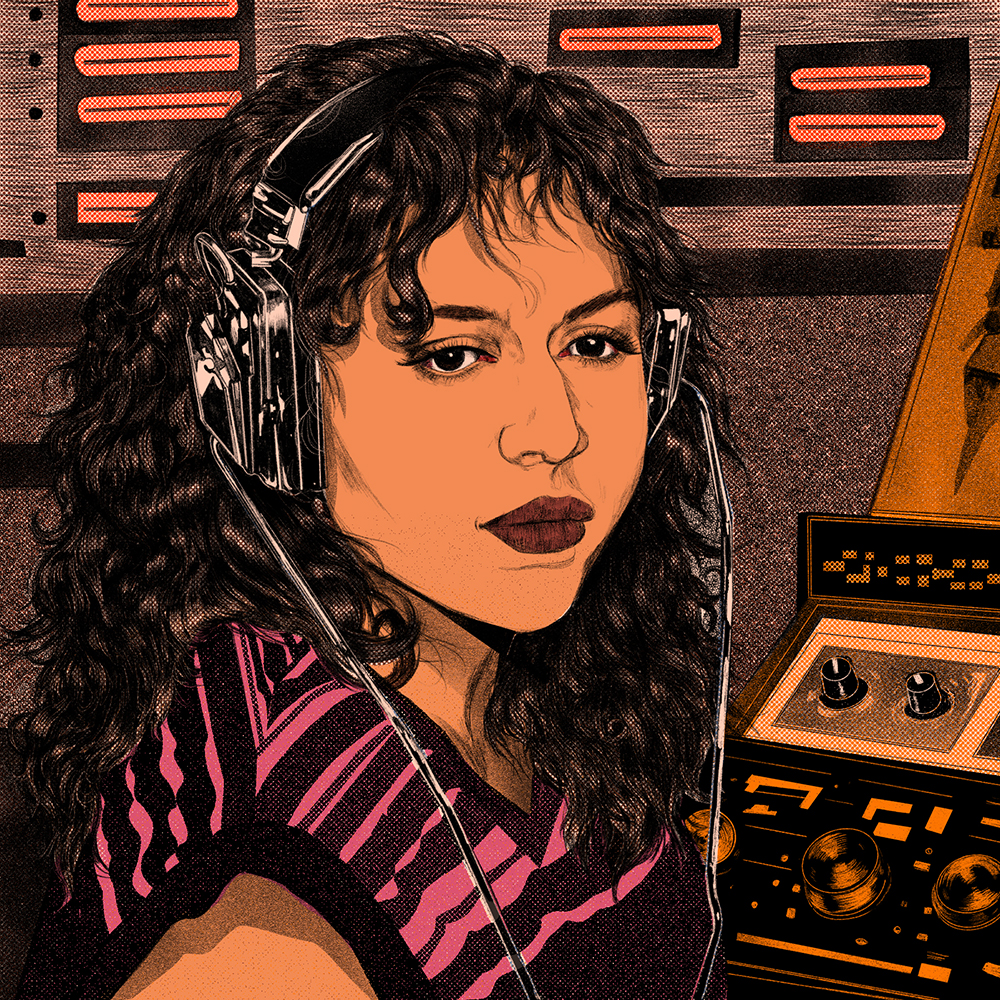
When Ramon talks about KDNA, she pronounces the call letters together into the station’s nickname, cadena, Spanish for “chain,” symbolizing the community connections the station was built upon — connections it tries to strengthen and spread.
“The station always made a point of focusing specifically on issues that affected women, serious issues,” Ramon said. “Sexual abuse, just about any subject you can think of — mental health, women’s careers, education.”
The shows invited women to call in and discuss difficult subjects like abusive relationships or, on one notable program, incest, which led to a significant response from listeners.
KDNA was also careful to keep from alienating female listeners during hours that weren’t specifically dedicated to women’s programming. For example, the station avoided playing music with misogynist lyrics.
“There were songs that sometimes would focus on things like a man killing his wife because she was unfaithful, but not making it sound like that’s not the right thing to do,” Ramon said. “We did not air anything that demeaned women or in some way would cause women harm.”
There was resistance to this kind of programming. Women needed to push to be taken seriously as broadcasters, Ramon said.
“The men who were on the radio were immediately respected and they were important. And the women, on the other hand, sometimes we were in the position that we had to defend our reputation,” she said. “It was hard, you know … especially in an agricultural area that’s very conservative, and not just the area being conservative, but the Chicano community being conservative in terms of their attitudes about women.”
Over time, Ramon noticed a shift — women were hearing they were not alone, and the men who listened heard women’s perspectives.
“I think the presence of women on the radio station helped change some of those attitudes,” she said.
KDNA was founded in part with grants for training and education. And the station trained many women on how to produce radio programs. “There were young women who came in who said later on, they never thought that anything like that would be possible for them,” Ramon said.
This is another commonality among women-run radio stations — the support of new generations of women in media.
“Media is power,” said Margaret Sentamu, executive director of the Uganda Media Women’s Association (UMWA). The association began in 1983 as an organization for women working in journalism. In 2001, it launched the radio station Mama FM in Uganda’s capital, Kampala, with the goal of putting more women on the air. Even though there were hundreds of radio stations in the country, they weren’t covering women, or when they did, the portrayals were often negative.
“The mainstream media was sidelining women,” said Sentamu, a co-founder of the station. “We thought that it was important to start our own radio station, where we would have the power to determine who appears on the radio and who does not appear on the radio.”
Mama FM broadcasts programs on human rights, gender-based violence, reproductive health, agriculture, and leadership, and the station helps connect women to services they may need in the area. It also has a specific goal of empowerment, and states as part of its mission under UMWA “to enhance the visibility and status of women and other marginalized groups.” Through training and by example, the station encourages women to become leaders in their homes and communities.
“We profile women who have achieved, who are making a difference in their communities,” said station manager Catherine Apalat. One program features panel discussions where women and men talk as equals about politics and topics in the news. The station travels outside Kampala for remote broadcasts where women in smaller communities are invited to speak on-air. Off-air, Mama FM hosts workshops where women are trained in broadcasting, public speaking, and taking more prominent roles in the community.
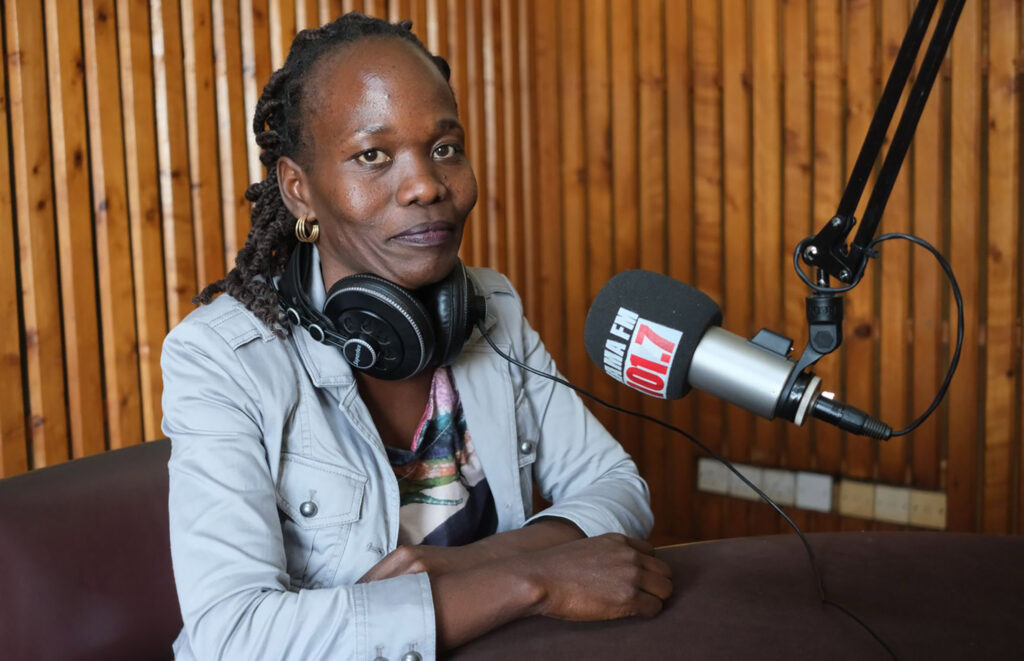
“As women, we are not brought up to be leaders, but after we have trained the women, we expose them to the radio and encourage them to speak their minds,” Sentamu said. “They can now express themselves. They can engage in different forums. They have stood up for leadership positions, and they have become better communicators, particularly with their husbands. They now know when to engage their husbands on very important issues.”
“The mainstream media was sidelining women. We thought that it was important to start our own radio station, where we would have the power to determine who appears on the radio and who does not appear on the radio.”
— Margaret Sentamu, executive director of the Uganda Media Women’s Association and co-founder of Mama FM
Sentamu and Apalat said that women who have been to Mama FM’s workshops, on its programs, or have worked at the station have gone on to hold positions of leadership in other radio stations, in businesses, and in local politics.
“If your voice appears in the media strategically and speaking about issues, then it can form part of the national agenda,” Sentamu said.
Mama FM is licensed by the government, as are all radio stations in the country, but it receives no federal support. Most of its funding comes from NGOs and organizations based outside Uganda — including Norway (home of a feminist radio station that inspired Mama FM), Austria, and from the United Nations agency UNESCO. The station is looking for ways to keep paying its licensing fees and electricity bills. When I spoke with Sentamu and Apalat, they were in Tanzania at a meeting about fundraising put on by a Finnish organization.
“It is really tough to run women’s radio or not-for-profit radio stations,” Sentamu said. “Our governments do not support us, and they do not even appreciate why women’s voices have to appear, have to be represented in the media.”
The lack of appreciation can extend beyond government. Many media organizations lag in representation for women on-air. The 2025 United Nations Global Media Monitoring Project found that “of the people seen, heard, or spoken about in print and broadcast news, only 26% are women,” and progress in representation has essentially been flat since 2010.
“It’s very important [to have women on staff]. It makes the editorial newsroom richer,” said Lina Chawaf, a Syrian journalist who is now a visiting researcher at Harvard, where she was also a member of the 2025 fellowship class at the Nieman Foundation for Journalism. Chawaf was working for Arabesque FM in Syria when the civil war broke out in 2011. She refused to broadcast propaganda, and the regime “asked me to leave the country or they would kill my children.” In exile, Chawaf founded Radio Rozana, a station that focuses on human rights, with an emphasis on issues affecting women.
“I just had this dream, because I want to deliver the voice of the voiceless people inside Syria, especially the women that have always been obliged to be silent in our country,” Chawaf said.
Rozana broadcast citizen journalist reports and programs aimed at women from two transmitters — one in Turkey near the border, and a smaller one hidden in northern Syria. Radio was more reliable than the internet given the shakiness of the electricity grid and uneven web access during the conflict. This accessibility, along with the localness and anonymity of the airwaves, made it possible for women “to talk and share their pain, share their point of view,” Chawaf said. It also can impart a feeling of comfort and a sense of stability during a crisis.
“Even listening to a voice talking to you gives you some space for feeling secure,” she said. “Even if you talk nothingness: ‘Hi, good morning. How are you?’ Even if you say all this, it gives you some [sense of] safety.”
Since launching Rozana, Chawaf has traveled the world to help start stations in remote and war-torn areas, including in Libya, Yemen, and Sudan. With each endeavor, she said she is “careful and aware about having women on the staff,” and representing a wide array of diverse voices. In one meeting about setting up a station, she had an experience similar to Ramon’s at the station manager’s conference forty-six years ago.
“I was looking and I said: ‘There’s no women here. I’m the only woman here,’” Chawaf recalled. This wasn’t due to a lack of interest from women. Chawaf worked on diversifying the team, and now that organization has more women on staff than men, she said.
Like the leaders of KDNA and Mama FM, Chawaf, who left Rozana in 2025, has stories of women who called in anonymously to discuss a subject and ended up having their lives changed. She recalled one woman who told her: “I was listening to Rozana, and I discovered that my husband, who is beating me every day, that it’s not his right.” Chawaf recalled. “She started calling Rozana, and we put her in contact with a lawyer in Turkey, and she was able to divorce.” After that, Chawaf said, the woman became a journalist for the station.
Chawaf also has stories of men who heard a program and were spurred to take action. She remembers a partner in a mental health organization telling her that men were bringing their wives or sisters to the clinic, saying, “We were listening to the radio to Rozana, and we discovered that we have to bring them here,” she said.
“It’s changing behavior, and we were happy.”
As they pursue their mission, each outlet has gone beyond its initial medium. They stream online, they post to social media, and, like Mama FM, they host events. (Rozana stopped broadcasting over the air after Chawaf left.) KDNA hosts health fairs and distributes cards with information about preventing sexual harassment in agricultural work, among its other community activities. The station is a hub that fosters a physical version of the community-building it began on-air.
Whether broadcasting from a tower, streaming to a phone, uploading a podcast to a server, convening a meeting in a local hall, or posting to a social media channel, these stations carry on the core mission from their foundations in radio — to give women a voice.