
The Fall 2025/Winter 2026 edition of Nieman Reports represents the magazine’s final print issue as it transitions to an all-digital format. A combination of factors — many of which are affecting the wider media industry — has resulted in the move to online-only following a nearly 80-year run in print.
There’s much to think about and enjoy in this new print edition of Nieman Reports, and even more online. The issue examines challenges and trends in the news industry in the United States, France, Myanmar, Nepal, and Sudan, while our cover story looks at the evolution of Nieman Reports.
The same great journalism about journalism that readers have come to expect from the magazine will continue at niemanreports.org. In fact, it’s been appearing there for years already, including stories that don’t make it into print. Despite the changing format, our commitment to global media coverage remains as strong as ever.
The black pirate flag was the first thing I noticed.
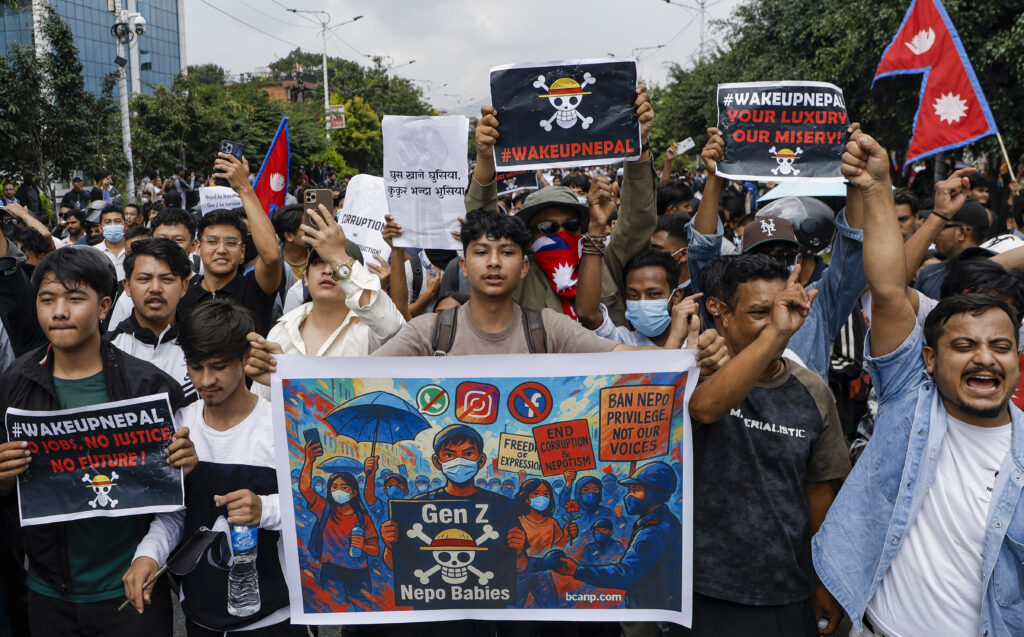
Although I had seen the Jolly Roger image of a skull and crossbones before, this one was distinct: a grinning cartoon skull wearing a straw hat — the flag of a fictional gang of pirates fighting oppression and corruption in the Japanese anime series “One Piece.”
When it first started appearing in early 2025 on the TikTok and Instagram feeds of young people taking to the streets during protests in Indonesia, I paid it little heed. That was until my 13-year-old daughter pointed out that the “Straw Hat Jolly Roger” had started circulating on social media in reference to my home country of Nepal.
The One Piece pirate flag — now heralded globally as a symbol of youth resistance — first started showing up in Nepal in early September 2025. Within days it had caught digital fire, culminating in a youth-led uprising that would topple Nepal’s government, leave the country’s political class reeling, and stun the nation’s mainstream media over its failure to understand power, shape narrative, and comprehend the ways in which a new generation was mobilizing.
As a journalist who has covered Nepal and the region for over two decades, I’m still processing those historic few days in September. What I find most unsettling is the fact that my teenage children — who insist they don’t follow any mainstream news — saw it coming long before I did.
The dramatic turn of events in Nepal, and the manner in which they unfolded, have since become a template of sorts for protests in many countries, led by a generation that insists on defining its own narratives, employing digital tools, and spreading its message through internet memes, Instagram Reels, and posts on video gaming platforms like Discord. Since the Nepal uprising there have been similar protests in Madagascar, Morocco, Peru, Bulgaria, and beyond, where governments have been swiftly overthrown or leaders have been put on notice by a groundswell that starts on social media. Many participants in these movements, especially in Nepal, identify as members of Generation Z, born between 1997 and 2012 and currently between 13 and 28 years old.
These spontaneous, youth-led, social media-driven uprisings across several countries appear to be less anchored in a shared global ideology, according to experts, but instead in a common grievance: the sense of a broken social contract.
“The level of conflict in these societies comes from that big chasm between a rapidly changing society and political systems that don’t keep up,” said Aboubakr Jamaï, a Moroccan journalist (and 2007-08 Nieman Fellow) who has studied protests from the February 20 Movement in Morocco during the Arab Spring uprisings, to the more recent Gen Z-led protests around the world.
In many of these countries, corruption — often manifested in failing government services — emerges as a core grievance that’s central to young people’s sense of frustration. A report by Bloomberg Economics — which used a machine-learning model to analyze 22 million data points related to youth-led global protests — has come to a similar conclusion: Rising inequality, unemployment, and corruption are strong predictors of youth-led unrest. The same analysis highlights several global hot spots that are at heightened risk of upheaval in the near future, including Angola, Guatemala, the Republic of Congo, and Malaysia.
“This generation does not benefit from what their grandparents, and to some extent their parents, received,” Jamaï said. “They feel short-changed.”
The spark
The trigger for Nepal’s protests is a familiar tool of authoritarian control: censorship.
On Sept. 4, Prime Minister K.P. Sharma Oli, then in his third term, abruptly banned more than two dozen social media apps, including Facebook, X (formerly Twitter), YouTube, and Instagram. Discord, a communication platform mainly used by video gamers, escaped the initial crackdown and would soon be repurposed as a powerful organizing tool.
The government’s justification was regulatory, saying that foreign social media companies had failed to register locally. It also claimed to be curbing misinformation, hate speech and fraud, and enforcing accountability on international platforms. But the subtext was clear to many: Stifle dissent.
In a country where more than half the population uses the internet daily, and where social media is interwoven with commerce, self-expression, and news consumption, the ban was catastrophic.
Downloads of virtual private network software — used to circumvent restrictions on the internet — skyrocketed by 8,000% in Nepal within days. Far from silencing criticism, the ban ignited it. Online platforms quickly transformed into underground channels and forums for defiance.
Leading up to the ban, Oli had been perturbed by a growing chorus of social media posts with hashtags including “nepokid” and “nepobabies” — aimed at calling attention to government corruption by comparing the privileged lives of the children of political leaders to those of ordinary Nepalis. The nepobaby trend, according to protest organizers, had been inspired by young people in the Philippines, who had tapped into growing public outrage aimed at the tone-deaf children of government officials — especially those tied to a corruption scandal over flood management contracts — who liked to flaunt things like luxury fashion items on their own social feeds.
In Nepal, the backlash over the social media ban ricocheted across the diaspora. With Nepalis living in more than 180 countries — and, by some estimates, 1,500 to 3,000 Nepalis leaving the country each day amid chronic unemployment, especially among young people — labor migration has become a way of life for many. The remittance economy is now such an integral part of Nepal’s economic model that money sent home by workers abroad accounts for roughly one-quarter of Nepal’s gross domestic product.
The diaspora is intimately tied to its homeland by social media platforms, and many were outraged that they could no longer reach family members over WhatsApp or Facebook Messenger. Meanwhile, small businesses that relied on social media stalled, and a huge source of information and ties to the outside world ground to a halt.
Young people quickly mobilized, announcing a protest for Sept. 8. It was largely planned over Discord, with organizers sharing QR codes to connect to servers with names like YouthAgainstCorruption. Traffic in these online groups quickly swelled to thousands of participants. Conversations were peppered with queries like “What should we do if they start attacking?” or “how to make molotov cocktails.” Although many of those participating in the discussions were activists who already had social media followings, the movement was purposefully and avowedly leaderless. Many joined in protest organizing conversations anonymously.
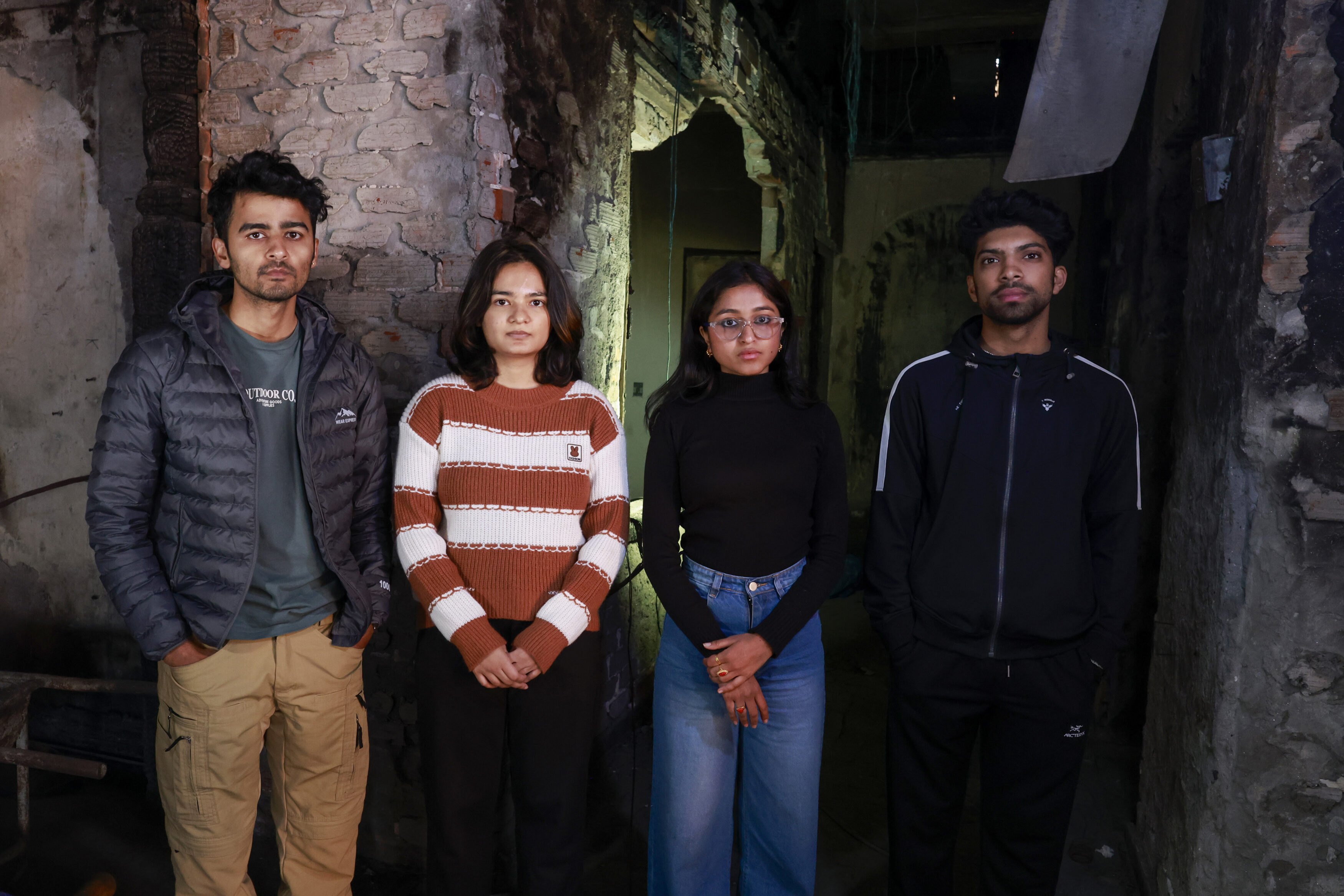
“We did mock protests on the 6th and the 7th and laid out a basic plan of action,” said Ayush Basyal, a 26-year-old student who teaches the Nepali language online, often to the children of the diaspora. Basyal, who helped organize the protests, said he and his team experimented with artificial intelligence tools in attempts to refine the language and visual grammar of the planned resistance. They tested memes on the AI chatbot Perplexity and ChatGPT, to see which ones might gain traction or resonate as slogans. On Instagram, phrases including “We meme, therefore we are” and “We won’t logout of democracy” went viral ahead of the protest march. Some of those posts were later deleted after organizers faced harassment and blame for the unrest that followed.
Just how leaderless the protests were quickly became apparent. Some organizers encouraged protesters to join the marches wearing their school uniforms and circulated checklists for participating — Bring sunblock, hats, water bottles — as if they were going on a field trip. Some emphasized that the protests would be peaceful, while other anonymous accounts shared tips for engaging in violent pushback.
Meanwhile, as momentum was building largely online, much of Nepal’s mainstream media was focused elsewhere, including reporting on a three-day conference being held by the prime minister’s party at which Oli complained about young people and defended the social media ban.
Those in tune with the growing protest movement had been hearing that a large crowd was planning to gather on Sept. 8, and some even tried warning the authorities, including a few children of police officers who tried to sound the alarm to their parents. But authorities appear to have downplayed the rumors, or dismissed them as just another one of the frequent, small protests by discontented youths that are commonplace in Nepal.
Two dramatic days
On the morning of Sept. 8, crowds began to gather at the Maitighar Mandala junction in the heart of the city center in Kathmandu — a traditional starting point for protest marches. Because of the leaderless structure of the gathering, different social media posts had publicized conflicting start times for the march. Nevertheless, by about 11 a.m., thousands of people had begun marching toward parliament.
The police appeared to be woefully unprepared. An undermanned barrier blocking a road near the parliament building was quickly overrun. Some protesters turned violent, throwing bricks and attacking the outnumbered police. The authorities hastily ordered a curfew — though few heard the warnings — then police opened fire on the crowds, and according to reports, used live ammunition, water cannons, batons, tear gas and rubber bullets. Seventeen young protesters were killed outside parliament and two others elsewhere in the hours that followed. Many more were injured.
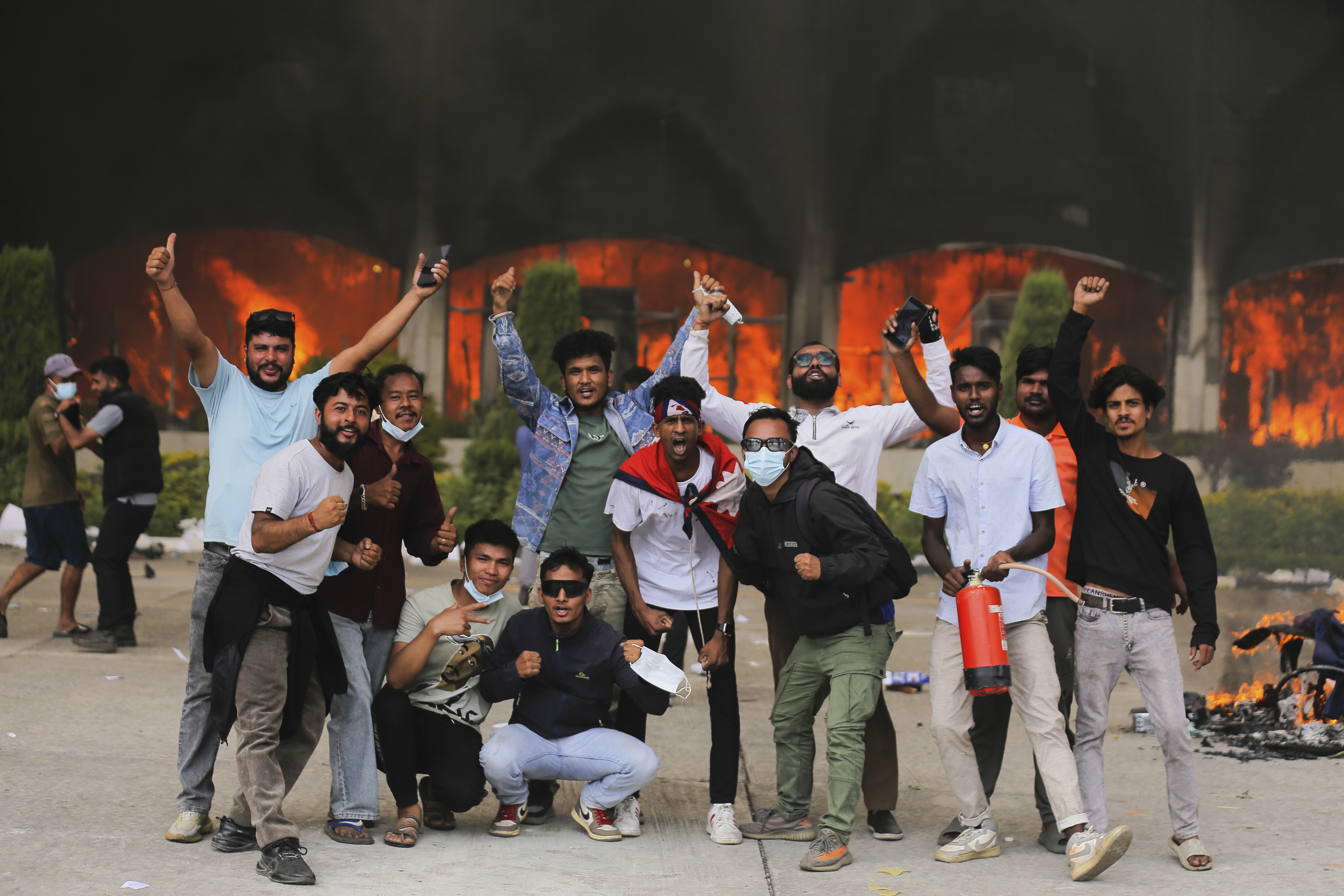
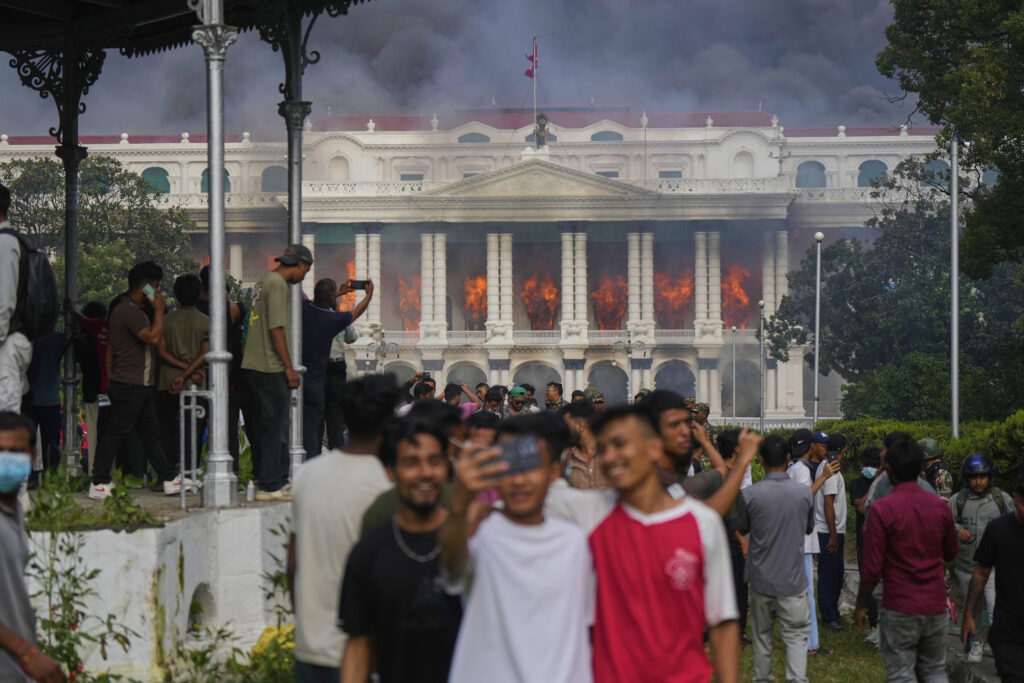
The killings by police of young protesters, some in school uniforms, fueled the growing outrage. On the second day of the protests the crowds grew, expanding to include people of many age groups. Amid widespread disorder, the police retreated. Politicians' homes, and public buildings — including parliament, the Supreme Court, several ministries and some private businesses — were burned in an arson spree that started in Kathmandu and spread to other cities across Nepal.
Onlookers used their phones to broadcast live feeds as political leaders, including the prime minister, had to be rescued by army helicopters. By the end of the week, the death toll had increased to more than 70 people. Thousands of inmates escaped prison, with over 4,000 still missing. Property worth millions of dollars had been destroyed. The prime minister resigned.
While this dizzying series of events was being broadcast around the world, Nepal’s legacy media was caught completely off guard.
The reasons why things developed so quickly and unexpectedly, and the ways in which they were organized and by whom, will likely be debated for years to come. But one thing is clear: The mainstream media initially missed out, and struggled to catch up, on one of the biggest stories in the nation’s recent history — largely because it had taken shape on communication platforms that many journalists had been ignoring — and continue to ignore — at their peril.
Games, reality, and risk
Those who were present at the parliament on the first day of the protests, including members of the police, reported being startled by the strange behavior of the protesters. As officers fired live rounds into the advancing crowds, instead of dispersing, many demonstrators continued to move toward them. Footage from the scene shows someone shouting the word “PUBG!” at various intervals throughout the protest.
To make sense of this term, I turned to my colleague, Rafid Hossain, who has been analyzing social media footage from Nepal’s protests as part of an open-source investigative documentary we’re working on for the BBC.
Hossain explained that PUBG — or PlayerUnknown’s Battleground — refers to an online multiplayer “battle royale” genre of video game that has anywhere from dozens to thousands of people playing it at any given moment, fighting to be the last one standing. For many young people, Hossian included, games like PUBG are not merely entertainment, but an integral part of the media environment they inhabit.
One thing is clear: The mainstream media initially missed out, and struggled to catch up, on one of the biggest stories in the nation’s recent history.
In the game, players are dropped off alone or in teams onto a vast battlefield where survival depends on strategy, split-second decision-making, and astute combat awareness in an atmosphere that is tense and unpredictable. It develops a mindset in players that can sometimes bleed into real life, Hossain said, adding of the Nepal street demonstrations, “If I were to put myself in a protest like that, the game would play in my head.”
Others involved in the protests noticed a similar phenomena, with video game references front and center.
“In the game, you have to communicate with your team members to survive,” said Basyal, the language teacher who helped organize the protests. “When I saw the footage [of the protests], it felt like a manifestation of the game.”
In some of the footage Hossian and I reviewed, we noticed protesters moving in ways recognizable to those who play PUBG: taking cover deliberately, positioning makeshift shields, advancing in short, coordinated bursts. “It was very much like they were in a game,” Hossian said.
In the game, however, death is only temporary. “When you die in PUBG, the round ends — but you can restart in a new arena,” Hossian said. “It makes death feel less frightening.”
On Sept. 8, as protesters continued to push forward toward the line of fire, organizer Rizan Gurung also found himself thinking of the game. “So many protesters thought the guns were like those in PUBG,” he said. “As if, even if you die, you can keep playing.”
Several people who witnessed what played out during the street marches said they saw a dangerous kind of cognitive dissonance among young protesters immersed in the digital world. It was as though they were operating with the kind of risk, repetitive actions, and survival tactics common in video games, but in a situation where they were not accounting for the fact that death would actually — not virtually — be final.
A generation fueled by frustration, and technology
In the wake of the protests, some of the organizers have reflected on how and why they were able to mobilize so effectively, and quickly, online. Many credit their digital fluency to the COVID-19 pandemic.
“During lockdown, communication and content‑consumption patterns changed a lot,” Basyal said. “People got used to talking in online space. That progressed into protest organizing.”
For 24‑year‑old climate activist‑turned‑organizer Tanuja Pandey, the protest’s spark was less about ideology than infrastructure. “It wasn’t a deep political awakening at first, it was an algorithm,” she said.
Trends like “fit check” videos — clips of young people styling their protest gear and trading tips on what to wear to take to the streets — circulated alongside more overt calls to action. Thousands of viewers engaged with the content, including many far beyond Nepal. The focus of the comments section often shifted from talk of protester demands to remarking on aesthetics, and how cool members of Gen Z looked. Some of the edgiest video snippets were turned into posters that were plastered across social media.
“It wasn’t a deep political awakening at first, it was an algorithm.”
— Tanuja Pandey, Nepali youth activist
This continued throughout the protests. On Sept. 9, as many places across Nepal were in flames, social media feeds featured an aesthetic of revolt, with clips featuring young people “aura farming,” (slang for attempting to boost one’s “aura” by doing a repeated action in a cool and effortless way), in front of buildings on fire. The clips were quickly translated, subtitled, and remixed into new formats, circulating across platforms and spreading around the globe.
Although, as one organizer put it, the protests had a sense of “fun,” for others like Pandey, they represented a coming of age for her generation.
“The protests forced us to confront injustice, question systems of power, and decide whether we’d participate, resist, or advocate for change,” she said. Many young people “reacted emotionally” when violence broke out. “Then, for some, [the protests] turned into a political awakening. They helped us develop a sense of responsibility, awareness, and identity,” Pandey added.
Discord, meanwhile, was quickly becoming a global hub for protest planning, linking youth movements from Kathmandu to Casablanca. Among those joining Nepal’s Discord servers were Gen Z activists from other countries who reported drawing tactical inspiration from the discussions they were watching unfold in real time.
Hidden away from the gaze of journalists or politicians, many said the platform — which is largely decentralized, allows for secure, anonymous communication, and features multiple “servers” that can function like individual forums — felt like a safe organizing space. It was rare to find anyone over 35 engaged in the discussions — few older people had seemingly even heard of the platform. One source I interviewed recalled Oli, asking in apparent bewilderment: “What is this thing called Discord?”
On Sept. 10, I joined a Facebook livestream of a Discord poll in which people were voting on who should replace Oli as prime minister. It was a method of regime change never quite seen before. Participants appeared with avatars, many of which were faces of anime characters with usernames like “Ghost” and “Jalebi,” and a steady stream of GIFs punctuated serious political arguments over who should run the government.
Members of the Nepali diaspora chimed in from across the world, a unique feature of this new kind of protest, according to Jamaï, the Moroccan journalist who studies youth-led uprisings. For example, the large Moroccan diaspora across Europe has remained politically connected to their homeland and “use their freedoms and resources to challenge the regime from abroad,” Jamaï said.
In Nepal, names floated for leadership ranged from Kathmandu’s rap artist Mayor Balendra Shah to the maverick politician Harka Sampang, the mayor of Dharan — both countercultural figures already mythologized online. The chat moderators struggled to corral the chaos and bring order to the proceedings.
“Our agenda is clear, but we need more than one representative to negotiate with the army,” one voice chimed in. “Even if just one or two of us are in the interim Cabinet, it will do. We just have to hold an election,” said another.
Following a marathon session more befitting the live video streaming platform Twitch, the young organizers finally coalesced around a candidate they felt had both credibility and independence: former Supreme Court Chief Justice Sushila Karki. She would be appointed interim prime minister — with the quiet backing of Nepal’s president and military — by the end of that week, the first woman to hold the position. She is expected to oversee elections in March to determine who will officially lead the new government going forward.
Journalism on its back foot
Nepal’s media arrived late to the game. Basanta Basnet, editor of the popular online news portal OnlineKhabar, was candid about the failure of the mainstream media to capture the historic uprising. “Since we became a republic, we failed to be watchdogs,” he said.
Nepal became a federal democratic republic in 2008, following a decadelong civil war between forces backed by the longstanding monarchy and Maoist insurgents. But the young democracy has struggled to find its footing — and many viewed the recent past as a kind of political déjà vu: the same aging leaders, the same political parties, and a constant rotation among prime ministers. Despite a new constitution in 2015 that guaranteed freedom of the press, many feel the mainstream media has focused too heavily on covering constantly shifting party loyalties and backroom deals at the expense of deeper issues.
“We were dragged into party journalism,” Basnet said. “I personally assigned reporters to political parties when I should have focused on public delivery beats like poverty, health, education.”
It was in these areas of society — poverty, health, education, and elsewhere — that the discontent that fueled the protests had been quietly growing, out of view of traditional media. Despite many media outlets adapting to the digital age, technology-wise, Basnet said, they retained old habits. “We function like old print papers, with the same writing styles,” he added.
Multimedia journalist Kamal Prasai put it more bluntly. Even when younger reporters produce creative, platform-native content at the speed of breaking news, “print journalists wouldn’t share it until their text was done. It defeats the purpose,” Prasai said.
In the recent uprisings, footage shot by citizens on smartphones, livestreams, memes and online influencers did what traditional journalism failed to: define in real-time what was happening, why it mattered, and how it felt to be part of it. And young people turned to those sources for up-to-date information and to reflect the reality they were seeing before them — leaving legacy media still further behind.
“Mainstream media and mainstream politics are really on the back foot,” said Gina Neff, an organizational sociologist focusing on technology at Cambridge University. “They don’t grasp how quickly information spreads, and they don’t understand how to shape narratives in this changed world.”
Neff described modern technological platforms as producing “affective publics” driven by emotion. Content that excites or enrages travels faster, because algorithms reward it.
“It can really seem like the world is always on fire,” she said.
Neff is careful not to dismiss Gen Z movements as artificial. “That doesn’t mean all Gen Z protest is the product of algorithmic manipulation — absolutely not,” she said. “But technology amplifies supercharged emotional content, and it makes manipulation easier."
“Mainstream media and mainstream politics are really on the back foot. They don’t grasp how quickly information spreads, and they don’t understand how to shape narratives in this changed world.”
— Gina Neff, sociologist at Cambridge University
Verifying facts in real time
Nepal’s legacy media not only failed to see the uprising developing, but also found itself squarely in its firing line, fueled by the polarized messaging of social media. Arsonists burned down two national news agencies, including Nepal’s largest media house, Kantipur, which had once resisted the monarchy and stood firm in 2005 against King Gyanendra’s censorship.
Activists like Pandey saw the irony in the protesters targeting these legacy outlets.
“We were fighting for freedom of expression,” she said. “Why would we burn down the media?”
Despite disagreeing with the targeting of media outlets, Pandey, like many young activists I spoke to, said she does not entirely trust them. “We don’t need legacy media because social media is already doing that job,” she said.
Blogger Umesh Shrestha (no relation to the author), who has been running a site called Nepal Fact Check for years, shares Pandey’s skepticism.
“Nepal’s media once did more than report news; they actively nurtured democratic values,” he said. Over the years, “partisanship and lack of fact-checking have eroded trust.”
Following the Gen Z protests, Shrestha has been combing through social media images trying to verify their accuracy. For example, he was able to verify that an image of Nepal’s government center, Singha Durbar, on fire was AI-generated. It had been making the rounds on social media since Sept. 7, leading him to wonder if such images were responsible for inciting violence.
“Simple reverse image search no longer works,” Shrestha said, adding that AI-generated images have made verification much more difficult, especially when they circulate alongside real footage. Verification of images on the scale of the widespread protests in Nepal takes an enormous amount of time and resources that most newsrooms in the country do not have.
What’s next for journalism in Nepal?
Nepal is preparing for elections on March 5, with several ministers stepping down to run for higher office and Karki’s mandate as interim prime minister drawing to a close. Some of the young protesters are expressing frustration that Nepal’s would-be new leaders seem more focused on moving quickly toward elections, but slowly on any of the demands that drove the masses into the streets in the first place, such as ending corruption.
“We are a generation who want change immediately,” protest organizer Gurung said.
The events that have unfolded in Nepal go far beyond a simple political crisis; it has caused an irreversible rupture in the ways that information and power function. The uprising showed how networked, digitally driven organizing can destabilize long-entrenched systems in a matter of days. Political leaders, once dismissive of social media, now understand their own fragile grasp on power in the face of massive online mobilizations. And traditional media, which has long played a central role in democratic struggles, is now left to confront declining public trust in what it does and the disappearance of the monopoly it once held over shaping the public narrative. It must also figure out ways to reach new audiences where they are — if it wishes to remain relevant.
For journalists in Nepal and beyond, the question now is whether they are willing to meet these challenges.
“We need to re-embed accuracy, verification, and accountability into this new information ecosystem,” said Neff, the Cambridge University sociologist. “The kind of powerful storytelling great journalism has always done is still in demand — but those stories must be told in formats young people can actually find.”