
In 2025, journalism was pushed to new limits by governments, tech platforms, economic pressures, technological changes, and audiences whose trust in the media continues to steadily diminish.
Nieman Reports’ most-read stories of the year trace those fault lines: from Gen Z-led protests in Nepal to the state of U.S. public media; from scenes of families being forcibly separated in U.S. immigration courts to a deep dive into fact-checking, global press freedom, news on social media platforms, and issues affecting student journalists.
As the year comes to a close, take a look at the Nieman Reports stories that most resonated with readers.
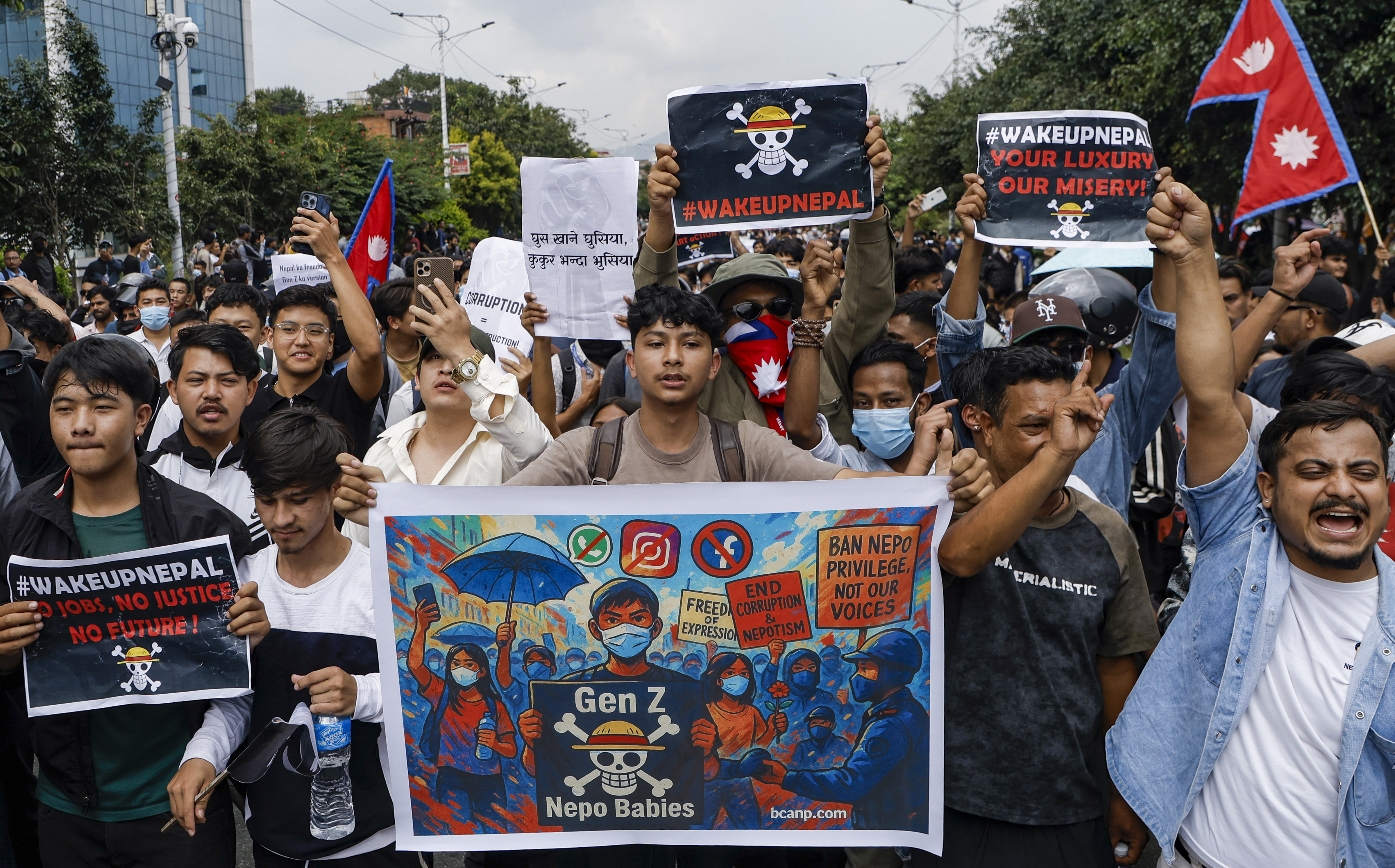
In September, tens of thousands of Nepalis — many in their teens and early 20s — took to the streets of Kathmandu and cities across the country in protests that helped bring down the government of Prime Minister K.P. Sharma Oli.
Veteran journalists were stunned not only by the scale of the uprising, but by where much of the protest organizing took place: an online Discord server, where hashtags, Japanese cartoon symbols, and memes became the language of politics. As Subina Shrestha, a 2017 Nieman Fellow, reports, the protests offer a lesson for journalists everywhere in how fast-moving, digitally driven community organizing can expose the blind spots in traditional reporting and the public’s distrust of legacy media.
For our visual journalism column AfterImage, photographer Carol Guzy reflects on documenting a heart-wrenching moment she captured outside a federal building in New York City: a security guard breaking down in tears as he watched a woman and child grapple with the detention of their loved one by immigration authorities. “I believe we need to check our biases at the door, and let our photographs speak. But the most heart-wrenching stories to document are family separations,” Guzy writes. “Whichever side of our deep political divide one sits on, the inescapable reality is that it’s too often spouses and innocent children who are caught in the crossfire of controversial immigration reform tactics.”
For the first time ever, more Americans get their news from social media than from any other source, according to the 2025 Digital News Report from Oxford’s Reuters Institute for the Study of Journalism. Ryan Y. Kellett and Ben Reininga, both 2025 Nieman Fellows, share what lessons the media industry might take from the growing “newsfluencer” or social media creator space, which has expanded from a niche segment of the news industry into an increasingly influential force.
In response to escalating threats to student free speech across the U.S., a coalition of student media advocacy groups issued a rare alert in April, urging college newsrooms to rethink long-standing journalistic norms in order to protect student journalists and sources. Nieman Reports Editor Samantha Henry reports on how the Student Press Law Center, the Associated Collegiate Press, College Media Association, and others changed their recommendations on things like takedown requests, anonymous sourcing, and digital safety practices, as they could potentially pose increased legal and personal risks for student journalists.
What happens when the outlets producing most of the news in a state become nonprofit organizations? With little notice, that has quietly but steadily been taking place in Maine. In New England’s northernmost state, nonprofit ownership has enabled greater collaboration among different newsrooms, expanded investigative reporting, and increased coverage of communities long underserved by traditional media. Reporter Jon Marcus investigates the various models and looks at how critics have raised questions about transparency, funding sources, and the sustainability of nonprofits as a model for saving local news.
In the last three years, nearly 10,000 media workers have been laid off in the U.S. — that’s more than 1 in 10 editors and reporters employed in the industry, according to Bureau of Labor Statistics data. “Layoffs are the new normal," writes Katherine Reynolds Lewis, a regular Nieman Reports contributor and founder of the Institute of Independent Journalists. In this column, she shares best practices for handling a layoff — and tips on how to bounce back quickly.
When the U.S. Congress voted in 2025 to rescind more than a billion dollars previously allocated for public broadcasting, it marked the largest victory yet in the nearly 60-year fight conservatives have waged on government-supported media. Gabe Bullard, a 2015 Nieman Fellow, reports on how the elimination of federal support for the Corporation for Public Broadcasting has had a drastic impact on the public media sector.
During his more than a decade in power, media watchers say, Israeli Prime Minister Benjamin Netanyahu has waged an increasingly aggressive campaign against the country’s independent press. Dina Kraft, a 2012 Nieman Fellow and Israel correspondent for The Christian Science Monitor, reports on how Netanyahu’s government has banned or boycotted news outlets it deems hostile, restricted journalists’ access to Gaza, and sought to privatize Israel’s public broadcaster. These moves, critics argue, are part of a broader push to weaken democratic institutions in Israel.
As Meta shuttered its third-party fact-checking program amid claims of bias, attacks on fact-checking intensified across the political and media landscape. Angie Drobnic Holan, a 2023 Nieman Fellow and director of the International Fact-Checking Network at the Poynter Institute, argues that these assaults do more than target individual journalists: They erode public trust in truth itself.
In ‘Tool of the Trade,’ Nieman Reports explored a shift in journalism: the decline in use of the classic reporter’s notebook. As digital tools become more sophisticated, offering features like automatic transcription, cloud storage, and AI-assisted note-taking, spiral-bound notebooks risk fading into obsolescence.
In response to the piece by Gabe Bullard (NF '15), we put out a call asking journalists if they still use a reporter’s notebook and to share any stories about this long-standing tool of the trade. The numerous responses we received paid homage to notebooks that played a key role in witnessing historic events, recording vivid observations, and, in at least one case, capturing the first documentation of a romantic relationship.