In early April, I wrote a story for The Free Press about the frail state of the relationship between the Vatican and the Trump administration. My reporting was meant to provide some insight into what was rapidly turning into a public fallout. Several conflicting positions on crucial issues — from immigration policy to the military interventions in Venezuela and Iran — had already been building up over months.
While reporting on these circumstances, I learned of a very unusual meeting that had until then remained secret. In late January, the then-apostolic nuncio (ambassador) of the Holy See to the United States, Cardinal Christophe Pierre, was invited to the Pentagon to meet with U.S. Undersecretary of Defense for Policy Elbridge Colby, with their respective delegations. From what I was able to verify, this was a format that had no precedent in the history of full diplomatic relations between the Holy See and the United States, which began in 1984.
The Vatican has no weapons other than those of diplomacy, and it is therefore at the very least unusual for the Holy See’s ambassador to have a formal meeting at the Pentagon. That explains why it had been kept secret. Vatican and U.S. officials who spoke to me about it, on condition of anonymity, described a very tense and at times openly confrontational encounter, designed to pressure the Catholic Church into aligning itself with the Trump administration’s positions. At one point, my sources told me, one of the American officials made a reference to the Avignon Papacy — the period in the 14th century when the papacy was de facto subjugated to the French Crown and forced out of Rome. It was an unsavory comment about the relationship between political power and the freedom of the Church, but in the context of a meeting at the Pentagon, it took on a particularly sharp edge.
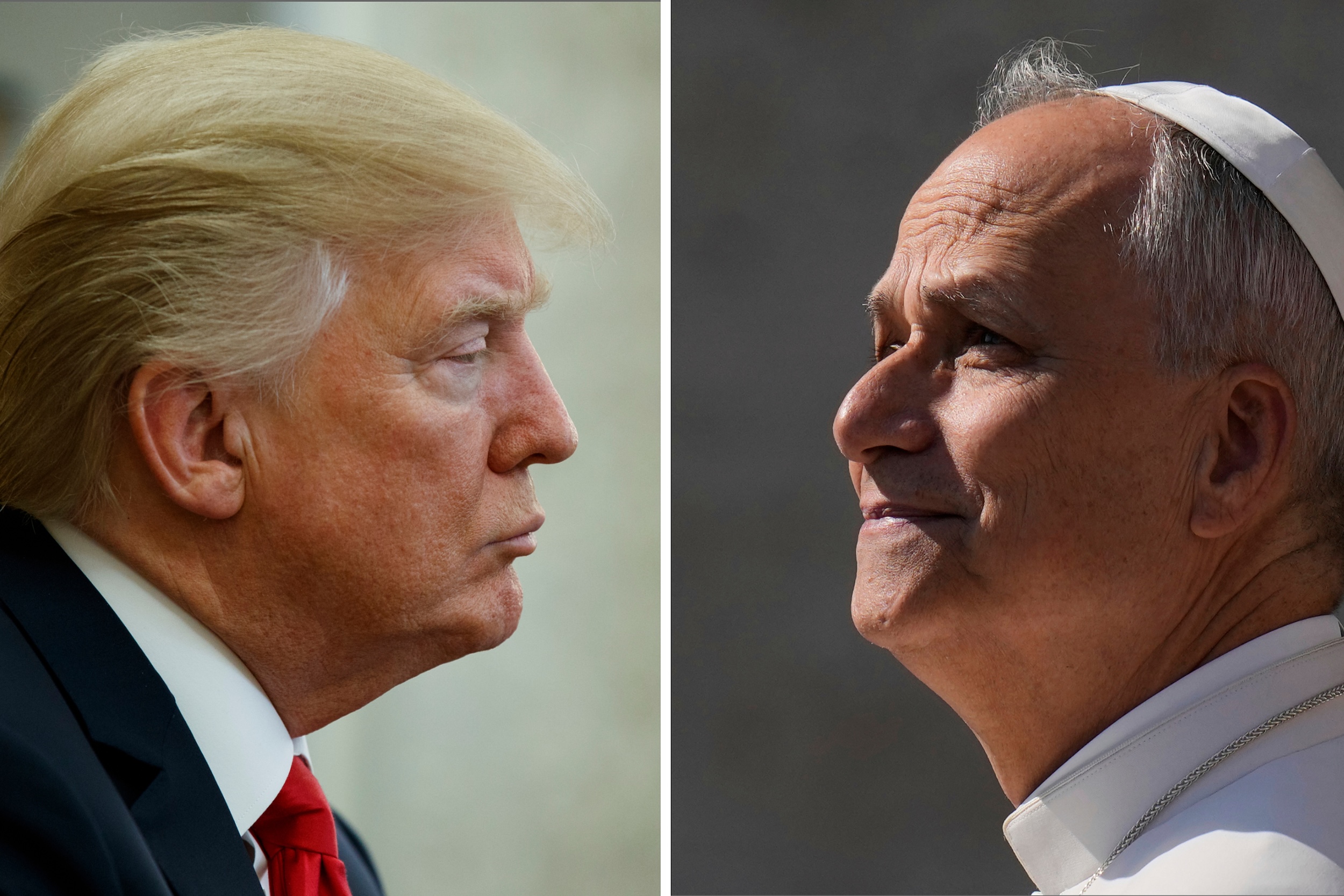
The tension between Rome and Washington was an open secret, but the story about the Pentagon meeting proved to be a crucial spark in making my article go globally viral. Timing was also key. On April 7, the day after the story went live, Pope Leo XIV for the first time directly confronted President Donald Trump over his threats to destroy Iran by saying “a whole civilization will die … never to be brought back again.”
“Today, as we all know, there has also been this threat against the entire people of Iran. And this is truly unacceptable,” the pope said to reporters outside Castel Gandolfo, the papal summer residence. In another unprecedented move, the pope — who was born and raised in Chicago — invited his fellow U.S. citizens to contact their political representatives and ask them “to work for peace and to reject war and violence.”
The pope’s words acted as a detonator for the story. In the high-speed, low-context social media ecosystem, the timeline of events got confused or purposefully twisted — and I had the surreal experience of watching my story get reinterpreted, rearranged, and in some cases, grossly distorted.
Some users suggested the Holy See ambassador had been summoned to the Pentagon as a result of the pope’s statement, making the whole story even more explosive. In a similar way, the subsequent commentary and additional reporting that built off my piece overemphasized certain details, distorting the original narrative. For example, the reference to the Avignon Papacy — an unsavory joke that had been casually dropped into the conversation — somehow morphed into the Pentagon issuing a direct military threat against the Vatican.
An interesting aspect of the story was seeing how the parties involved framed their responses, and how those responses changed over time. The Apostolic Nunciature (embassy) in the United States, for example, published a brief statement confirming the Jan. 22 meeting involving Cardinal Pierre at the Pentagon, saying he and several officials had discussed current affairs. “Meetings with government officials are a standard practice for the Nuncio, who serves as the Holy See’s ambassador to the United States. The Apostolic Nunciature is grateful for the opportunities to meet and dialogue with government officials and others in Washington to discuss areas of mutual concern,” the statement read. Although confirming that the meeting had taken place, it did not provide specifics, but it also did not take issue with the media reports about it.
On April 9, the Department of Defense also confirmed the meeting had happened, but did take issue with the coverage. A Pentagon official told media outlets in a statement: “The Free Press' characterization of the meeting is highly exaggerated and distorted,” adding that the meeting had been ”a respectful and reasonable discussion.” “We have nothing but the highest regard and welcome continued dialogue with the Holy See,” the official said. The Pentagon’s rapid response social media team also posted several pictures of the meeting, showing members of the delegations shaking hands and smiling politely.
The photos, while emphasizing the friendly atmosphere, had clearly been taken before the meeting began. Had they been taken at the end, the body language would likely have told a very different story. In releasing the photos, the Pentagon reiterated that the meeting had been “cordial,” “respectful,” and “reasonable,” adding that media reports were “grossly false and distorted.”
But a few hours later, something shifted. The U.S. ambassador to the Holy See, Brian Burch, wrote on his official social media accounts that “I was pleased to speak today with His Eminence, Cardinal Christophe Pierre. As expected, he confirmed that recent media characterizations of his meeting with Undersecretary Colby are ’fabrications’ that were ’just invented.’”
According to the American ambassador, Cardinal Pierre went so far as to describe the published reports about the meeting as entirely false, even though the nunciature — that is, Cardinal Pierre himself — had made no such claim in its official statement only a few hours earlier.
The political and diplomatic implications of these comments were profound: The characterization of what a key participant in the much-discussed meeting had said did not come from him directly, or through the official channels of the government he represented, but instead from a representative of another government involved in the dispute. On April 10, the Vatican Secretariat of State confirmed Pierre’s words as reported by Burch, and said that “the narrative offered by some media outlets about this meeting is completely untrue.”
After four turbulent days, the Holy See fully embraced the narrative established by the U.S. government, and took a substantially stronger stance compared to its previous response. Emboldened by this development, the White House went on the offensive, claiming that the story that the U.S. had tried to pressure the Vatican had been “totally rebuked by both the Pentagon and by Cardinal Christophe Pierre” and dismissing it as “100% garbage Fake News.”
In the end, the person who confirmed beyond any doubt that tensions between the Holy See and the administration had reached a boiling point was none other than Trump himself. With his rambling post on Truth Social on April 13, in which he called the pope “weak on crime” and “terrible on foreign policy,” the president opened the public phase of a rift that had been going on for months behind closed doors, and that continues to unfold before our eyes.