In the fall of 2012, just weeks into my Nieman Fellowship, our class went to see “Marie Antoinette” at the American Repertory Theater at Harvard University.
I struggled with the play, and I remember feeling like I couldn’t grasp what was happening on stage, that I was missing something everyone else understood. When our curator, Ann Marie Lipinski, asked me later what I thought, I admitted as much.
“Well,” she replied, turning down her mouth, “you’re hard to please.”
She wasn’t wrong.
At the time, I was a crime reporter. I had recently founded Homicide Watch D.C., an independent digital publication dedicated to telling the stories of people whose lives might otherwise be forgotten. My work revolved around police, prosecutors, defense attorneys, and public records. Theater wasn’t just outside my beat — it barely registered at all.
If you had told me that evening at the start of my fellowship year that, more than a decade later, I would create a podcast (a podcast!) devoted to Boston theater (theater!), I would have laughed. I knew nothing about theater. Or podcasts. Or Boston, for that matter.
And yet that’s exactly what happened.
For some people, careers run fairly linearly. For others, myself included, we’re constantly seeking the right conditions to grow. It’s not comfortable, and probably not financially responsible either. But whether because it’s a mix of brain chemistry, circumstance, or something else, it’s just how we operate.
Since my inauspicious start with “Marie Antoinette,” I had explored A.R.T. and other local theaters during my fellowship year and beyond, and found that I felt at home there, soaking in the storytelling that as a journalist is part of my DNA.
And so maybe I shouldn’t be surprised that last fall, with my brain itching for something new, and with some time available, circumstances aligned and led to the conception and launch of “Scene in Boston.”
The idea itself came together in a shared Lyft ride after the Online News Association conference in New Orleans. A mutual acquaintance had organized the airport shuttle, and I didn’t know our fellow passenger (and my future co-host), Lisa Thalhamer. Lisa was finishing up her masters degree at Northeastern University, and we were talking about reasons to stay in Boston when we could go anywhere.
I don’t remember it, but she claims I said something like, “Boston’s theater scene is what keeps me living here.” With that, the fuse was lit and we were off, sharing notes on shows we’d seen over the years, our favorite theaters, and secrets to getting cheap tickets.
“We should see something together,” I remember saying as our Lyft pulled up to the airport curb. “No,” said the woman who had organized the ride. “You guys need a podcast.”
It’s surprisingly easy to start something if others share your excitement. After that Lyft ride, I spent a week dreaming about what a Boston-area theater podcast could be. It would be interview-based, I decided, to open up the world of how theater is made to those who sit in the seats; creative-centric, to build connections between artists, audiences, and companies across the region; and community-minded, to help audiences navigate and connect with the extraordinary range of theater happening across Greater Boston.
Finally, I talked to another friend whom I often see shows with and asked her if the idea was crazy.
“Not at all,” she said, adding, “Would you be interested in doing it at Boston Arts Academy?”
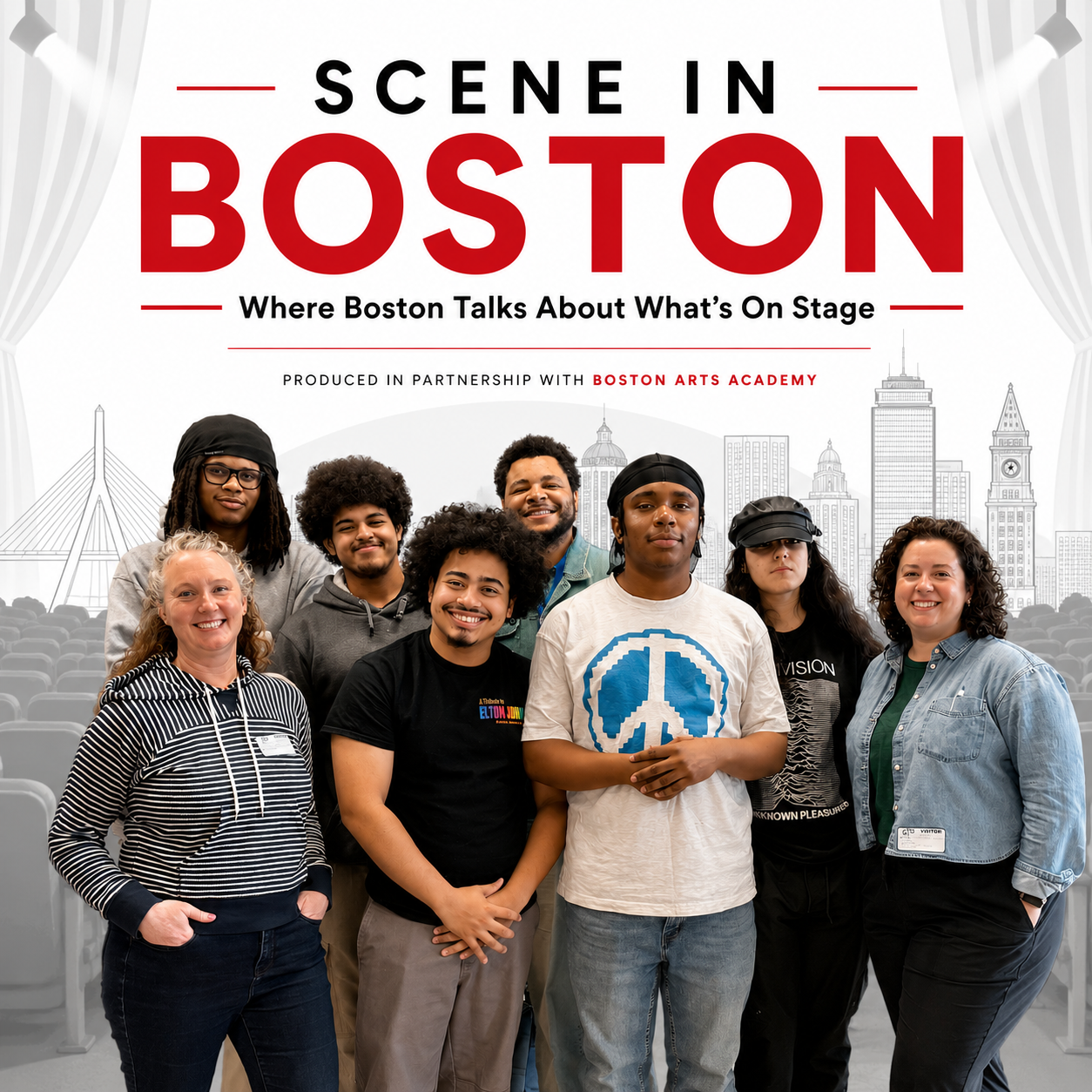
BAA, Boston’s only public arts high school, had a newly trained cadre of audio engineers and a full studio. My friend was an administrator at the school and knew that the students needed a project. Piloting “Scene in Boston” could be perfect, and I already had experience building a student reporting lab for Homicide Watch D.C. My answer was a resounding yes.
And so, two weeks after that ride to the airport, I had an idea, technical resources, and my own digital journalism and business building experience. But did I have a partner? I called Lisa.
“So what if we actually do this?” I asked. Convinced it was a great idea, but less convinced on co-hosting, she agreed to give it a shot.
We used the rest of the year to research and get ready to launch. We talked about what we liked. (“Pop Culture Happy Hour” for Lisa; the “Playbill” podcast for me). We were accepted into the Tiny News Collective, which helped with access to fiscal sponsorship, web hosting, and other infrastructure. Dan Kennedy, Ellen Cleg, and Jeb Sharp at Northeastern pointed us to Riverside.fm for remote recording and occasional editing and LibSyn for distribution. We found Otter.Ai for transcriptions. We set up social media accounts and created Instagram templates. Grants from the Boston Opportunity Fund and Massachusetts Cultural Council provided further momentum.
Finally, in early January, a mere 16 weeks after that Lyft ride to the airport, we sat behind the mics and recorded our first episode.
None of us were sure how the first season would go. Could we book interviews? Could the students manage the recording? Would Lisa and I even like the work? But from the first sound check, we were all hooked. There was something magical about starting from a place with zero expectations, a bunch of beginners, and a lot of joy. For Lisa and me, that joy was in learning more about theater. For our guests, it was in sharing their work. And for the students, it was in working in a professional capacity (even if their choice of podcast topics might have been a breakfast cereal showdown and not Boston theater).
When I think about it, each piece filled a gap that I hadn’t yet identified. This was true when I reached out to theaters, too. I was nervous to send those initial emails and attend the first coffee meetings. I felt like an imposter. There were no bylines they could look up to see how I thought about theater or what my qualifications were. In my mind, I had no qualifications. And yet the people I met with were overwhelmingly supportive and encouraging. And that was in no small part because I was filling a gap that they had as well. And it wasn’t just that they wanted to get word out about the shows — they also wanted to work with BAA, and I learned that many of our guests wanted to know more about the students in the multimedia program, and frequently asked for tours of the school once we finished recording.
We developed our editorial calendar based on what we were interested in, but kept it flexible to absorb what we were learning. This was useful early on when several guests encouraged us to see “Gem of the Ocean," produced by Actors’ Shakespeare Project.
Neither Lisa nor I had experience with any of August Wilson’s work. Maybe I should have been embarrassed, but I found freedom in saying that maybe there were others out there like me, and that together we would learn. We added an episode to our season to make that happen, exploring Wilson’s place in American theater, and seeing two shows along the way (in addition to “Gem of the Ocean” at Hibernian Hall in Roxbury, Massachusetts, “Ma Rainey’s Black Bottom” was playing at the Goodman Theater in Chicago while I was there on a work trip in the spring — a welcome coincidence!). That willingness to follow our curiosity became one of the defining characteristics of the season.
The flexibility that sustained the partnership also defined my own experience. This was my first season producing audio, and I was learning right alongside the students. Learning to record live-to-tape was new for me, and I was saved more than once by the fact that theater people are good storytellers. We can — and do — edit for time, but learning how to structure conversations in real time, listen for narrative threads, and guide interviews toward a satisfying arc has been a skill, among many, that I’ve watched myself develop over the course of the season.
This season taught me that meaningful conversations about theater begin not with expertise, but with curiosity. Learning to trust my own reactions — and then test them through conversation — has changed the way I experience live performance and, unexpectedly, the way I trust myself. By the end of the season, I could see the students beginning to trust themselves too.
There’s something contagious about being around people who are encountering a craft for the first time. The students ask questions I would never think to ask because they haven’t yet learned what is “supposed” to be obvious. In a profession that can sometimes reward cynicism, they make curiosity feel like an asset again.
There’s something contagious about being around people who are encountering a craft for the first time. The students ask questions I would never think to ask. ... In a profession that can sometimes reward cynicism, they make curiosity feel like an asset again.
There’s a picture I keep on my desktop now, of audio cords wrapped neatly on top of a studio soundboard. I snapped it the afternoon we wrapped our first season. We’d just finished a debrief with the students and one of them, Alex, was telling us about how much he’d learned.
“I didn’t even know how to wrap cords when we started. And now I just did it without thinking. All those cords over there?” he said pointing to the neatly wrapped pile on the soundboard. “I wrapped those.”
It’s such a small thing. But journalism is full of small things that become second nature only through practice. Watching the students has reminded me that confidence grows the same way. And then, suddenly, maybe, you’re a theater journalist. And you’re planning Season Two.
Laura Amico is a 2013 Nieman Fellow