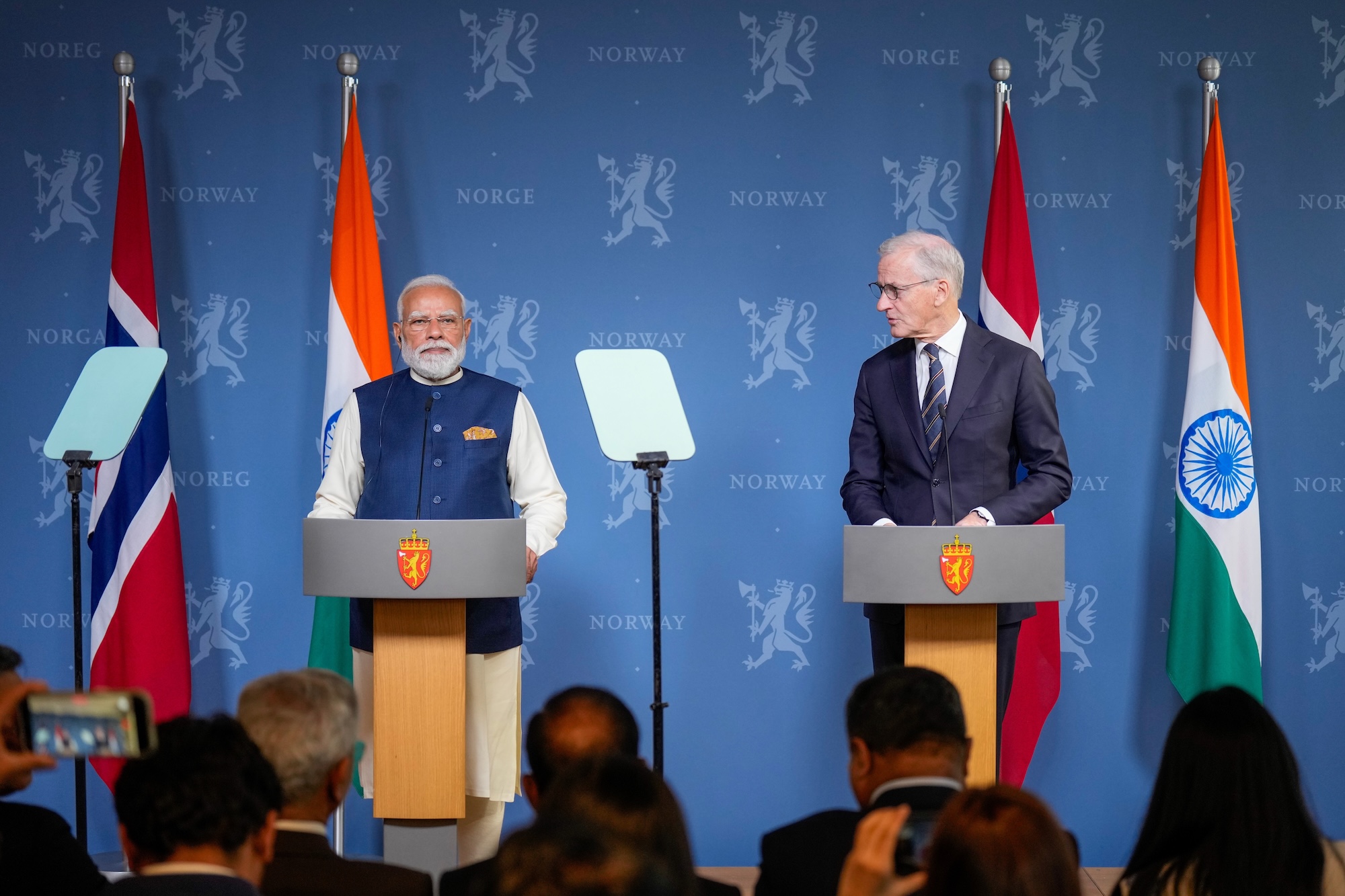
When Norwegian journalist Helle Lyng shouted a question at Prime Minister Narendra Modi as he was departing, without talking to reporters, from a joint press appearance with Norway’s Prime Minister in May, she did not expect a response, knowing the Indian leader had not held an open press conference during his 12-year tenure.
Although Lyng did not get an answer from Modi in Oslo, she found herself the target of an online mob led by India’s legions of right-wing internet trolls. What she didn’t expect was that a social media post she made about the incident would garner millions of views, and touch off an intense backlash in India.
In the online video, Lyng, a reporter for the Norwegian newspaper Dagsavisen asked, “Prime Minister Modi, why don’t you take some questions from the freest press in the world?” Modi walked away without responding.
Along with the video, Lyng wrote: “Norway has the number one spot on the World Press Freedom Index, India is at 157th, competing with Palestine, Emirates & Cuba. It is our job to question the powers we cooperate with.”
Lyng posted the video on X, and within minutes it had spread across India, garnering millions of views and thousands of comments. While some commenters praised Lyng’s questions, others launched a torrent of abuse against her, including death threats and doxing.
“It’s been surrealistic,” Lyng said, adding she had posted the video on X because she wanted it to reach an Indian audience, but never expected it would trigger a backlash. “I didn’t think it would reach the public in that sense, because press freedom hasn’t really ever been [a] hot topic for the public. It’s more like a press thing. So, yeah, I’m shocked,” she said.
Some commenters threatened to kill her family, or to cut her throat. “There were so many people calling me really nasty things,” Lyng said. At one point after she had posted the video, Lyng said her Instagram account was suspended by Meta.
Her account was restored after Reporters Without Borders in a May 22 statement, denounced the “vicious cyberharassment campaign” against the Norwegian journalist. Lyng said things had since died down, and would hopefully be returning to normal soon, “if things can ever be normal again.”
The intensity of the backlash may have been shocking for Lyng, but for many Indian journalists, it felt deeply familiar.
It was not only the nature of Lyng’s question that stood out to them, but the casual normalcy with which a European reporter had been able to ask it. The incident revealed something much larger than the harassment of a foreign reporter. It exposed the ecosystem that has developed around India’s most powerful figure — one in which asking routine questions of the prime minister of the world’s largest democracy has become an exceptional act.
Modi has not held a fully open, unscripted press conference since he took office in 2014. While he occasionally grants interviews to carefully selected outlets and appears at highly choreographed media events, opportunities for spontaneous questioning by the press are virtually nonexistent in India.
The incident revealed something much larger than the harassment of a foreign reporter. It exposed the ecosystem that has developed around India’s most powerful figure — one in which asking routine questions of the prime minister of the world’s largest democracy has become an exceptional act.
India’s legacy television news ecosystem, often noisy and adversarial, is now widely seen as overwhelmingly pro-government, with prime-time debates often anchored in the ruling party’s political ideologies. For independent journalists who continue to report critically, the Norway episode cast a spotlight on just how accustomed the Indian media has become to a prime minister who does not make himself available to the press for routine questioning. Instead, the Modi government’s media strategy seems focused on avoiding unscripted scrutiny, deflecting questions about press rights, and leaving reporters who are critical of the system vulnerable and exposed to online abuse.
Lyng said she got a sense of the effect this has had on India’s journalists when she appeared on Indian television channels following the controversy. What surprised her, she said, was not so much the criticism she was getting from Indian government supporters, but the reactions of some journalists, who expressed anger at her instead of solidarity with a fellow reporter.
“I knew that the press situation was bad and that there was a lot of control within the media,” Lyng said, but it didn’t really hit her until she had a few interviews with leading Indian TV news channels. “It was super aggressive,” she said. “That really surprised me, that … a reporter or a TV anchor could sit and grill me for 20 minutes, but not grill her own prime minister.”
During the interviews Lyng did with Indian media, she said she was pressed on why she hadn’t questioned President Donald Trump about his views on the Black Lives Matter protests during her stint as a U.S.-based correspondent last year.
“I tried to explain to them that Trump gets questions [from the press] every day. On Black Lives Matter, he’s been questioned about [it] a lot, … so I don’t need to ask Trump.” She added she had pressed Trump on other issues, such as during a 2025 White House visit by Norway’s prime minister, “I asked Trump about Greenland and about our trade differences and how he viewed trade,” she said.
The Norway snub was not an isolated incident for Modi. During the Netherlands leg of the same tour, Dutch journalists also pressed the Indian delegation about Modi’s refusal to take questions, as well as concerns expressed by Dutch officials on India’s stance on press freedom and minority rights. Sibi George, a senior diplomat, deflected on Modi’s behalf by trivializing those who had asked. “We face these kinds of questions basically because of the lack of understanding of the person who asked the question,” he said.
Modi has followed a similar playbook on prior trips. In 2023, during a trip to Washington, Wall Street Journal reporter Sabrina Siddiqui tried to ask the prime minister about minority rights and free speech issues in India during a joint press conference with President Joe Biden. Siddiqui was subjected to online harassment by Hindu nationalist supporters that got so intense that even the Biden administration was moved to condemn it.
At home in India, the government continues to tightly choreograph press control, restricting access to press events and selecting which outlets can attend.
In 2020, while reporting on the Modi government, I obtained internal policy documents showing senior Cabinet ministers discussing strategies to “control narrative” and monitor what they described as “negative journalists.” The disclosure triggered a national debate on press freedom, revealing the government’s obsession over controlling the media and narratives about the administration.
In this tightly restricted atmosphere, critical questions from journalists are extremely rare. Instead, the mainstream media frequently amplifies the ruling party’s line. But the administration’s attempts at press manipulation often falters on international shores — as Modi’s recent trip to Europe has shown — in countries where journalists are more accustomed to holding the powerful to account. Lyng’s question resonated with many journalists in India, not because it was particularly confrontational, but because it was so ordinary.
In many democracies, asking a leader why he refuses to answer questions would scarcely make news. In India, the question itself became the story.