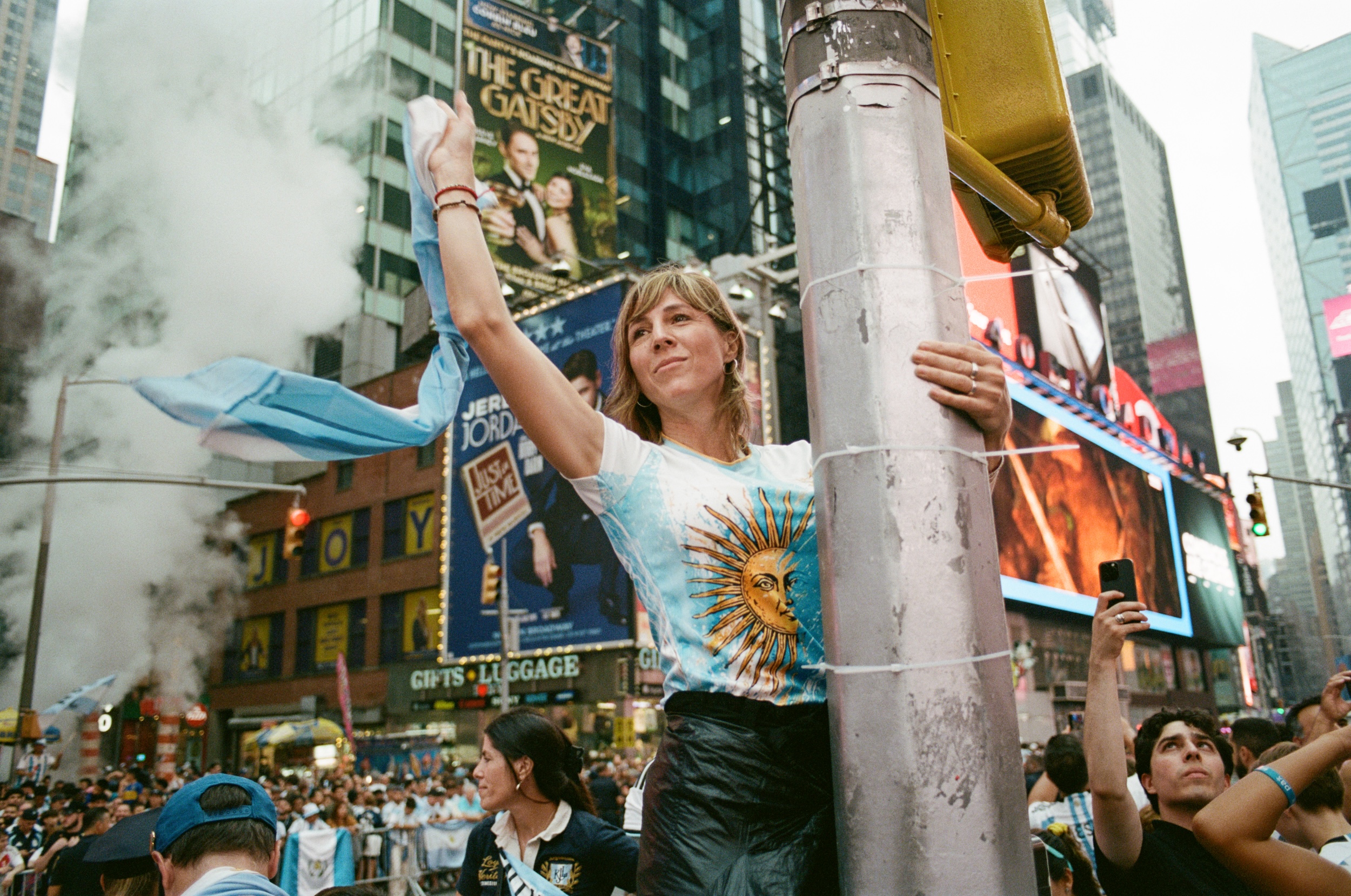
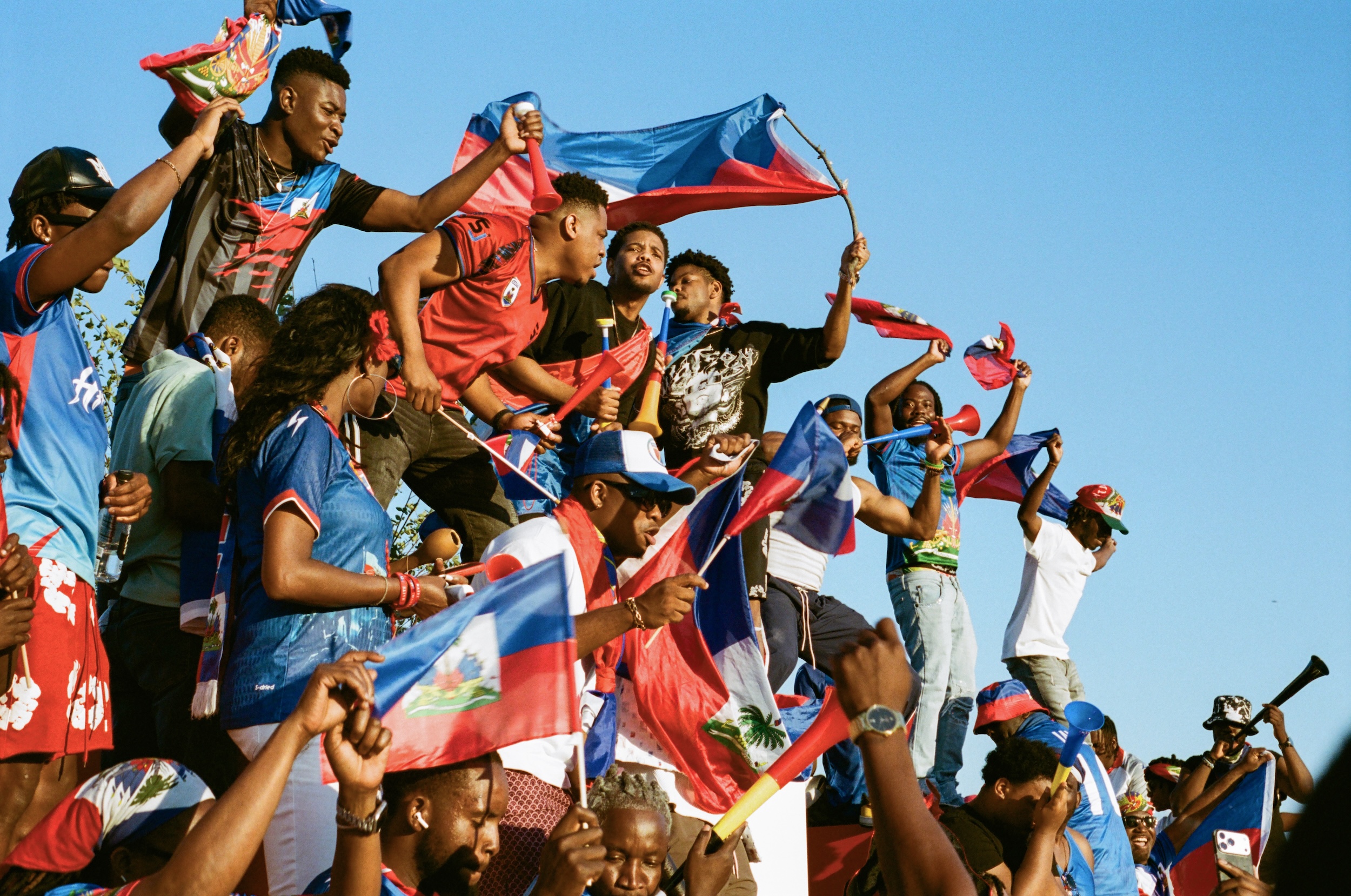
Haiti supporters celebrate before their team's World Cup match against Brazil on June 19 in Philadelphia. Photographer Yutao Chen said, "My image of them sums up the whole experience for me: an overload of all the senses, crowded and loud." Yutao Chen
Photographer Yutao Chen first developed an interest in soccer during his childhood. As a lifelong follower of the sport, he seized the opportunity to cover the 2026 FIFA World Cup, traveling across the United States to document fan reactions throughout the tournament. He undertook the project independently, financing it himself rather than on assignment. Chen chose to work in film over digital, he explained, because he wanted these images to be imperfect, personal artifacts, shaped by his own perception rather than an exact record of events.
This conversation has been edited and condensed for clarity.
The first World Cup I remember watching was in 2006, when it was held in Germany. At first, the sport was an escape from reality for me, an experience to share with other fellow fans, forget our issues, and fully immerse ourselves in a game for 90 minutes. Later I realized soccer is one of the few ways I can connect with the world. I grew up in China, and my need to consume soccer news and analysis is what drove me into journalism. I spent a lot of time reading The Guardian and other outlets, and that’s how I got comfortable with English.
I am now living and working in the U.S. This was the first World Cup I got to experience myself — not just as a fan, but as a documentarian. Months before, I purchased tickets to four games, held in Boston, Philadelphia, New Jersey, and Dallas, based on their accessibility, my budget, and the narratives I anticipated the most. This was an expanded World Cup, with 48 teams competing, so you got a lot of firsts: countries playing for the first time, like Curaçao, or returning after decades, like Norway and Iraq.
For me, soccer is much more than what happens on the field. I don’t necessarily remember all the score lines and all the goal scorers for each World Cup, but I remember specific moments — what I was doing at the time, who I was watching with, the stage I was at in my life. I’d arrive four or five hours before kickoff and just hang around outside the stadium, talking to people and making images. For me, the most interesting moments actually happen before the game with the fans.
Before the Haiti-Brazil match in Philadelphia, I expected the most passion from the Brazil fans. It turned out to be quite different — the best moments I captured came from Haiti fans. My image of them sums up the whole experience for me: an overload of all the senses, crowded and loud. When I photograph, I want a lot of control over how things look, but here I was rubbing shoulders with other people, working with very limited space. It felt overwhelming, and with film there are times I feel like I’m fighting with the gear. A lot of my images from that scene were made head-on with the crowd, which captured the emotion but not the scale. When I went to the side, the image showed the crowd better — the flags blowing in the wind, the way people interact with each other. That’s what I wanted to document: not just my own personal memories, but the World Cup’s magic of connecting people — not just people from the same country, but from different parts of the world.
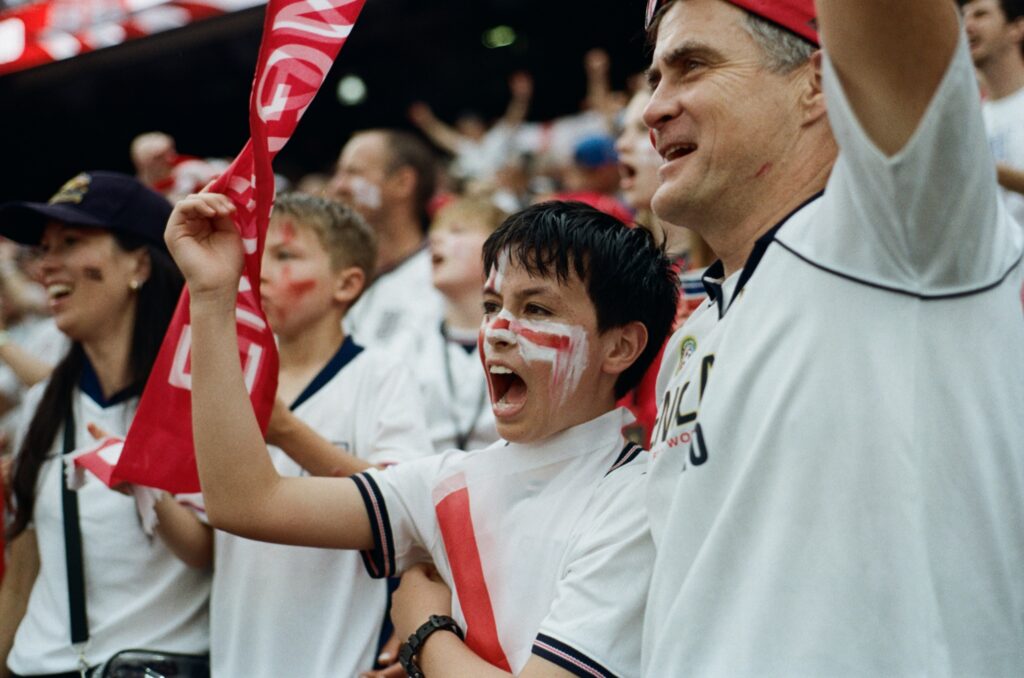
I paused during this moment to sing “Wonderwall” with all the England fans after their game against Panama. As a fan of English football, it was a moment I had fantasized about for quite some time. Right before the game ended, I went down to the concourse, and as soon as I heard them singing, I got emotional. I put the camera down and sang with them. Being close to the fans, I was still able to capture the joy on their faces, but at that moment, I wanted to prioritize the experience for myself.
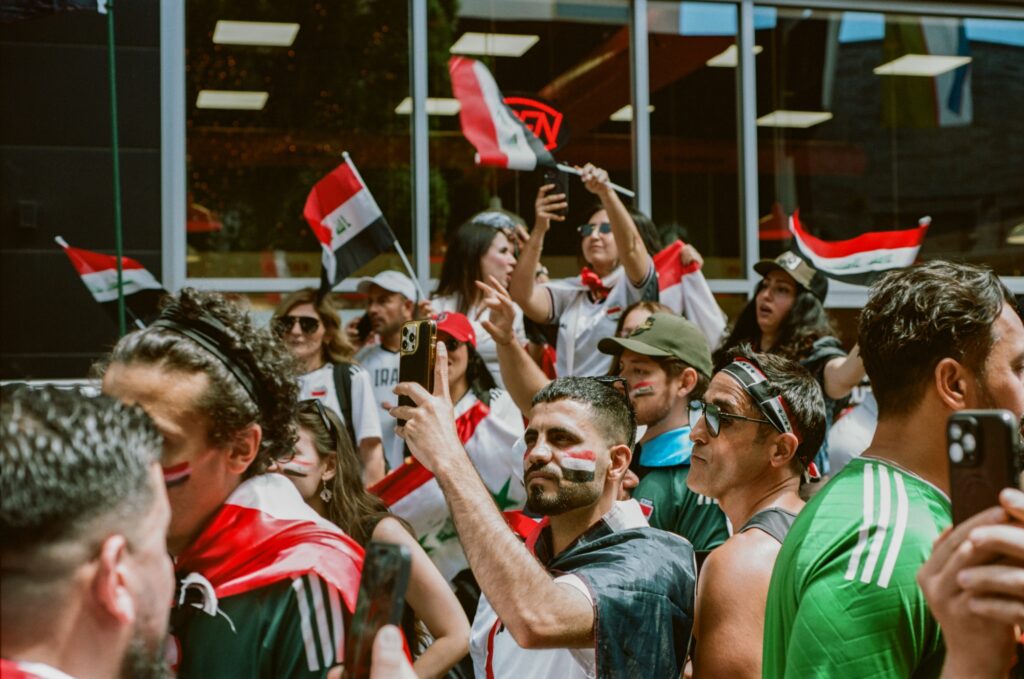
The World Cup is a battle between countries. It happens every four years, so it’s rare. There are rivalries, feuds, and controversies. But overall, I found it to be a celebration of soccer — like the Oscars for movies. There are winners and losers, but people are celebrating the sport. At the Boston game, Iraqi fans were dancing and singing because it was their first World Cup qualification in decades, and Norwegian fans — who’d also waited a long time to qualify — joined in and welcomed them. I wanted to document this World Cup in a way that, years later, someone could look at these images and know: This is from 2026, and this is in the U.S.
As told to Megan Cattel.