If someone had told me that the vast, well-funded propaganda machine of India’s Bharatiya Janata Party (BJP) would finally be rendered powerless by a bunch of kids, I’d have laughed at the absurdity of it.
Yet, here I am, witnessing a historic reckoning for the Indian government — and for Indian journalism — unfold before my eyes on Instagram Reels.
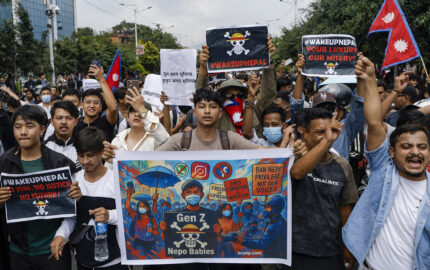
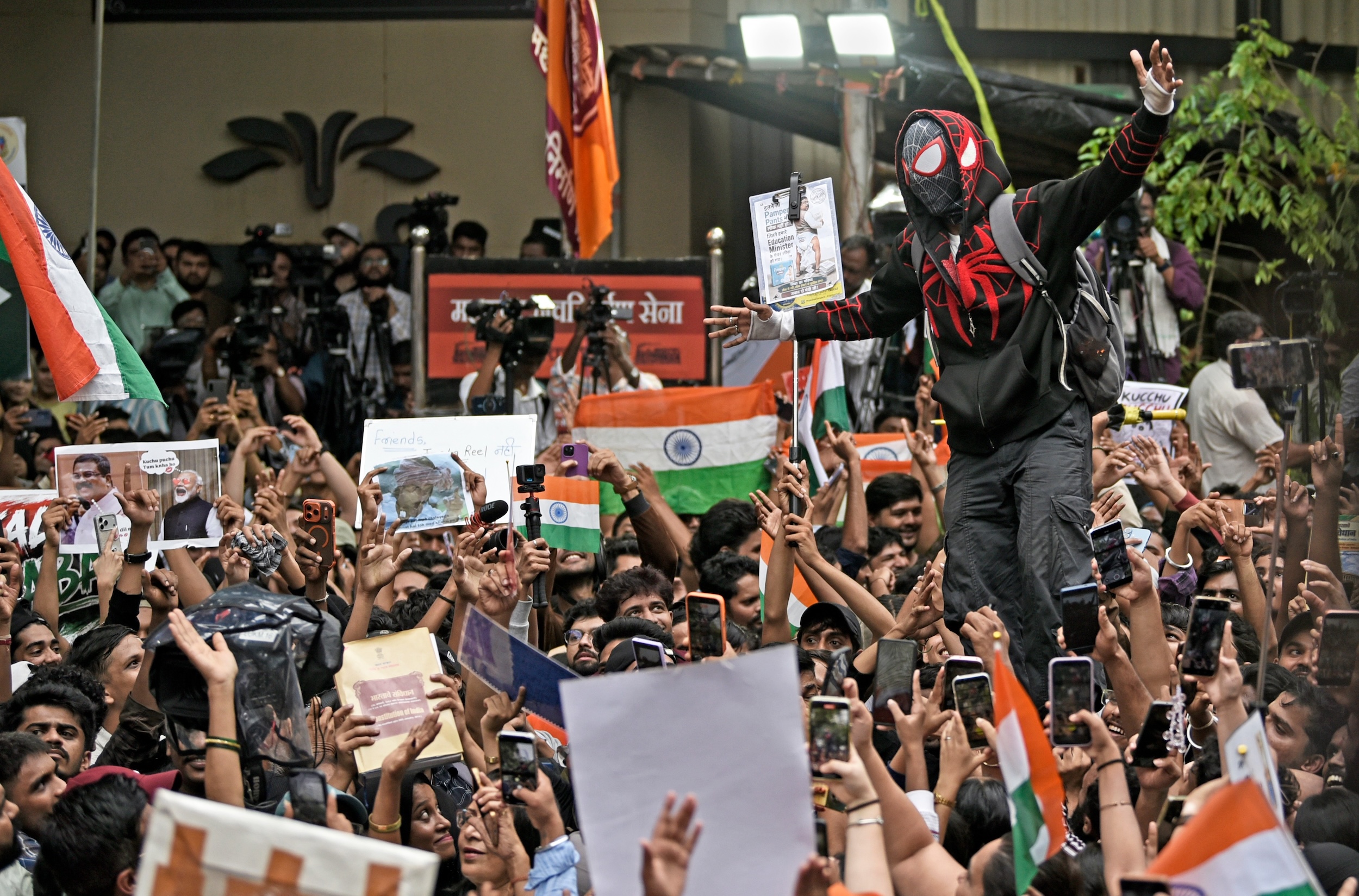
While youth-led protests are not new to India — and have erupted across Southeast Asia in recent years — the current student mobilizations in the country are the most significant since Prime Minister Narendra Modi came to power in 2014.
What began as a specific grievance stemming from a scandal that students uncovered in India’s educational testing system has quickly evolved into a broader critique of the government, and a powerful assertion of student agency. The sudden success of the movement has also revealed the changing nature of the mainstream media’s role in Indian society, and how ill-equipped it has been to cover these seismic societal shifts.
One of the most striking aspects of this growing discontent is the student protesters’ remarkable control over the narrative of their movement, and the way it’s being covered. If the government has been the primary target of the students’ wrath, the media — specifically pro-government television news channels — seems to be a close second.
For example, as tens of thousands of young people began a historic march to Parliament in New Delhi on June 20, a reporter from a right-wing news channel stood at the center of the bustling crowd, tightly gripping his microphone and waiting to deliver a live report. Before he could say a word, however, a protester pointed a camera phone at him and shouted: “Let’s hear what [he] is about to say. Then we, the public, will decide what to do with him.”
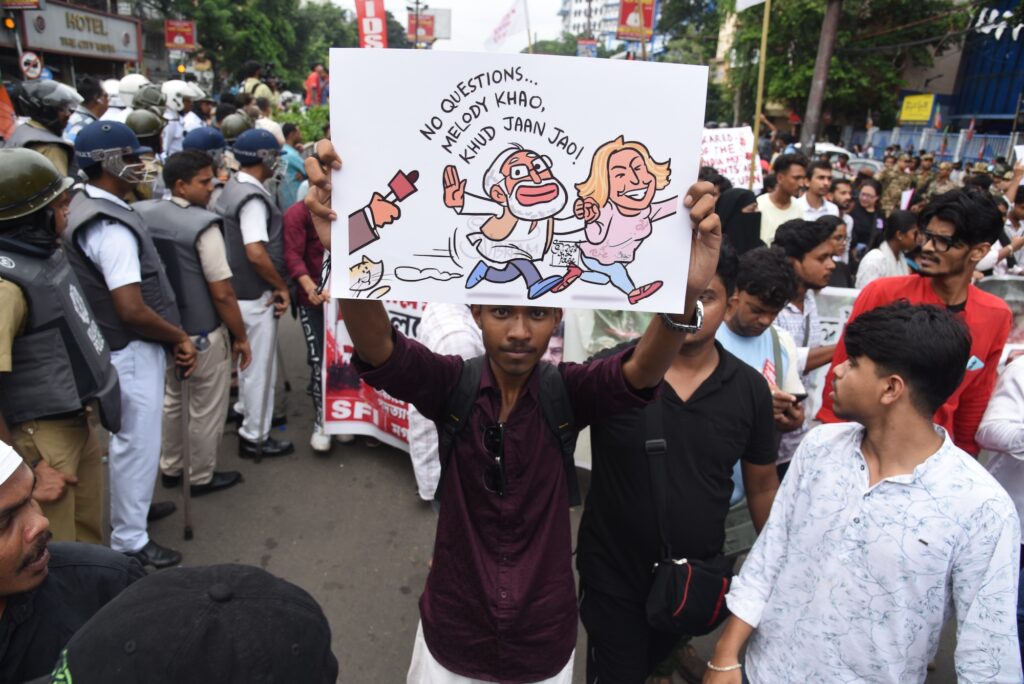
Throughout the month, small crowds moved alongside reporters, fact-checking them in real time. If their coverage was determined to be pro-government, they were escorted from the area amidst chants of “Godi media, hai hai!” (Down with the lapdog media!)
India, which was ranked near the bottom (151st out of 180) in the Reporters Without Borders 2025 World Press Freedom Index, boasts a massive media market of thousands of daily newspapers and 450 privately owned TV channels dedicated to news, most of them owned by close allies of Modi. Political “reporting” from these outlets is often a barrage of radical propaganda, casting the prime minister as a righteous leader beloved by the masses.
But the recent protests — organized by the youth-led, satirically self-named Cockroach Janata Party, or “the cockroaches” — are upending many standard political and societal conventions. The movement, which has deliberately decentralized leadership, is characterized by its ability to mobilize rapidly and at large scale, as well as by its mastery of social media and open hostility toward traditional right-wing media it views as having propped up Modi’s regime for too long. Reporters from these outlets suddenly find themselves being heckled, harassed, and shunned. Students at one protest site displayed a banner featuring photographs of the most recognizable prime-time TV anchors, their faces crossed out with red X marks, and the words: “India’s worst enemies, more dangerous than terrorists.”
Related Posts
Suhasini Haider, the diplomatic affairs editor of The Hindu — one of India’s largest independent newspapers — said that while there is never any justification for violence against journalists, the rising anger being shown toward partisan outlets is making those who work for them reflect on the consequences of their actions.
“For the first time, it has given them a pause,” Haider said of media outlets that support the Modi government. “The dangers of partisan reporting have come home for those journalists who didn’t face accountability for taking stands that were only in favor of the government. None of the earlier protests in recent years has managed this.”
In a departure from coverage of prior big stories, the most well-known television anchors from pro-government outlets stayed clear of the protests, with their outlets opting instead to send younger reporters. And many of the younger journalists covering the story have been careful to remove all visible signs of their station affiliations, like channel logos from their microphones, before entering the protest grounds.
Modi has long exerted tight control over the mainstream press and directed political discourse, using the BJP to build one of the world’s most formidable propaganda machines. The administration’s information ecosystem includes everything from television news channels that run coordinated pro-government campaigns to an extensive network of social media influencers on platforms like YouTube and even the messaging app WhatsApp.
These mass protests have shown that, for all its sophistication, the party’s media machine has a major blind spot: Instagram.
Within a week of creating an Instagram account in May, the Cockroach Janta Party had amassed 22 million followers. The BJP, by contrast, has around 8.7 million followers.
“Five years ago, people were scared to speak,” CJP founder Abhijit Dipke told NewsLaundry, a site specializing in critiques of the Indian media. Dipke added that this protest movement has been born of internet culture and built by digital natives. “People are no longer afraid. They say with pride that they support CJP. That is our biggest victory.”
Dipke, currently a student at Boston University, said organizers had been blown away by the viral internet response. After posting a Google Form on the social media platform X for people to formally register as party members, more than 350,000 quickly signed up. Dipke added that organizers were hoping the digital mobilization would translate into changes in real life too.
Modi had to get on Instagram and make his first “selfie video” in an attempt to reach students with his messaging. He also instructed his Cabinet to quickly become Instagram-savvy in order to connect with young people. Throughout the protests, the familiar tools at the government’s disposal — using TV channels to discredit protesters as “anti-nationals,” having pro-government journalists subject organizers to hostile questioning, or conducting false flag attacks — have failed as students have kept “establishment journalists” out of protest sites while using Instagram to get their own stories out.
This movement, largely led by members of Gen Z (those born between 1997 and 2012), sounds nothing like previous protests against the administration, for example, by farmers or Indian Muslims. The young cockroaches seemingly pride themselves on being ungovernable, using vocabulary filled with profanity and internet slang, and openly mocking Modi through rap songs, placards, graffiti, and a slew of insults. The ferocity of the current language would once seem unthinkable, breaking with a decade of strictly enforced reverential language being used to describe Modi’s carefully crafted political persona. He expects to be addressed as the “Honorable Prime Minister” and by the deferential honorific “ji” following his name.
So far, the right-wing news channels that long propped him up have found themselves to be suddenly irrelevant, and have failed to gain any control over the narrative.
“Godi [lapdog] media houses — not reporters, but editors-in-chief, billionaire owners, and anchors — need to understand that the youth has become politically conscious,” said Saurav Das, an investigative journalist who is a spokesperson for the CJP. “When the time is right, a tribunal will be formed, and the propagandists will be held to account for the crimes committed against India.”
These CJP-led protests feel like a defining moment of change in Indian journalism. The cockroaches have seemingly rendered India’s formidable propaganda machine superfluous. Suddenly citizens who can tell the difference between journalism that questions power and propaganda that amplifies it are taking matters into their own hands. As the mainstream media finds itself being forced to conceal its microphones or sneak around protests to try to get a soundbite — instead of its usual stance of loudly demonizing people to their faces — freelancers and independent journalists are suddenly getting hugged, thanked by protesters, and treated like heroes following more than a decade of repression. These once beaten-down journalists are now standing up taller and speaking without fear.
Suddenly citizens who can tell the difference between journalism that questions power and propaganda that amplifies it are taking matters into their own hands.
Ajit Anjum, a veteran journalist and former managing editor of India’s News24, who sought more editorial independence by starting his own YouTube channel in 2020, said prior protests in India had seen people turning to YouTube and independent media sources for information, but typically not members of Gen Z.
“Gen Z usually does not consume political content, but that has changed with this movement,” Anjum said. “The students broke this myth that they do not watch serious news. My videos got so many comments from first-time viewers. A huge segment of the population has joined us and supports us. This movement’s success was beyond my imagination. Street protests have won for the first time under Modi,” he said.
But the fight is not over yet. Parliament has come to a standstill. The government has begun its crackdown on these digital natives, and many of their accounts are being suspended. The Delhi Police have stepped up their monitoring of social media, and posts deemed offensive are being taken down by platforms at the request of the government. To borrow from newsroom jargon, we are in the middle of a “developing story.”
But the prevalent master narrative — of an omnipotent Modi as a revered leader of the masses — has been dealt a severe blow, and seemingly cast aside by a rising generation.
It feels like India is awakening from a malevolent spell, and trying to return to its forgotten, democratic form. Anjum noticed this change when, finding himself surrounded by self-described cockroaches at a protest, he heard one student telling others about the “enormous contribution” made to their movement by honest reporters. He watched as others nodded in agreement, some approaching to shake his hand or take a selfie with him.
He repeated several times: “We’re just ... we are only doing our job,” but his words were drowned out by a burst of applause.