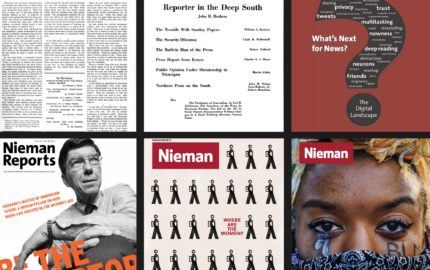
The Fall 2025/Winter 2026 edition of Nieman Reports represents the magazine’s final print issue as it transitions to an all-digital format. A combination of factors — many of which are affecting the wider media industry — has resulted in the move to online-only following a nearly 80-year run in print.
There’s much to think about and enjoy in this new print edition of Nieman Reports, and even more online. The issue examines challenges and trends in the news industry in the United States, France, Myanmar, Nepal, and Sudan, while our cover story looks at the evolution of Nieman Reports.
The same great journalism about journalism that readers have come to expect from the magazine will continue at niemanreports.org. In fact, it’s been appearing there for years already, including stories that don’t make it into print. Despite the changing format, our commitment to global media coverage remains as strong as ever.
You wouldn’t know it from the preponderance of headlines, but the world’s biggest humanitarian crisis is not in Gaza or Ukraine. It’s in Sudan, and it began in April 2023, when fighting broke out between the national army, the Sudanese Armed Forces, and its erstwhile ally, a paramilitary group called the Rapid Support Forces (RSF). The violence has consumed the country, with some estimates putting the death toll as high as 400,000, and with widespread rape and looting, 12 million people displaced, and 25 million facing hunger.
“I don’t think I’ve ever seen as big of a disconnect between the scale of a crisis and the scale of media coverage in my life,” said Tom Perriello, who was U.S. special envoy to Sudan in the last year of the Biden administration. “And that is both because the scale of the suffering in Sudan is so high and because the [media] coverage is abominably low.”
An assault in late October on the city of El Fasher, where eyewitness accounts suggest that RSF fighters massacred thousands of civilians, received some attention. But that only underscored the extent to which the international media has neglected Sudan’s war as newsrooms struggle financially, and wars in the Middle East and Eastern Europe — places of greater strategic importance to the West — consume much of the world’s bandwidth when it comes to human misery.
There was a time when Sudan routinely made headlines. Two decades ago, up to 300,000 people in the Darfur region of western Sudan — most of them from Black non-Arab villages presumed to support local rebels who had taken up arms against an oppressive government in Khartoum — were killed by militiamen allied with the army and government forces, or died from hunger or disease. Human rights advocates — even the U.S. government — called it a genocide. The violence drew the attention of U.S. activists, politicians, and Hollywood celebrities, notably George Clooney. “Save Darfur” signs began appearing in front yards.
The situation today is arguably worse. But the narrative that Sudan is barely being covered eclipses the important role that Sudanese journalists — at least 32 of whom have been killed in the current war — have played for decades as they struggle to let the world know what is happening in their homeland.
“I don’t think I’ve ever seen as big of a disconnect between the scale of a crisis and the scale of media coverage in my life, and that is both because the scale of the suffering in Sudan is so high and because the [media] coverage is abominably low.”
— Tom Perriello, former U.S. special envoy to Sudan
A global story made personal
I grew up hearing about Sudan from my parents. It was their homeland, and in their telling a place of vast beauty and vast potential. In the 1970s, they moved to the United States — where I was born and spent much of my childhood — so my father could attend graduate school.
He loved to remind me that Sudan was the biggest country in Africa and had enough farmable land to become a breadbasket of the world. On yearly family visits, we would relax on the banks of the Nile and take in museum collections of ancient artifacts. Little of the Sudan I knew appeared in mainstream news coverage, which was understandably dominated by urgent stories about famine and war and usually failed to probe beyond sweeping generalizations of “African” against “Arab” or “Christian” against “Muslim.” If my non-Sudanese friends had even heard of Sudan, it was thanks to “We Are the World,” the 1985 single recorded to raise money for famine relief in Africa.
I had just graduated from high school when Omar al-Bashir took power in 1989 in a coup. Reliable information became much harder to find as his dictatorship cracked down on the press. State-owned media dutifully delivered mundane government announcements while independent or opposition media outlets became targets for harassment, censorship, and arrests.
Many Sudanese journalists went into exile, and as the internet took off in the early 2000s they began to establish independent media outlets that focused on Sudan from abroad. The Sudan Tribune, an online publication with editions in English and Arabic, is edited from Paris. SudaneseOnline.com, which is put together in Arizona, became a trusted source for news and analysis. The Ayin Network, based in Nairobi, sought to provide deeper coverage of violence in the Nuba Mountains with support from development agencies and pro-democracy institutions in Europe and the United States — and later expanded its coverage to all of Sudan.
At the same time, the advent of regional Arabic-language satellite TV channels — Doha, Qatar-based Al Jazeera, and Saudi-owned Al Arabiya and Al Hadath — offered another source of news about Sudan. The networks weren’t above criticism or immune from state repression, but they were far more trustworthy than state-controlled media and attracted tens of millions of viewers in the Middle East and North Africa.
I eventually became a journalist and in 2007 moved to Khartoum to put my knowledge of Sudan to use and try my hand as a freelancer. There were only a handful of Khartoum-based correspondents for English-language media. The plan was to stay four months. It turned into eight years. Bashir’s government made it difficult for journalists to travel freely or even take photographs in public.
I left Sudan in 2015 to pursue a graduate degree. Four years later, Reporters Without Borders ranked Sudan 175th out of 180 countries in its annual World Press Freedom Index.
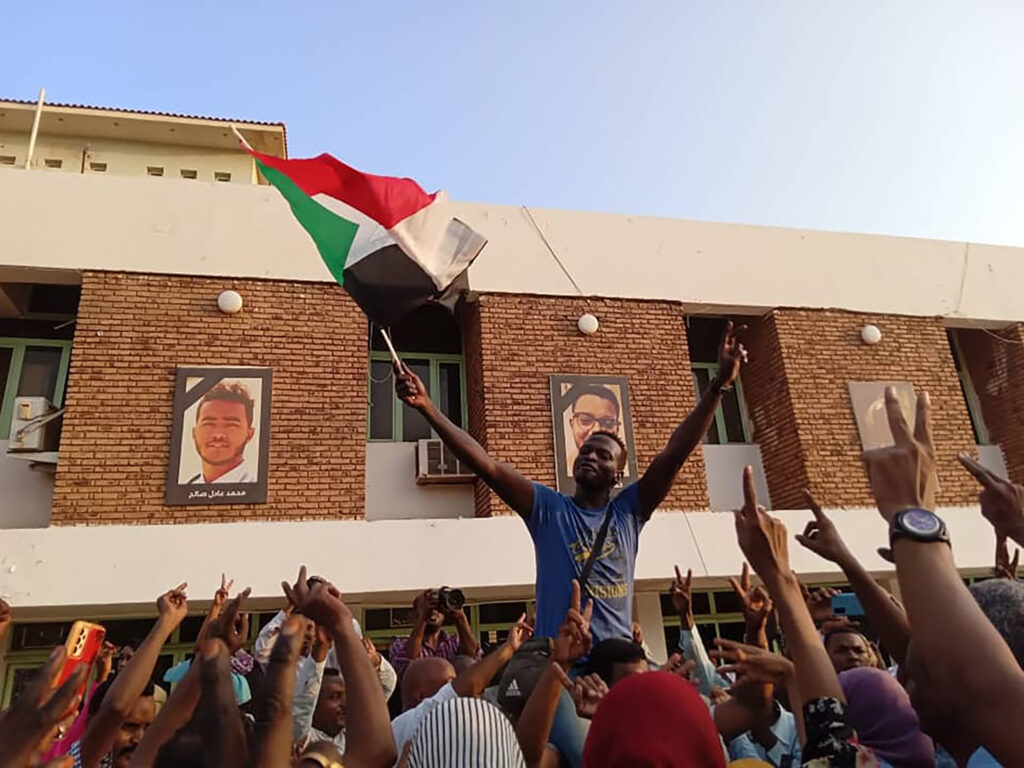
But that April, the nonviolent protests that became known as the Sudanese Revolution, and the collapse of the dictatorship, opened a new era of hope for the country — and for its press. With Bashir on trial for the 1989 military coup, a transitional government announced that democratic elections would be held in about three years. State-owned media began covering local protests and airing debates over topics that were once off limits, such as establishing diplomatic ties with Israel.
“It was a win for journalism,” said Shamael Elnoor, a former columnist for the independent Al-Tayyar newspaper who once was forced to leave the country after Bashir’s uncle accused her of blasphemy.
Then, on Oct. 25, 2021, the military took over the government in a coup. Journalists were arrested. “The next day they raided our office, broke the doors and some equipment,” said Elhag Warrag, the founder of the independent Al-Dimuqrati newspaper.
When I went back to Sudan in April 2022 to work on a research project and a memoir, internationally brokered negotiations were underway between the military and civilians. That August, the Sudanese Journalists Syndicate, an independent trade union that had been banned under Bashir, was revived along with hopes of greater protections for the press. But bigger problems loomed: The alliance between the country’s top two military leaders — the heads of the army and the RSF — was starting to fall apart.
The war begins
On the morning of Saturday, April 15, 2023, I was in my studio apartment in downtown Khartoum getting ready to shop for the Eid al-Fitr holiday when I heard rapid gunfire. From my balcony, I could see government vehicles racing down a one-way street in the wrong direction. I videoed what I could with my iPhone and posted it on Twitter (now known as X). Fighting between the Sudanese army and the RSF had begun.
“This is the worst-case scenario,” I explained in an interview with Sky News. A network from India wanted to interview me over Skype with the city visible behind me. But with rumors of snipers in my neighborhood and no protective gear, I decided it was too dangerous.
Soon the electricity cut off and internet service was flitting in and out. With a laptop and two cellphones barely charged, I had no choice but to turn down more interview requests. I needed my phones for urgent communications. I spent the next nine days trapped in my apartment building with 31 people. We finally managed to leave after negotiating with RSF fighters outside. I made it to another part of town and eventually by bus across the border into Egypt.
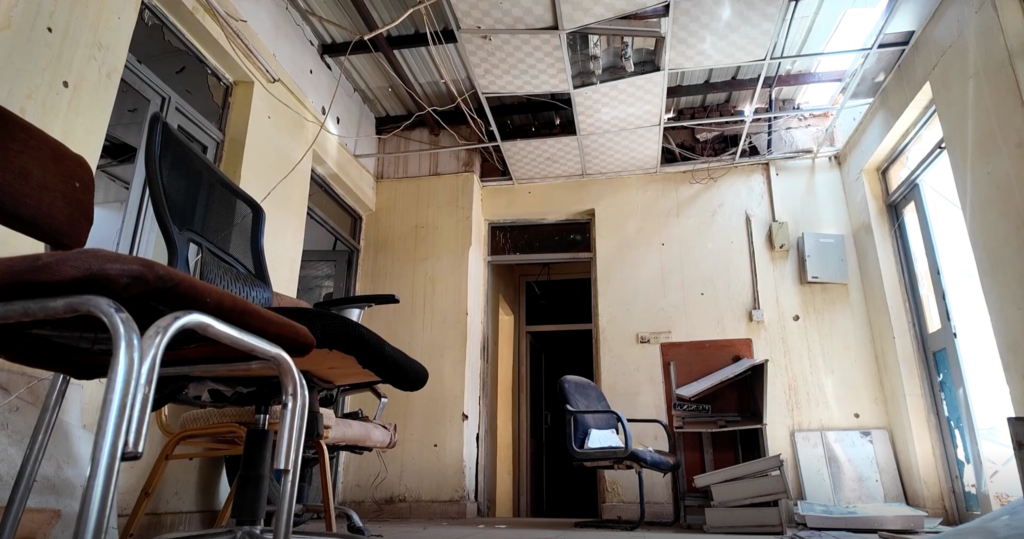
Across the Sudanese capital, RSF fighters were occupying, looting or destroying media offices. The morning the fighting began, they stormed the offices of Sudan TV and cut short a live broadcast.
Sabah Mohammad Al-Hassan, a 35-year-old columnist with the independent newspaper Aljareeda, was trapped alone at her family’s home in a Khartoum suburb. She managed to publish a column online the day the war broke out, arguing that the army and the RSF both bore responsibility for the war. The headline: “Stop! You both lose!”
“I wrote my opinion from the first day,” she told me. For the next two months, she continued to write from home, surviving on lentils, chickpeas and rice and barely venturing outside. Finally RSF soldiers who had raided the neighborhood arrived at her door and forced her to leave.
She fled to her family’s ancestral town of Shendi, a three-hour drive north, and continued to publish columns. Then one day she was watching state-owned television when she heard her name in a long list of civilian leaders and some journalists wanted by the army for allegedly supporting the RSF. She escaped concealed under a long abaya, eventually making it to Egypt to continue her work.
Hundreds of Sudanese journalists have found themselves displaced or jobless. Some media outlets relocated to Port Sudan along the Red Sea, where top leaders and staff of the Sudanese army regrouped to form a de facto government.
The army briefly detained three journalists from the Sudan Tribune, whose offices were looted, and the RSF expelled two of its correspondents from territory it held in Darfur. Of its 14 Sudan-based reporters, five wound up relocating to Cairo or Kampala, Uganda. Journalists from many other outlets did the same.
New independent media outlets also emerged, including Atar Magazine, which attracted attention with articles that captured the desperate voices of ordinary people trapped in the fighting. The Sudan War Monitor, a collaboration of volunteer journalists and open-source researchers who gather intelligence, pieced together stories by analyzing cellphone videos, GPS data and other digital sources. “We knew no one was going to cover [the war],” said Alsanousi Adam, a journalist with the team. Among his publication’s biggest scoops was a video that showed army intelligence officers executing detainees and bragging about it to each other.
A battle on many fronts
One major challenge for Sudanese journalists has been countering a flood of misinformation and propaganda — much of it propagated by the RSF or the Sudanese military. Both sides publish websites, PDF newspapers and social media posts. The army uses the hashtag #ma’rakat al-karama, which means “battle of dignity,” on X, Facebook and Telegram. The RSF uses #ma’rakat al-dimuqratiya, or “battle for democracy.” “Both sides in the conflict have actively conducted propaganda campaigns, deliberately embedding misleading and false information into their messaging to strengthen their respective narratives,” said Nihal Abdellatif, a project coordinator at Beam Reports, an independent fact-checking organization that was founded in 2021 in Khartoum but relocated to Nairobi, Kenya, during the war. “We have witnessed new and increasingly sophisticated forms of disinformation that spread faster and are more challenging to verify, notably the use of AI.”
In another effort aimed at shooting down propaganda, a group of journalists representing 20 Sudanese independent outlets formed the Sudan Media Forum. The leader of the initiative, Kamal Elsadig, who is also the editor of Radio Dabanga, a Sudanese news organization based in Amsterdam, described it as “an alliance to support and develop media and defend press freedoms, peace, and democracy and counter hate speech, misleading information, and disinformation.”
It’s a tall order. “Ninety percent of Sudanese media institutions have been damaged or completely destroyed,” the Sudanese Journalists Syndicate concluded in a report in April. The group recently said that 32 journalists have been killed since the beginning of the war and that many others have been assaulted, detained, tortured, or kidnapped. One victim was Sudan Bukra correspondent Halima Idris Salim, who was run over by an RSF vehicle while reporting on dire conditions at a hospital in the city of Omdurman. Another was freelance columnist Yahya Hamad Fadlallah, who was arrested for allegedly collaborating with the RSF and tortured and denied medical treatment. In October 2025, RSF fighters abducted and detained a stringer for Al Jazeera in El Fasher, Muammar Ibrahim, claiming in a social media video that it was investigating the journalist’s “biased” reporting.
Compounding their pain, Sudanese journalists say it often feels like nobody outside their country is watching. In April, 10 Sudanese reporters still in the country published a letter in the French daily Le Monde. They wrote: “We, Sudanese journalists, call for an international mobilization to support those who inform you from inside the country — at the risk of their lives — whether on the frontline or in forced exile.”
Compounding their pain, Sudanese journalists say it often feels like nobody outside their country is watching.
International media struggles
In the early days of the war, regional and international news organizations were forced to improvise like everybody else.
Many Arabic-language outlets had correspondents in Sudan, but most were holed up in a building in south Khartoum, where wide-angle shots of the city taken from the rooftop could capture only a small portion of the violence. Al Arabiya/Al Hadath hired Al Migdad Hassan, a pharmacist with some journalism training who happened to live in an area that other reporters could not reach. “Khartoum was chaotic in the early days of the war, and my first live broadcast was from a cellphone held by a friend,” he told me. “Without much experience in the beginning there was fear but then I started to get enthusiastic about covering risky assignments.”
In November 2023, Al Jazeera Mubasher, the network’s C-SPAN-like channel, launched a daily hourlong program called “al-Harb al-Mansiya” (The Forgotten War) that included a daily summary of events and live discussions with politicians and commentators across the Sudanese political spectrum. Anchor Ahmed Taha, an Egyptian, has become a favorite among Sudanese viewers for his willingness to challenge his guests with difficult questions. In a typical post, one X user said: “People in Sudan watch Ahmed Taha in clubs like they’re watching soccer.”
As for global media outlets, several with Arabic-language divisions managed to provide some coverage. DW Arabic launched al-Sudan al-An — (Sudan Now) — in 2023, and BBC News Arabic dedicated an emergency shortwave radio service to news about Sudan.
Foreign journalists had few options for entering Sudan. One possibility was to cross the border from Chad into territory held by the RSF, but heavy fighting usually made that too dangerous. Many more attempted to enter through Port Sudan, which was controlled by the army, only to be denied visas.
That gave Yousra Elbagir, a Sky News correspondent based in Johannesburg, what she called a “homecourt advantage” over her competitors. A citizen of both Britain and Sudan — and therefore free from the visa requirement — she became the first Western journalist to report from the ground for an English language media outlet. She got in through Port Sudan and persuaded military authorities to let in her team as well. She had already covered the evacuations of foreign nationals from Sudan to Djibouti and on to Jeddah, where she unexpectedly ran into her uncle and hugged him during a live broadcast. From inside Sudan, she embedded with the army and recorded footage of the destruction of the old Omdurman souq and reported from her family’s ransacked house.
Other outlets tried to keep up with Elbagir, but in truth, hopes that Sudan would finally receive the attention it deserved were doomed nearly six months into the war, with the Oct. 7 Hamas attack on Israel. In the fall of 2023, coverage of Sudan dipped significantly. “The ‘forgetting’ of Sudan is less about oversight and more about hierarchies of visibility in global and regional media ecosystems,” said Hussein AlAhmad, an assistant professor of media and communication at the Arab American University in Ramallah and an expert on media coverage in the Arab world. “In terms of news value, unlike Ukraine or Gaza, Sudan exists in a liminal space.”
“The ‘forgetting’ of Sudan is less about oversight and more about hierarchies of visibility in global and regional media ecosystems.”
— Hussein AlAhmad, assistant professor of media and communication at the Arab American University in Ramallah
That December, Sudan experts Alex de Waal and Abdul Mohammed published an opinion piece in The New York Times with the headline: “The War the World Forgot.” It lamented the poor media coverage of Sudan and argued that the United States risked becoming a silent witness to genocide.
Three months later, in March 2024, the Sudanese army regained control of the Sudan Radio and Television offices in Omdurman and began granting more visas to foreign journalists. They included reporters from BBC News Arabic, The New York Times, The Washington Post, The Wall Street Journal, PBS News, CBS and The Atlantic.
Embedding with the military became the surest way for journalists to travel in Sudan. It wasn’t ideal, since the military controlled what reporters could see. But at least the outside world was paying more attention. Many of those trips were arranged by Lt. Col. Hassan Ibrahim, who handled foreign media requests for the army. He was killed in an RSF drone strike in March along with another military reporter and four Sudan TV crew members as the army was retaking the presidential palace. “Col. Hassan was a kind, vibrant man who loved Sudan & kept us safe while reporting,” Leila Molana-Allen, a correspondent for the “PBS News Hour,” posted on X.
Coverage by U.S. public media outlets has suffered since the Trump administration and Congress cut funding. In March, two journalists from Voice of America who had just spent two weeks reporting in Sudan received notices that they were being put on administrative leave, because the Department of Government Efficiency was dismantling the U.S. Agency for Global Media, which includes the network. “We have this rich material and can’t use it now,” one of the journalists told me. The elimination of the agency also ended funding for Bayn Nilein, or “Between Two Niles,” a weekly program about Sudan that aired on Alhurra, which is owned by the U.S.-based Middle East Broadcasting Networks.
Since leaving Khartoum, I have followed events and media coverage closely. I’ve written about the war and spoken on panels about it in hopes that more people will learn what is happening. Despite the efforts of Sudanese journalists working against enormous odds, there remains much to report on. “I think only 10% of this war has been covered,” Mohamed Eltayeb, a Sudanese journalist who has worked for various Arabic satellite TV stations, told me.
It all makes me wonder: If one of the greatest humanitarian crises ever recorded doesn’t warrant robust media coverage, well beyond what local reporters can provide, what does?