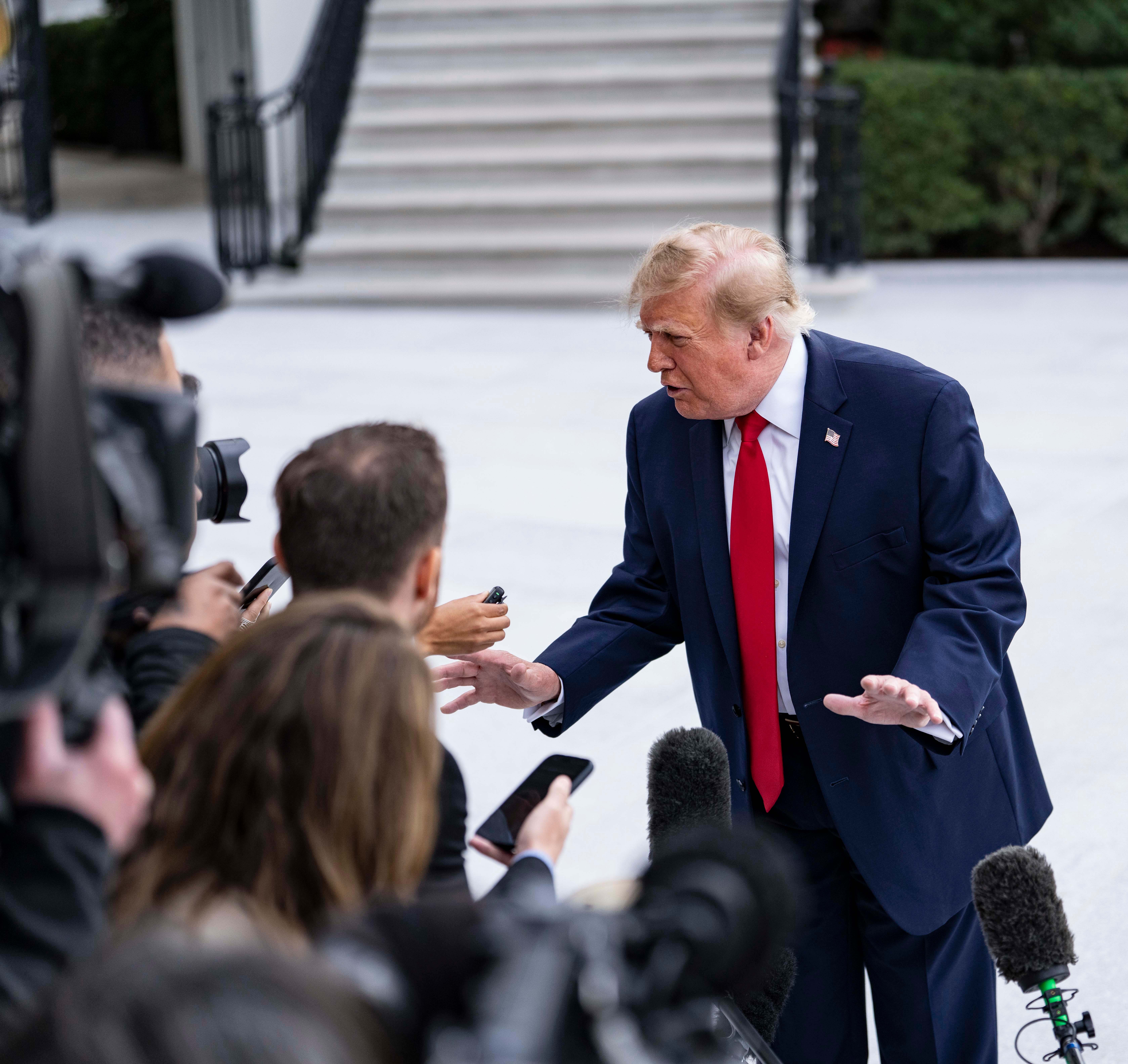
The Trump administration’s latest attacks on the news media have followed a familiar pattern: President Donald Trump lashes out at news outlets for perceived bias and follows up with restrictive actions that appear blatantly unconstitutional; a judge’s ruling follows, temporarily halting the actions; and the administration pivots and pushes ahead with other restrictions.
This time it was the removal of three outlets — CNN, MS NOW, and Politico — from White House press access in September. After the groups sued, and U.S. District Judge Timothy Kelly issued a temporary restraining order restoring their access on Sept. 24, the administration barred CNN and Politico from providing pool coverage on trips outside Washington. Kelly issued a longer, preliminary injunction on Oct. 14, halting the administration from blocking the news organizations’ access to the White House while the case proceeds.
Meanwhile, in another escalation involving TV pool coverage of the White House, the Justice Department announced Oct. 9 it was investigating the major news networks for possible federal antitrust violations after they briefly suspended all pool coverage of the president in protest of CNN being excluded from the pool.
Legal precedent appears to be in the news organizations’ favor — aided, perhaps, by the administration’s own arguments in court.
In its initial legal documents, the White House contended the reporters for CNN, MS NOW and Politico were removed because they were a national security threat, an argument the judge rejected in his short decision. He wrote, “Defendants offer little to back up their asserted national security interest to justify revocation of Plaintiff’s hard [press] passes.”
Lucas Powe, a legal historian and University of Texas law professor, said the president made it clear in his public statements that the restrictions were viewpoint-based, meaning they were generally unconstitutional rationales based on the president’s preferences, rather than the result of national security concerns.
“I’ve never seen any flesh on his argument that it was a national security issue,” he said. “I was just thinking, it’s so unjustified, a flat-out viewpoint discrimination.”
Kelly, in his Oct. 14 ruling, was more explicit about the First Amendment concerns surrounding the White House access bans and Trump’s statements.
“His comments are more than enough to show a likely causal link between Plaintiffs’ protected First Amendment speech and his revocation of their hard passes,” he wrote.
As the news organizations continue to seek a permanent court order blocking the government from restricting their access, the president has remained committed to his argument. Trump told Time magazine in a late-September interview, “I do respect the free press, but I don’t respect fake news.”
To push back against access limitations, news organizations have leaned on the clear case law supporting their rights and prepared to press for access, including documenting violations.
Nicole Ligon, a law professor at Campbell University who studies media rights and worked on press access cases as an attorney, said Judge Kelly’s decisions to block the White House’s effort to revoke press access followed a series of D.C. federal court cases that have established that news organizations must be given clear reasons, which cannot be viewpoint-based, when seeking to limit their access.
Members of the press who have White House credentials are understood to have a “liberty interest” in those credentials, Ligon added — meaning the journalists generally have a constitutional right to act without government limitations. Ligon pointed to the decision in Sherrill v. Knight, a 1977 federal case, which established that the White House cannot revoke a press pass without following an established process, providing compelling reasons, and allowing the journalist to respond.
“The D.C. Circuit is very clear, and they have to follow the Sherrill precedent,” Ligon said. “You’re going to get the same answer consistently with that.”
The precedent is primarily based on the Fifth Amendment’s due process protections, though the requirement that the administration provide a compelling reason includes First Amendment limitations on viewpoint-based restrictions. It was established when Robert Sherrill, a congressional reporter for The Nation, was denied a White House press pass in 1966 with no explanation (and no written notice). It wasn’t until several years later when, in a response to a Freedom of Information Act request, it was revealed that he was considered a security risk because he’d been arrested for assault in Florida. “Notice, opportunity to rebut, and a written decision are required because the denial of a pass potentially infringes upon first amendment guarantees,” the court wrote at the time.
The Sherrill findings were reinforced in Karem v. Trump in 2019, in which the judge reinstated Playboy correspondent Brian Karem’s pass when his White House access was withdrawn without process after he had a verbal altercation with Trump aide Sebastian Gorka at a press event. The court stated the White House failed to provide fair notice and the suspension conflicted with Karem’s First Amendment rights.
The court’s ruling quoted a statement from the longtime former television journalist Sam Donaldson arguing that while the existing White House press pass system had been in place for decades, no president or their staff had ever threatened to revoke or suspend his or any other journalist’s hard pass “because of alleged misconduct during a press conference or other press event until President Trump took office.”
CNN reporter Jim Acosta’s White House access was revoked in November 2018 after a heated exchange between himself and Trump during a press conference. Acosta asked Trump questions about his immigration policy and the special counsel’s investigation into Trump’s 2016 presidential campaign, refusing to hand over the microphone after the president declined to answer and called on another reporter.
The White House provided Acosta a letter explaining why his access was barred. Still, Kelly, the same judge overseeing the current case, ordered the White House to restore Acosta’s access.
Similar access rights were upheld when Defense Secretary Pete Hegseth revised press credential requirements for the Pentagon in January 2025. The new policy required journalists to sign a document pledging they would not report information that was not authorized by the Pentagon. Nearly every news organization refused to sign and lost access to the Pentagon. A federal judge ordered the Pentagon to restore press access last spring, and the government responded in June by closing the building’s press offices altogether and declaring them a classified area.
By closing the press area, Hegseth avoided First Amendment concerns that arose in the White House access ban last month because the government wasn’t favoring some journalists over others.
Mark Feldstein, a former investigative journalist for CNN and ABC who is a broadcast professor at the University of Maryland, said these access precedents are in place for good reason.
“The reason the press has access is not because the press is a special interest that gets special privileges,” he said. “It’s because we’re the conduit to the public. We’re the eyes and ears of the public, and when Trump restricts access to these federal buildings, he’s restricting the public right to know.”
“The reason the press has access is not because the press is a special interest that gets special privileges. It’s because we’re the conduit to the public. We’re the eyes and ears of the public, and when Trump restricts access to these federal buildings, he’s restricting the public right to know.”
— Mark Feldstein, broadcast professor at the University of Maryland
The Associated Press was removed from access to Air Force One and the Oval Office in February 2025, though it retains White House press credentials. The AP lost its privileges because it declined to acknowledge Trump’s renaming of the Gulf of Mexico as the Gulf of America, a viewpoint-based restriction. Initially, a federal court reinstated the AP’s access; however, a federal appeals court allowed Trump’s ban to take effect in June 2025, and it has remained in place as the case continues.
In a departure from precedent, and speaking specifically about spaces like the Oval Office and Air Force One, Circuit Judge Neomi J. Rao argued that “the White House therefore retains discretion to determine, including on the basis of viewpoint, which journalists will be admitted.”
The White House has used Rao’s reasoning in the ongoing Associated Press access case to justify blocking CNN and Politico from access on Air Force One during the president’s recent travels. The decision allows that in the special circumstances of Air Force One or the Oval Office — both small spaces with limited room — individual news outlets can be blocked from entering, at the president’s discretion, while still retaining their White House access.
Ligon, the law professor, said news organizations that lose access should continue to press for it. Whether they have been blocked or not, they should document every single time action is taken against their organization or the media, including viewpoint-based attacks, “so, you have some kind of evidentiary record.” She added that in addition to keeping a record of their efforts and rejections, they should seek alternatives, like day passes or credentials for specific events. And when news organizations lose access, they should demand a reason for any threatened exclusion in writing. “I would just keep going,” Ligon said. “I wouldn’t just stop, so that you could show evidence that this person actually wants access.”
These records can help build a case if the government restricts access in the future. Powe, the University of Texas law professor, said such paper trails might be needed since this administration has been more restrictive than those in the past.
“If I were going back in history, attacking the press, every president does [it], but most don’t do anything about it,” Powe said. “When you’re revoking CNN’s credentials, you’ve reached a ‘wow’ level.”