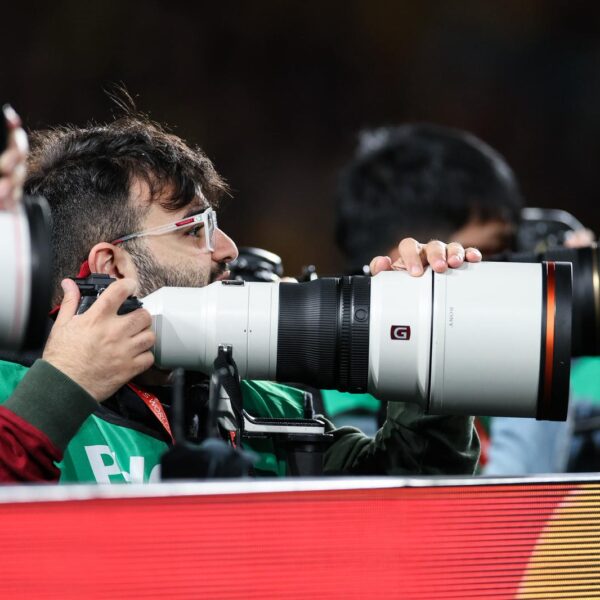
At the age of 26, Iranian photojournalist Sajad Imanian has already covered several international sports events such as the Olympic Games and past World Cup soccer tournaments. He hardly expected his nationality would haunt him six years after leaving Iran to live in Australia, where he is working as a social media specialist with the Asian Football Confederation.
An independent journalist, Imanian applied for a U.S. visa to cover the 2026 FIFA World Cup, co-hosted by the United States, Canada, and Mexico. When his appointment came up at the U.S. Consulate General in Sydney, he found himself being questioned over his Iranian military conscription status and possible trips to Lebanon and Gaza in an interview that took almost an hour.
“I said I hadn’t even set foot in those places,” Imanian said.
The Sydney-based photojournalist’s visa application to cover the games for the AFC was rejected because of his national origin, and his story is not an isolated case. Several Iranian reporters who were planning to travel to the United States to cover the World Cup and follow the Iranian national team’s journey hit the same barrier: Trump administration travel restrictions affecting the nationals of World Cup participating nations Iran, Haiti, Senegal, and the Ivory Coast. Exemptions exist for athletes, team staff, and immediate family members, but they do not extend to fans or media.
These waivers, however, were not offered to the Iranian side whose three group stage matches in Los Angeles and Seattle were held under taxing conditions. The team’s original base was moved from Tucson, Arizona, to Tijuana, Mexico, before the tournament kicked off. The U.S. government didn’t allow the Iranian players to stay in the host city for post-match recovery and demanded that they immediately fly back to Mexico after each game. Fifteen team officials, including two analysts and a media manager, were never granted U.S. visas.
The visa problems have been described as unprecedented in sports journalism by press freedom groups. The International Sports Press Association (AIPS) raised formal concerns in a June 6 letter to FIFA, soccer’s governing body, warning of what it called a “long-standing and unacceptable problem” for journalists covering the tournament. AIPS president Gianni Merlo wrote that the organization was seeing “the denial of entry visas to regularly accredited colleagues,” citing “many cases” involving Iranian and African journalists. Some reporters, he added, had been issued single-entry visas — meaning that, after once entering the U.S., if they traveled to Canada or Mexico to follow their teams, they would be unable to reenter the United States.
“The cases are countless and, I repeat, unacceptable,” Merlo wrote.
Imanian contrasted his U.S. visa interview with his experiences covering sports events held in Europe, where, despite stringent visa requirements for Iranian citizens, he wasn’t even required by the host countries to apply for a visa.
“The 2024 Paris Olympics and 2026 Winter Olympics in Italy were both, of course, in Europe, and I am an Iranian citizen,” Imanian said. “They’d send us an invitation letter on letterhead that I’d use together with my Iranian passport, and that would be my travel authorization.”
“If you’re covering the Olympic Games, you present the invitation or ID card at the airport. The airlines recognize that letter, and the immigration officials recognize it, too,” he added.
The Committee to Protect Journalists (CPJ) said the situation reflects broader concerns about press access and safety amid heightened immigration enforcement in the United States, and noted that journalists have faced a range of risks while covering major sporting events. The 2026 World Cup presents “an unprecedented combination of heightened immigration enforcement and legal uncertainty that could affect journalists' ability to enter, remain in, and report from the U.S. as one of the host countries,” a CPJ spokesperson told Nieman Reports. The concern was serious enough that the CPJ published pre-event legal and safety guidance specifically for the World Cup.
Hatam Shiralizadeh is an Iranian sports reporter for the Tasnim News Agency. He watched Iran’s matches — and the team’s elimination — from Tehran, where he is based. He said he is one of more than 20 reporters who were supposed to travel with Iran’s national team but were never granted a U.S. Embassy appointment in Ankara, Turkey, where “Team Melli” — a nickname for Iran’s soccer team — was holding a training camp. These reporters had requested their visa appointments through the Iranian football federation.
“To cover the World Cup, all reporters require FIFA accreditation, which we received, but since we were ignored by the U.S. officials, we missed the opportunity to report on the event,” Shiralizadeh said.
"FIFA didn’t take any steps to help us,” Shiralizadeh said. “It was only the International Sports Press Association that made some efforts to resolve the situation, but it didn’t succeed.
After Iran’s opening match against New Zealand on June 15, Amir Ghalenoei, the team’s head coach, told reporters: “Our team is the most oppressed one in the whole World Cup. Our federation isn’t here, our media isn’t here, our management isn’t here.”
A U.S. State Department spokesperson told Nieman Reports that Presidential Proclamation 10998 suspends entry and visa issuance for most Iranian nationals, while allowing certain categorical exceptions and case-by-case waivers. The spokesperson said each visa application is reviewed individually under U.S. law following “rigorous review and thorough vetting.”
For Imanian, the immigration restrictions blocking Iranian-born journalists and fans from participating in the World Cup means the event has lost its enthusiastic energy.
“There will be negative impacts on our work,” Imanian said. “As someone who covered the 2022 FIFA World Cup through the final match … I don’t see this World Cup being nearly as appealing or exciting. In layman terms, it doesn’t give the audience that good vibe.”
FIFA did not respond to Nieman Reports’ request for comment.