
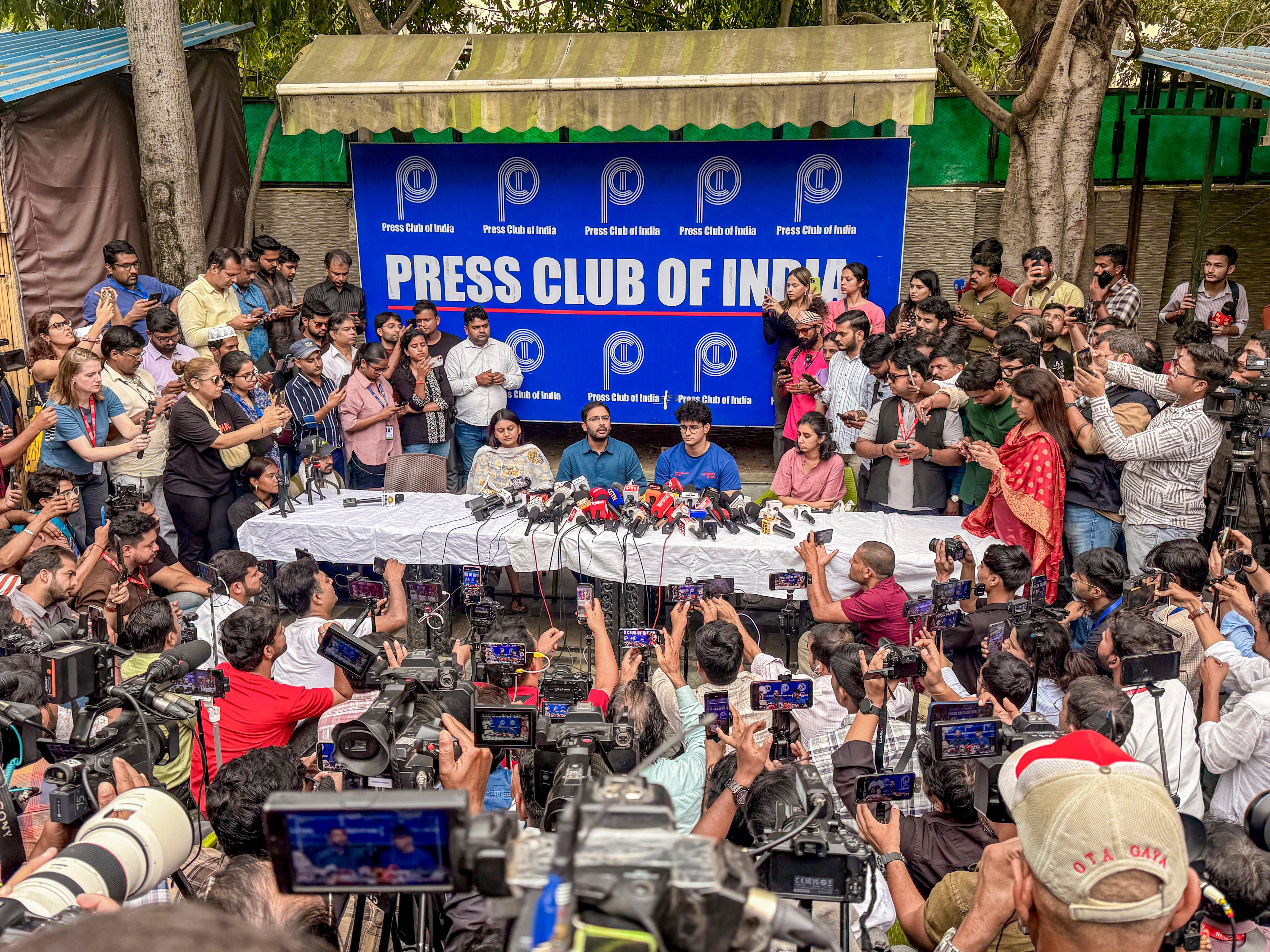
As protests continue across India over allegations of government corruption, dozens of members of the media have been subjected to arrest, detainment and assault, according to witnesses, press rights organizations, and the journalists themselves.
Thousands of protesters have taken to the streets of New Delhi in recent weeks, demanding the resignation of election officials allegedly tied to the deletion of nearly 130 million names from voter registration rolls. The protests — which have largely been organized by the Cockroach Janata Party, so named after India’s chief justice called the nation’s unemployed youth and activists “cockroaches” — are part of a wider wave of youth discontent aimed at Prime Minister Narendra Modi and his administration. Organizers have mobilized young people via social media, tapping into frustrations with government corruption, eroding trust in democratic institutions, and a lack of access to jobs and educational opportunities. The October protests follow youth-led demonstrations in July that led to the resignation of India’s education minister after a massive school exam scandal that was blamed for a spate of student suicides.
In the most recent demonstrations, the government has intensified its crackdown on protesters as well as the journalists covering them. Indian authorities initially denied permission for the latest demonstrations and issued orders barring gatherings, restricting access to dozens of Metro stations and trains, and suspending internet services in a 4-kilometer radius around the designated protest site, Jantar Mantar, a popular gathering place for demonstrations in Delhi.
But young Gen Z protesters took to the streets regardless, staging flash demonstrations at different locations across the city while playing a game of whack-a-mole with the over 30,000 police and paramilitary personnel the Modi administration deployed in response.
More than three dozen journalists were detained around Oct. 11 and 12, according to the Committee to Protect Journalists, with some reporting being “assaulted, heckled, or obstructed.” The organization Reporters Without Borders also condemned the crackdown and called on the Indian government to “put an end to obstructions hindering the free practice of journalism during social movements.” The group said journalists had been subjected to “a series of brutal arrests,” “detained, forcibly removed, shoved on buses, dragged along the ground and beaten,” and had phones and other equipment confiscated, damaged, or destroyed.
Reporters covering the escalating crisis reported being intimidated, detained, or assaulted. Among those swept up in the dragnet were photojournalists from Reuters and Agence France-Presse, alongside investigative reporters from domestic digital platforms like Newslaundry and The Wire. Journalists reported being held with no outside contact for hours at makeshift detention processing centers on the city’s outskirts, their phones and camera memory cards temporarily confiscated.
Ryan Thomas, a multimedia producer for Caravan magazine, said he was grabbed by his collar, slapped, and threatened with the butt of a gun as police insisted he delete footage he had shot of the protests. “I kept telling them, ‘I am cooperating,’ but that did not stop them,” Thomas said. “Then they shoved me inside a bus, made me sit down, tried snatching my phone and breaking my camera.”
An Oct. 11 order from India’s Supreme Court stating that lawyers and journalists “shall not be hindered in the discharge of their professional duties in any manner whatsoever,” was seemingly ignored by Delhi Police as the spree of arrests and detentions continued. Law enforcement officials were also reportedly keeping a close eye on social media, removing at least 300 posts deemed to portray the police in an objectionable manner.
“These incidents are deeply troubling and a blot on India’s democratic traditions,” Kunal Majumder, the Committee to Protect Journalists’ Asia-Pacific program coordinator, said in a statement. Majumder said the police actions violated international press freedom standards, the Supreme Court order, and journalists’ constitutional rights. “As the world’s largest democracy, India has a special responsibility to uphold press freedom, protect journalists from interference, and hold police officers accountable for assaulting or obstructing them,” Majumder said.
On Oct. 14, the Press Club of India organized a silent march to protest the recent attacks and posted on X: “Attacks on journalists carrying out their professional duties are unacceptable and undermine the fundamental right of the media to report freely and fearlessly.”
India remains one of the world’s most dangerous countries for journalists, ranking 151st out of 180 in RSF’s 2025 World Press Freedom Index. As Modi faces mounting political challenges, concerns over censorship and crackdowns on press freedom have intensified.
These latest aggressive sweeps have been especially targeted at independent outlets that don’t toe the government line. Reporters at protest sites have been documenting and livestreaming alleged acts of collusion between law enforcement officials and right-wing paramilitary forces — some of whom seem to be dressed in police uniforms.
Freelance and independent journalists — many of whom have been pushed out of mainstream outlets or downsized in recent years — are facing the worst of the intimidation and crackdown. They are often relegated to working without the nominal protection of official press credentials, or health insurance for any physical or psychological injuries they may suffer. And young reporters being sent by outlets to cover the protests often don’t get the kind of hostile environment training needed to stay safe during high-risk assignments.
Freelance and independent journalists — many of whom have been pushed out of mainstream outlets or downsized in recent years — are facing the worst of the intimidation and crackdown.
Veteran freelance reporters like S Rajshekhar said the latest protests, which he has been covering, mark a change in tactics for the government.
"This is an angry, frightened state lashing out,” Rajshekhar said, adding that in past protests, there was widespread public outrage after police were seen attacking people in public with nail-tipped batons and pellet guns. To avoid similar backlash this time around, Rajshekhar said he’s heard multiple accounts of civilians being beaten inside Delhi Police vehicles, adding he personally witnessed such attacks when he was detained covering the protests.
“If the idea is to intimidate protesters into not protesting, the attacks on reporters — rough handling, groping, detention — is a corollary,” he said. “Both the government and Delhi Police want to work in the shadows, and here, the attack on freelancers and alternative media is inevitable. They are the only ones doing any meaningful work on the ground," he added.
Although some young people participating in the protest movement have criticized certain sectors of the media — especially those considered mouthpieces for the government — there has been growing support for independent journalists trying to cover the story. Neha Bora, one of the leaders of the student protests and president of the All India Students Union, posted on X: “When they came for the journalists, they came for the republic’s memory. A nation that cannot be reported cannot be remembered. Solidarity with every journalist beaten, detained or arrested by this regime.”