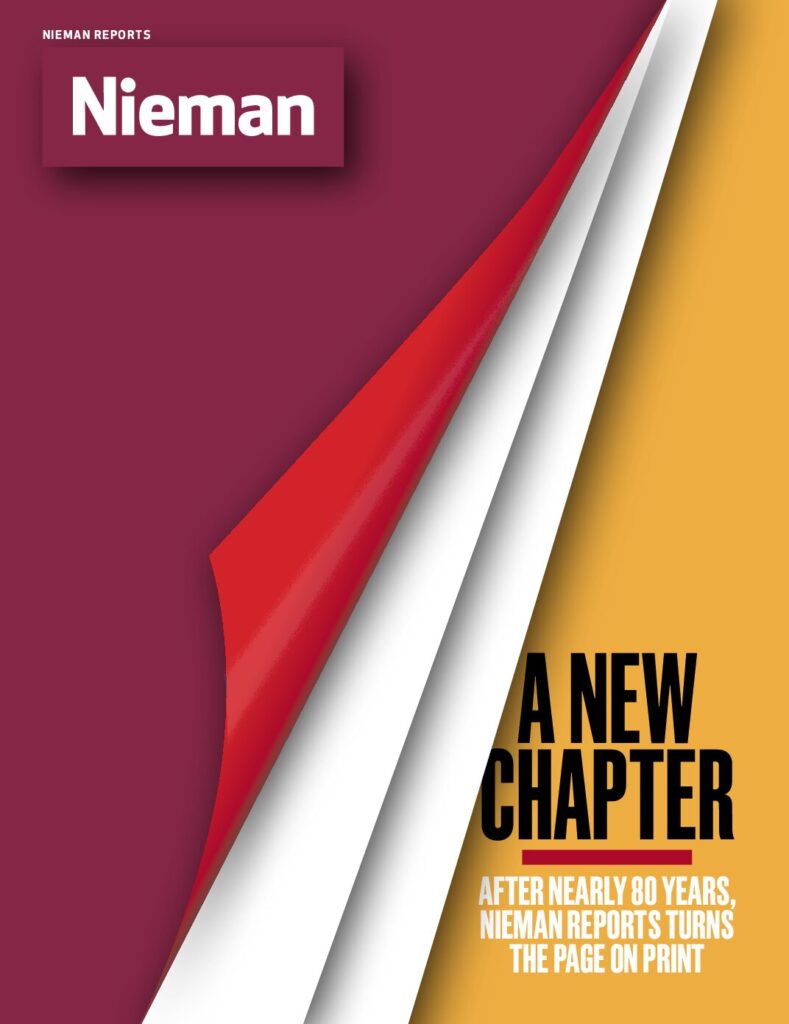
The Fall 2025/Winter 2026 edition of Nieman Reports represents the magazine’s final print issue as it transitions to an all-digital format. A combination of factors — many of which are affecting the wider media industry — has resulted in the move to online-only following a nearly 80-year run in print.
There’s much to think about and enjoy in this new print edition of Nieman Reports, and even more online. The issue examines challenges and trends in the news industry in the United States, France, Myanmar, Nepal, and Sudan, while our cover story looks at the evolution of Nieman Reports.
The same great journalism about journalism that readers have come to expect from the magazine will continue at niemanreports.org. In fact, it’s been appearing there for years already, including stories that don’t make it into print. Despite the changing format, our commitment to global media coverage remains as strong as ever.
In his nearly 50-year career in French media, Jean-Michel Mariou has produced offbeat literary and cultural shows on public radio, directed regional operations for public television, and authored four books. But over the last decade, he has watched in distress as newspapers, radio stations, and television news channels across France have laid off reporters or simply gone out of business. In the Corbières region, the poor hinterland where Mariou lives, the main print daily, L’indépendant, has been in steep decline since its 2015 takeover by one of France’s biggest regional conglomerates.
“The very notion of journalism is being flattened,” Mariou said. “It can leave you feeling like you can’t breathe.”
And so last summer, at age 73, Mariou decided to do something about it. He and a graphic designer teamed up to create a local publication called Le Matin des Corbières. With a website that vows to “encourage civic debate,” a proud leftist perspective, and plans for four print editions a year, it is staffed by five volunteers who hold their monthly editorial meeting at the bistro in the medieval village of Lagrasse, where most of them live.
The publication is part of a nationwide surge in alternative media startups. The exact numbers are difficult to pinpoint, but the most recent government tally, from 2021, identified 632 online-only news outlets, up from 391 in 2015. The Independent Online Press Union now represents 270 publishers, the vast majority of them having set up shop in the last decade.
Embracing France’s robust tradition of antiestablishment, left-leaning journalism, the new outlets tend to be overtly political, with an agenda meant to appeal to younger readers and counter the country’s dramatic shift to the right and the consolidation of traditional media under billionaire owners over the last 15 years.
Even though the startups represent a tiny portion of the media landscape, they have an outsized presence, having broken several big political stories that the mainstream media has been forced to follow.
Many of these new outlets are shoestring operations struggling to find a business model that can cover their costs. Financial failure is common, especially at the local level. But the successes have given idealists like Mariou enough hope to keep trying.
The first two print issues of Le Matin des Corbières — which included an in-depth report about a new housing project, a profile of young winemakers, a debunking of arguments that environmental policies led to recent wildfires, and an investigation into allegations that a local abbey had become a conduit for far-right ideas — each sold over 400 copies at 4 euros (around $4.70) apiece. Along with revenue from about 100 digital “memberships,” Mariou said, that’s enough to keep the publication in business at least another six months.
“We know we’re going to have a very fragile economy,” he said. “But frankly, if you’re crazy enough to get involved in the local independent press today, you can’t just turn back.”

A new sector emerges
France’s media ecosystem once revolved around well-funded public broadcasters and a constellation of heavyweight newspapers with clear ideological identities: Libération and L’Humanité on the left, Le Figaro on the right, and Le Monde in the center. But things began to change in the 1980s, when the opening of the country’s airwaves and the privatization of the national television channel TF1 ended the state’s near-monopoly on public broadcasting.
In 2005, the influential banker Édouard de Rothschild bought the newspaper Libération, whose founders were Jean-Paul Sartre and Serge July. That same year, Vincent Bolloré, a conservative Catholic billionaire with business interests spanning maritime shipping, global logistics and commodities, launched a new TV channel called Direct 8. By 2007, Bolloré had added two daily newspapers and one of the world’s largest global communications groups to his holdings. It was the beginning of a buying spree that would eventually earn him comparisons to the Australian-born media mogul Rupert Murdoch and make him the dominant player in the club of 11 billionaires whose holdings account for 80% of France’s daily press sales and 57% of its television audience.
Bolloré has long portrayed himself as a defender of conservative values without claiming membership in any political party. But his media empire consistently depicts France as a country in decline and under threat because of unchecked immigration — echoing Marine Le Pen, leader of Rassemblement National (RN), the far-right party that has attracted global attention while becoming a leading competitor in French politics.
As Bolloré and other media barons have amassed power, public trust in the news has plummeted. Just 32% of the French public trusts reporting by the country’s news outlets on major current affairs today, compared with around half of respondents in the early 2000s, according to the long-running Verian-La Croix media trust barometer, though the wording of survey questions and indicators have evolved over time. Even as big outlets remain dominant, they have been shedding readers.
That has opened the way for the new generation of startups that the French commonly refer to in English as “pure players” to distinguish them from traditional media with a print or broadcast legacy.
The first of note was Bondy Blog, which was founded after the 2005 Paris banlieue riots to give voice to the marginalized residents of these long-neglected neighborhoods. It was soon followed by Rue89, which was founded by former Libération journalists and promised a press “revolution.”
The biggest step forward came in 2008 with the founding of Mediapart. Led by a former editor of Le Monde, it focused on political accountability and long-form investigative reporting rather than the churn of daily news — a strategy that many doubted could succeed financially.
But the gamble paid off. Today Mediapart has more than 245,000 subscribers and annual revenues of around 25 million euros (about $30 million), making it one of the most financially successful digital newsrooms in Europe. Its reader-funded, advertising-free model has allowed it to retain a strongly independent editorial line.
The site has also become a key player in setting France’s national news agenda, exposing some of the country’s most consequential political scandals. Notably, it was the first to report several key aspects of the so-called Bettencourt Affair, publishing secret recordings that helped trigger judicial investigations into alleged illegal campaign financing and conflicts of interest involving senior figures close to then-President Nicolas Sarkozy.
“For a long time, mainstream media never cited online independent media. It was almost seen as not real journalism, and it was viewed with a lot of skepticism,” said Nikos Smyrnaois, a media researcher at the University of Toulouse. “But through their investigations and their huge number of scoops, Mediapart has managed to legitimize this kind of independent reporting.”
By the standards of French media, Mediapart enjoys high levels of public trust. In a 2025 survey by the Reuters Institute, 47% of respondents who recognized Mediapart said they trusted the information it provides.
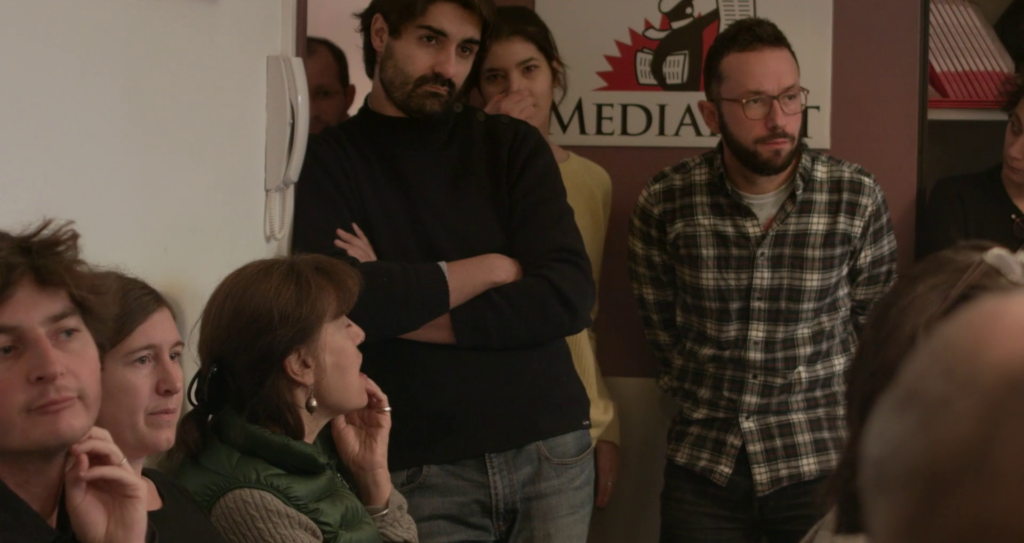
In 2019, the founders of Mediapart started the nonprofit Fund for a Free Press, which has provided financial support to nearly 50 other independent outlets. This past October, eight independent outlets also banded together to offer a joint subscription through a shared platform, La Presse Libre, which was supported by the fund to help expand the their reach and revenue.
Nobody has been able to replicate the success of Mediapart, but many are trying. Among the most recent entrants in a crowded field is a Christian magazine called Le Cri, which hit newsstands this past October with an initial print run of 20,000 and an openly anti-far-right editorial line.
“There is real momentum,” said Charlotte Clavreul, director of the Fund for a Free Press. “Public awareness is growing, and people are increasingly ready to support independent journalism.”
Appealing to a new generation
In many ways, the new French outlets resemble the alternative weeklies that once thrived in the United States: left-leaning publications that eschew a sober, institutional tone for personality and passionate argument. Popular sites including Streetpress, Basta!, and La Déferlante often embrace the language of activism: anti-fascist, resistance, intersectionality, and feminist revolution.
Smyrnaois said traditional journalistic values of objectivity and neutrality carry little weight with people under 35. “They prefer media that take a strong position, notably on questions like inequality, sexuality and gender, ecology, and social justice,” he said. “Because, if you like, their era calls for it.”
Nathan Delaunay, a 25-year-old winemaker in Lagrasse, said independent outlets seem “less corrupted than the big, traditional media” and that their reporting strikes him as “more factual and more reliable, and less filtered through political interpretations.”
— Charlotte Clavreul, director of the Fund for a Free Press
“There is real momentum. Public awareness is growing, and people are increasingly ready to support independent journalism.”
Many of the new media organizations portray themselves as bulwarks against the extreme right. In the run-up to 2024 legislative elections, with Le Pen’s party expected to achieve major gains if not outright victory, more than 90 news organizations released a statement warning: “Freedom of the press is in its sights. Throughout Europe and the world, it is under attack wherever the far-right rules.”
Le Pen’s party fell short of expectations, finishing third behind a leftist coalition and a centrist alliance led by President Emmanuel Macron. It’s difficult to say what impact the newer outlets had on the election, but there is no question they made an outsized contribution to the political debate. For example, several candidates from the RN withdrew from their races after Streetpress — a youth-focused investigative site that reaches as many as 6 million people a month — published a series documenting their racist statements, extremist affiliations, or opaque fundraising networks.
“We cannot say that this is just another political regime, just another political stance,” said Salomé Saqué, a journalist at Blast, a hybrid news site and web TV channel. “And we cannot say that as journalists we will just let this happen by treating fascist parties or fascist excesses like any other news event.” One of Blast’s anti-right videos during the campaign racked up more than 480,000 views on YouTube — viewership on par with or exceeding that of some mainstream outlets.
“[The youth] prefer media that take a strong position, notably on questions like inequality, sexuality and gender, ecology, and social justice. Because, if you like, their era calls for it.”
— Nikos Smyrnaois, media researcher at the University of Toulouse
Saqué said the appeal of Blast also stems from its focus on inequality and attacks on mainstream media for catering to the well off. “I come from a very rural area in the Ardèche department,” she said. “Growing up, to me the media was something for rich people, for city folk. It seemed very, very far removed from my own life.”
One subscriber, Francis Derussy, a 41-year-old art installer, said he felt that he and the Blast employees “live in the same world, unlike the journalists and so-called experts we’re presented with on the radio and television every day.” He also lauded the site’s coverage of French territories, including his native Guadeloupe. “It’s completely different from what the big media and public broadcasting put out,” he said. “It gives you a bit of hope, even though the topics they tackle are anything but light.”
Alicia Even, a 22-year-old student from Nantes, said she appreciated Blast’s ability to combine rigorous journalism with a “dynamism and humor,” particularly on YouTube and social media, where she gets most of her news.
This solidarity between Blast’s audience and its newsroom is by design. Blast and many other independent outlets function as cooperatives in which employees and readers collectively hold shares, govern democratically and reinvest any profits in newsgathering.
“It’s completely different from what the big media and public broadcasting put out. It gives you a bit of hope, even though the topics they tackle are anything but light.”
— Francis Derussy, Blast subscriber
Economic uncertainty
But like news operations around the world, the new outlets are struggling to find a business model that works in the digital age. Most are lucky to break even.
Blast has always relied heavily on donations, starting with the 2021 crowdfunding drive that launched it. That campaign raised 923,000 euros (about $1,089,000) — a record for French media startups. Many of the journalists involved already had significant followings online. “At the beginning, there were just eight of us, and we were working out of a little apartment in Paris,” said Saqué, who had made a name for herself with viral videos of the populist yellow vests protest movement. “We didn’t have any fixed premises, any money, or a studio, and everything was done completely on the fly.”
Today, Blast has an annual budget of at least 2 million euros (about $2,365,300), around 40 employees, and starting salaries of about 34,000 euros (about $40,000) a year. A YouTube following of 1.6 million brings in a small amount of revenue, but most comes from donations. While the articles are free to anybody, more than 32,500 people elect to chip in, mainly through subscriptions starting at 5 euros (around $6) a month.
Another venture, Brief Media, which summarizes and explains the news in seven-minute daily digests, has built a profitable subscription model and has more recently diversified its revenue by selling subscriptions to high schools for teaching purposes. But its founder, Laurent Mauriac, who is also co-president of the Independent Online Press Union, said he worried about how many of his peers would be sustainable. Growth of the sector has slowed in the last few years, with more projects failing to get off the ground. “I think the main challenge remains achieving profitability and then maintaining it,” he said. “Because, in fact, the problem with a lack of profitability is that it often results in a loss of independence.”
The economic challenge is especially difficult for local publications with their naturally smaller audiences. Industry experts said just one online-only local startup has managed to break even: an investigative outlet called Marsactu that covers Marseille. Launched in 2010, it quickly became known for its granular reporting on politics and business in France’s second-largest city. But by 2015, it was financially insolvent and heading toward liquidation — until hundreds of readers mobilized to help five of its journalists buy the site and rebuild it around a subscription-only model. By the end of 2020, it had 5,000 paid subscribers — enough to support its staff of around 10 and avoid taking state subsidies that have been a lifeline for other local publications.
That has given Marsactu independence to go after local power players, offering coverage that its co-editor-in-chief, Coralie Bonnefoy, said is missing from the media chain La Provence, which is owned by billionaire shipping magnate Rodolphe Saadé and dominates the region. Still, the business is fragile. In 2024, Marsactu faced a defamation lawsuit — which was recently dismissed — for its investigations into the allegedly violent practices of a leading orthopedic surgeon, who claimed 600,000 euros (around $709,000) in damages. “Clearly, we know that a situation like this could spell the end for us,” Bonnefoy said.
Local and regional publications have one promising advantage over their national competitors: Readers trust them much more. Recent surveys from both the Reuters Institute and Verian found that about two-thirds of French readers had faith in their local media.
Rural concerns
Back in Lagrasse, Mariou is banking on that trust to grow his fledgling publication. His plan is to eventually cover the 30 towns and villages that make up the Corbières region.
Mariou insisted on a print edition, because paper and ink harken back to a time when the media and politics didn’t seem so distant to most people. The publication is now sold at a dozen newsstands, bookshops, and bakeries. Mariou also sells it at the Saturday market in Lagrasse, where he can appeal directly to potential readers.
Among those already won over is Pierre-Yves Rommelaere, a 45-year-old chef who lives in the village of St. Pierre des Champs. He lauded Le Matin des Corbières for reflecting his lived experience in a way that feels “concrete” because local reporters are “rooted on the ground and familiar with the territory, its people, and its history.”
In December, Mariou was preparing to publish his third print edition, with a heavy focus on regional municipal elections set for March. The big story is still the far right. In a region where the Socialist Party had long dominated, Le Pen’s party has been gaining ground rapidly, with its average share of the regional vote jumping from around 29% in the 2022 legislative elections to around 47% in 2024.
A former Maoist, Mariou said he believed that extremists have gained traction in part because the collapse of local media has left an information vacuum. He started Le Matin des Corbières as a “newspaper of the struggle” against the rising influence of the right. “I don’t see us saying to people, ‘You should vote for this guy or that guy,’” Mariou said. “On the other hand, we are going to try to follow the progression of the Rassemblement National across this territory to try to understand it.”
He suggested that small papers could play a pivotal role in the election results in some small towns and villages. In Lagrasse, which has a population of around 550, his publication is already read widely enough to at least get significant numbers of people thinking about the issues and what’s at stake.
“When you look at political debate today, it is completely out of touch,” he said. “I believe that we as independent local media can help to address that.”