
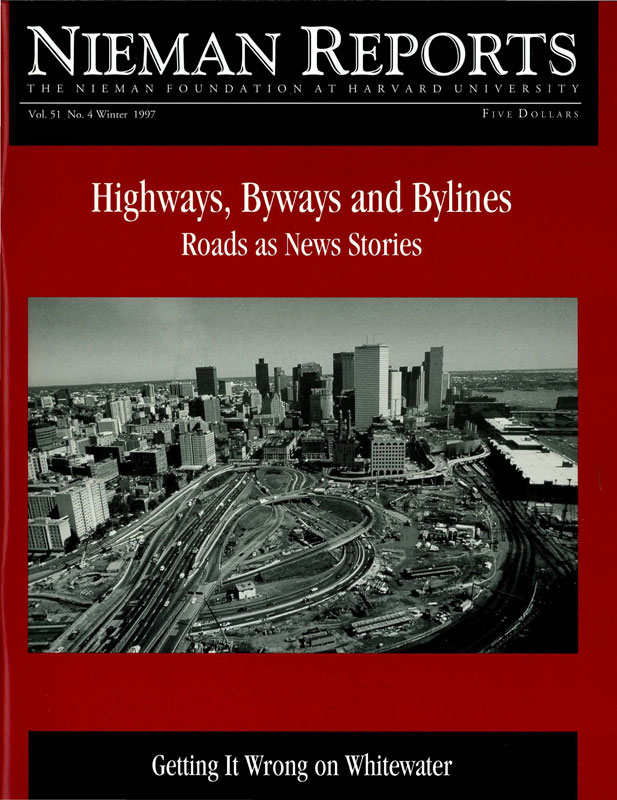
Peter M. Zuk is the Project Director for what we refer to as the largest public works project under way in the United States, the Big Dig. Except for the steeply escalating cost, the project — officially the Central Artery/Third Harbor Tunnel project, in Boston, to install a new under-harbor tunnel and to bury an eight-lane interstate highway under downtown — has gone remarkably well.
As far as we know.
I’ve spent the last four and a half years trying to find out otherwise, and I say “as far as we know” because I have a running argument with Peter Zuk about how much we really do know. I tell him I figure we get about 5 percent of what (if we knew about it) might be considered newsworthy events into print. He contends that, over time, we get everything that is newsworthy. But then he’s not a newsperson.
It is Peter Zuk’s job to protect this project politically. He does manage the project, but his real skill is to keep any part of it from becoming such big news that it harms the project’s forward progress. He’s a natural politician. He’s smart and he protects the project on behalf of one of the most demanding and most political creatures around, Massachusetts Turnpike Chairman James Kerasiotes. Penetrating a wall conceived by Kerasiotes and built by the state’s private consultant, the joint team of Bechtel Corp. and Parsons Brinckerhoff, is a significant challenge. No one at any level of the project will speak to a reporter without getting permission from the highest levels in advance.
The highly political nature of the Big Dig is one of the aspects that makes covering it both interesting and challenging. It is a huge political target for those not associated with it, so a reporter has to sort out the grandstanding from the legitimate criticism. Also, with so much money involved — $10.8 billion, by latest count — it tends to be vulnerable, thus the extensive efforts to protect it and keep the media at bay.
Other difficulties include:
- Continuing to cover the rest of the transportation goings-on — the Turnpike and Port authorities, the Massachusetts Bay Transportation Authority, the Massachusetts Highway Department, the daily commuting grind into Boston — while staying focused on the Big Dig.
- The technical jargon. Never have I worked on an assignment where documents were so voluminous and so useless. The engineering and construction aspects of the project are so arcane that each document has to come with a translator, or it is meaningless.
- Walking the line between boosters of the project and a world of critics who will do almost anything to croak it. As much as we like to say journalism is about objectivity, this is where the judgment comes in: What is the right balance between stories relating the extraordinary design and construction achievements on one hand, and the breathtaking failure to bring this monster in at anywhere near the original estimated cost of $2.6 billion?
- The sheer size of it. How do you make an issue of cost overruns of, say, $10 million, when that amounts to less than one-tenth of 1 percent of the price tag? And especially when project managers are arguing that spending $10 million now will save $50 million in the long run?
- Finally, persuading editors there is more to it than money. We in the media tend to be obsessed with cost, partly because people understand dollars and partly because that is one of the few objective measures of the project’s management successes or failings. But the project involves 100-plus contracts, almost all going on simultaneously, and each with hundreds of workers and stories of their own to be told to make up the full picture.
Bernie Cornelia, a field engineer with management consultant Bechtel/Parsons, describes his piece of the puzzle, contract C15A2, as having a variety of kinds of roads: tunnel; “boat,” or depressed, roofless road; surface lanes at the northern portal near Causeway Street. “All of these jobs have something that’s different, that’s interesting,” he said.
In short, the Big Dig is in microcosm, or, from a Boston viewpoint, a macrocosm, of reporting on a huge public works project.
First, the politics.
Often it is an attempt to hide bad news that gets management in trouble. These are stories that, if they are told incrementally, may not carry huge headlines. But when they come out after months of having been denied, and the credibility of those running the project is called into question, they almost always make page one.
One of my jobs is to keep an eye on the situation regarding the cost of the Big Dig. In the early years, there were annual, official cost estimates. Because the cost was continuously rising — for reasons we have documented that are mostly understandable and seemingly unavoidable — the annual cost re-adjustment caused managers serious headaches. So Zuk and his team abandoned it, substituting, instead, an ongoing, month-by-month monitoring of the project cost. These monthly management reports, as they are called, were no doubt useful, but they were a typical reaction on the part of the project to bad news. The solution sequestered the future bad news.
I had asked for these reports on a number of occasions, been promised them and never received them. I had frequently asked Zuk how costs were going since the ironclad $10.4 billion cost figure had been set forth a couple of years ago. He repeatedly assured me on a number of occasions that the numbers were tracking right to the $10.4 billion figure at completion, or maybe even better.
Then the McCormack Institute at the University of Massachusetts at Boston, directed by the Legislature with studying ways to cut costs on the project, came out with its report in July 1997. It had determined that the Big Dig’s own internal documents, the monthly management reports, were showing that the cost at the end of the project, in 2005, would be $10.8 billion — $400 million more than managers had pledged from late 1993 on. Big surprise, big news.
“We have a viable project that’s being well-managed,” Kerasiotes told me recently, after the Government Accounting Office issued a critical report, “and we’re not about to let anybody say that it isn’t.”
Says State Treasurer Joe Malone, “Any objective outsiders who have looked at the cost have said the administration is underestimating things.”
Kerasiotes preached openness and to his credit set up weekly briefings on the project when he took over as transportation secretary after William Weld was elected governor. The briefings diminished after the first milestone — the opening of the Ted Williams Tunnel — was reached. And they virtually ended when, on one occasion, I compared a routine handout on contract deadlines with the actual facts and wrote a story showing the project was slipping behind.
But by far the biggest problem I wrestle with is covering the Big Dig and at the same time trying to keep up with all the other aspects of transportation going on. Theoretically, I have responsibility as The Globe’s transportation reporter for anything with wheels, tracks or propellers. Fortunately, many aspects of transportation get covered by others on our staff. For example, Matt Brelis, who used to cover transportation, knows a lot more than I do about air travel and airports, and he almost always covers crashes or major problems at Logan airport. Because the Big Dig is at its peak of activity during my tenure in this job, I have to make it and the rest of ground transportation my first priority.
Peter Howe, another former transportation reporter, now covering science and technology for The Globe, is in a position to write about many of the new high-technology aspects of transportation. Environment reporter Scott Allen will usually cover clean air issues. We negotiate these things, usually through E-mail, among reporters and editors each day, to make sure whatever needs to be covered gets covered. I look for so much support from the rest of the staff simply because transportation is such a broad assignment these days. I could keep a staff of five reporters busy, turning out stories all of which would be worthy of good play in The Globe.
Even at a newspaper as large as The Globe, with as many editors, it is the reporter on the beat who is the real assignment editor. No one who doesn’t follow transportation and talk to scores of people daily about the subject could possibly keep abreast of what’s coming up. I tell my editor about the significant developments on the horizon, and he and I decide which ones to deal with first.
As I try to explain to my editors (and my wife), I’m a juggler. I have, literally, about 50 potential stories going at any time. I view them each as a ball in the air. Each one comes down every now and then, and I consider it, maybe make a call or two, and if it’s not a priority for the next day or at least the near future, I throw it back up in the air for another day. My desk is piled with paper and other material — story folders, tips, reports, newsletters, notes — that I dig out when any of these stories is ripe. Of course, I am making calls and talking to sources on several stories at once, and not infrequently someone I call will say, “You must have ESP,” because I have called just as a story of some kind is about to break. But there’s nothing metaphysical about it; it’s just that if you knock on enough doors often enough, you score some of the time.
I can’t think of a beat that is theoretically broader than transportation. But a mammoth project like this consumes our resources and dominates the public’s attention concerning transportation during the decade or so that it is underway. We at The Globe get at least a dozen calls a week concerning some aspect of transportation that — if I didn’t have higher priorities — could work on. A public relations guy calls about a new program for ergonomics training that the company he represents is providing to baggage handlers at United Airlines. A bunch of kids get into a fight on the way home from school on the MBTA and threaten passengers. A group of Amtrak workers calls to contend that they are being discriminated against on the job. The MBTA is celebrating the 100th anniversary of its subway system. Then there are the wish-list projects and their sponsors.
Even before the Big Dig is done and paid for, there are advocates for the North-South Rail Link, an underground tunnel linking Boston’s two major train stations and the commuter-rail systems on both ends of the city. But many people think that is a boondoggle, that the next spare few billion dollars should be spent instead on the Urban Ring, a circumferential transit route at the perimeter of the city, linking underdeveloped neighborhoods to areas where there are jobs and opportunities. For most of these constituencies, The Globe or The Herald is the only outlet; local television stations are not going to find time for these stories in their precious few minutes for news.
But for this decade or so the Big Dig is a top priority — one that one editor I work for said he thought should be made a full-time beat in itself, separate from the rest of transportation.
It is surprising, on a project that generates literally rooms full of documents, that paper is not more of a factor in reporting. Even lacking a law degree, I can usually figure out legal language when reporting. But engineering is another matter. Most of the documents I have seen associated with the Big Dig might as well have been written in some foreign language. I almost always needed someone to interpret them for me. So I haven’t made much use of documents. When another reporter and I were preparing a three-part series on the project back in 1994, we pored through boxes of paper, identified some letters and memos that either looked suspicious or about which we had questions, and asked for copies. But in many cases we made little use of those, and some we didn’t even pick up. The documents by and large just don’t tell the stories by themselves, we found. In fact, on more than one occasion I have been sent — anonymously — stacks of documents relating to one contract or another on the Big Dig. The senders (often no doubt seeking to damage a competitor) suppose that these documents will readily tell a story of waste or fraud or payroll-padding or something else newsworthy. In fact, the documents sit on my desk for months, generating no story at all, unless I can come up with someone to interpret them for me. In a way, the project is so complex that almost any part that a reporter seeks to learn about takes a tutor.
Sometimes even the words that fall from the lips of the official public spokespersons of the project are bewildering. “They’re jacking a 72-inch sewer pipe through to Purchase Street,” said the Big Dig’s Terry Brown.
Thus, I say, I often feel like I cover this job by Braille. An acquaintance, or a friend of a friend, or a tipster — anonymous or otherwise — will call with something that sounds plausible. I will work the edges of the story, calling anyone I know who might know something about that area: police overtime, say, or the use of jet fans in tunnel ventilation buildings. My initial goal is to substantiate the tip just enough, to learn enough about it, that when I talk to those in charge I will sound sufficiently informed that they will choose to open up and tell me the whole story, rather than stonewall or try to discourage me.
If the tip I get is particularly sensitive, it will be kicked up to Zuk’s level almost instantly. That in itself usually tells me there is something to it. Zuk’s first reaction is usually a combination of a limited number of facts — and lots of spin. Faced recently with a stinging letter from the state’s environmental secretary saying the Big Dig was behind in its commitment to provide harbor commuter-boat service, Zuk characteristically pronounced this good news, saying that after a brief delay the service would be superior to anything it would have been had it started on time. He is a lawyer, usually very careful and opaque with words when on the record. When I press, and especially when I am about to write a rather severe version of, say, a consultant’s assessment of the performance of Big Dig management, I will usually get the vivid, gory details — off the record, of course. And my real job is to shoehorn as much of that true story into the paper as I can, however distasteful or embarrassing that may be to the players. All of the political types on the project, right up to the chairman of the Massachusetts Turnpike Authority, are highly offended if you accuse them of lying to you, and very seldom does what you are told as a reporter qualify as a lie. But sometimes the answers turn out to be so carefully stated that they might qualify as virtual lies. My antennae go up when Zuk turns on the lawyerspeak.
“We are confident that we will manage to the $10.4 billion” cost goal, Zuk told me not long ago. Then he called back to alter the statement slightly: “I am confident there are steps we can take to move us back to the $10.4 billion.” Observed Joe Barresi, a senior fellow at the McCormack Institute, “They’re very sensitive about the $10.4 billion.”
When I’ve got a solid story involving criticism of the Big Dig for the next clay, I’m naturally torn between being safer — calling at the last minute for a comment, so that news doesn’t leak out to my competition early enough for them to act on it — and being more generous, which means giving project managers more time to respond. One real impediment to calling early for a response, however, is the rush of calls that typically come in from state transportation managers trying — always off-the-record — to talk me out of writing the story. Or into delaying it. The bigger the story, the more ferocious the calls from those in the transportation offices who want to debate the value of the story — and, if that fails, usually impugn the general integrity of the media in their treatment of this controversial project. All this takes place between 5 and 7 p.m., when deadlines are fast approaching or past and when I need to be writing, not answering the phone and engaging in emotional, sometimes personal arguments.
A number of the reporters who are most critical of the Big Dig — who in fact seldom if ever write anything but negative stories about it — operate, I think, from the premise that it should not have been undertaken in the first place. Their journalistic goal appears to be to bring it to a halt. That seems to me to be very shortsighted, akin to the too-popular attitude in the years after Watergate that one was not a successful reporter unless one had cost a few bureaucrats their jobs, or put some businessman in jail. And never is there a shortage of critics to quote.
Senator Robert Havern, Co-chairman of the legislature’s Transportation Committee, commented on an important bill governing the construction and operation of the new Central Artery and Ted Williams Tunnel. “There’ll be an anguished mob that will want more,” he said. “Unfortunately, this is way too important for political mischief.”
Balance is important, both for the sake of fairness and for upholding our credibility in the long term. When workers get hurt, when costs go up, when construction snarls traffic, when neighborhoods complain about dust and noise, those things are news and we’ve covered them. But the public’s frequent criticism that we dwell only on bad news is valid if we fail to tell the positive stories: the Big Dig’s remarkably safe workplace; the on-time opening of its first phase, the Ted Williams Tunnel; a traffic plan that, halfway through the project, has generated only marginally more grumbling about congestion in Boston than is routine in recent years.
At times The Globe has taken some criticism (primarily on talk radio) for allegedly going too easy on the huge project. But some of that has come from other reporters, whose work is characterized by an unrelenting assumption of bad faith, incompetence and dishonesty on the part of every Big Dig worker and manager. When reporter Charlie Sennott and I were digging up material for the three-part series on the project that we did in 1994, we initially assumed that the seemingly outrageous prices that the state had paid fora couple of buildings, the Analex and the Wang, would provide some sensational headlines. But, when we painstakingly reconstructed the negotiations and the thinking that went on before those structures were taken by the project, we found that the prices, while high, were apparently unavoidable under the circumstances. We even had project officials recall one attorney who had gone off to another job, so we could interview him about what had happened years before, when the decision was made to take one of the buildings. In short, to get at the truth of this and other matters we tried to apply our skepticism in both directions. This only seems fair.
Especially in Boston, where enthusiasm for public transit and a certain unusually strong (by national standards) desire for government action combine with an anti-automobile bias, a transportation reporter is caught in the middle. Staying in the middle, of course, is the challenge, and not being captured or seduced into favoring either side, which in the transportation world means either with transit types or car-lovers. Hard enough is the bewildering job of just finding the middle — resolving the historical question of whether people chose cars (and suburbs) over trolleys (and cities) more or less voluntarily, or whether they were forced into their Chevys (and later Toyotas) by Detroit, the big bad oil companies, and a federal government stampeded by the highway lobby.
I take the view in covering transportation, as I do in all reporting, that the people in and out of journalism who say objectivity is impossible and perhaps undesirable and shouldn’t be attempted — well, they’re dead wrong. On any issue, however complex and tugged at by however many varying views, a reasonably intelligent reporter can come up with a satisfactorily objective article provided he or she wants to. Of course there is no perfect objectivity — but the difference between that perfection and the objectivity that is achievable with some dedication and effort is so small that it is insignificant. Most reporters who aren’t fair or objective in what they produce don’t want to be.
At an ambitious seminar on the future of transportation in the greater Boston area a few years ago, there were three days of testimony and speeches from experts, questions from other knowledgeable specialists, and finally comments from the audience. The car-vs.-transit debate was played out during the three days in many ways. One of the last remarks from the audience, however, summed up the real long-term debate. The solution to the congestion problems and air-quality problems and parking problems and all the other ills associated with this car-dependent culture, he said, was to eliminate one-acre zoning. It was a euphemism, of course, for a program of planned communities and limits on sprawl and the ongoing development that has dispersed population and produced suburban communities extending from Boston Harbor out 30 miles to Route 495 and beyond. A reporter’s expertise in transportation these days has to extend to development policy.
The essential lesson of the big price of the Big Dig is that public participation — with an end toward doing big things but also pleasing most everybody, rather than rolling over a neighborhood-costs money.
The cost of making big projects palatable today is the so-called mitigation, or, to use a term once suggested to me by a BBC Scotland radio interviewer, “appeasement.” Whatever the stuff is called, accommodating the project to everyone’s needs and tastes and keeping the city functioning while it is ongoing is costing an estimated $3 billion of the $10.8 billion that the Big Dig is currently pegged at. That we did explain, as an important part of our 1994 series on the project.
But what we haven’t been able to fully explain, and what I continue to believe is the single most interesting facet of all these big transportation projects, is: Why can’t we tell ahead of time what they will cost? Now, one non-answer is: It’s a good thing we can’t, because if we could we would never build them. Only after $6 billion has been committed to a project, as it now has to the Big Dig, would we really consider spending what may turn out to be $12 billion or more on a project that initially was estimated at $2.6 billion. No one believes that, had that $2.6 billion estimated in the mid-1980’s been even as much as $5 billion, Congress would have committed itself to paying the bulk of the cost.
I don’t have the answer to this question, though I understand it better than I did when I began reporting the Big Dig four and a half years ago, and I hope to understand it even better — and to allow readers to understand it better — by the time I finish. The answer involves a lot of wishful thinking, steady optimism, the inability to foresee problems especially in complex underground construction, and a certain deliberate or careless lack of interest in the obstacles that might be involved. It is also possible that a vague fear of not being up to the financial or technical challenge leads engineers and even political leaders to blindly commit to building a visionary project, whatever the cost.
For me personally, the politics in transportation is a double-edged sword. It puts the people I cover on guard, but it keeps my editors interested. They love politics. I like public policy and reporting about tough choices — letting both sides make their best cases. I don’t particularly like covering politics, where superficial factors — egos and campaign chests and advertising, for example — get an inordinate amount of attention. But politics tends to rule at many newspapers, none more so than at The Globe. It takes an enormous effort to get my editors interested in the mechanics of building even such a monumental undertaking as the Big Dig. New tunneling technique? Forget it, unless it involves a fight between a contractor and the state.
I have a safety valve at The Globe for the many readers who want to know more about how the project is built: the kids’ page, called NewsLine. Every week, The Globe runs a page devoted to boys and girls. Staff members such as myself write 500-word pieces aimed at younger minds, perhaps explaining a little more than we do normally, and using more English, less of the jargon of news stories. The editor of the page is very grateful (she can’t pay extra) and the great reward is that a lot of people read it — not just the kids. Many adults want to know more about the concrete and the “rebar” (steel) and the surveying and the soil testing and the tunneling and chemistry and machinery and sweat that goes into building the Big Dig. And I try to give them a piece of that tucked away on the kids’ page several times a year. But the appetite, as I see it, is for much more than we offer now, and I do not want 2005, the end of the project, to roll around only to discover that one of the grand construction feats of the late 20th Century has taken place in the middle of our streets and we didn’t sufficiently tell people how it was done.
The politics of the project involves primarily two things: money and the environment. The money issue is being hashed out now in terms of the commitment that Congress made in the 1980’s, in a climate changed in two major ways: The job costs a lot more than anybody thought, and there is much more concern for getting spending under control nationally. The environmental issues are more complex. They require the transportation reporter to be familiar with the powerful advocacy groups, like the Conservation Law Foundation, quirky laws like the federal so-called 4(f) provision, which protects parks, and myriad other seemingly non-transportation-related details. As with the law, you learn about these issues as you do more reporting on them, and your coverage becomes more informed and authoritative as you gain experience.
Now, a look at the future. It helps us reporters, just as it does government officials, if we have a crystal ball. But, regarding most transportation issues, we simply don’t know. Will cities re-emerge and suburbs fade? Will Washington or the state capitals win control of transportation policy? We just can’t say, and we have to be willing to admit that. Sometimes it seems impossible even to sort out the recent past: Is the privatization of highway maintenance working — or, as critics say, is the state’s boasted success smoke and mirrors and manipulated books, with less tax money spent but taxpayers also getting less? One thing we do know is that transportation technology will continue to spin forward.
Today, it seems to me, the most important area of progress — along with “smart” cars and “smart” highways — involves smart ways of paying. Toll roads would be rapidly on their way to becoming a thing of the past, largely phased out were it not for the rapidly growing automatic toll collection industry. Toronto has a new private highway that only “members” can use. That is, there are no baskets in which to throw coins. If your vehicle doesn’t have a transponder on it, which identifies your car and automatically pays your toll by deducting it from an account or putting it on a credit card, you can’t use the road. That makes a lot more sense than the time-consuming, backup-causing, dangerous toll plazas of today.
I keep in touch by E-mail with a fellow who works in Tokyo and can keep me abreast of the cutting-edge developments in “electronic money,” or smart cards. This is a business story, a technology story, but it is one that I am convinced has a special importance in the transportation world. There is enough to keep up on without a topic this distantly related from traffic on the Expressway. But I follow it because I am convinced that the first widespread public use of money cards may well be in transit systems, and that use will spread to retail purchases. It is happening in Hong Kong and in Seoul, maybe soon in London. The use of credit-card sized plastic cards “loaded” with money, and reloadable, which with just a wave at the “turnstile” can pay transit fares, may be the tool that ushers in a largely cashless culture. I want to tell my readers if the local transportation agencies are lagging behind. The technology is there today, some in the industry say, but the impetus for banks and retailers to use the card instead of cash will only come when a community the size of the traveling community holds and uses such a card.
That, of course, includes just about everybody. That’s transportation.
I only know about 5 percent of this story, but I’m working on it.