

Many aspects of my Quaker faith have significantly influenced my career but perhaps none more profoundly than the abiding Quaker belief in being cheap. My fellow cultists refer to it as being “careful with money.”
There are obvious benefits of extreme thrift. By being too cheap to pay for cigarettes or psychiatrists, for example, I stay in a state of perpetual irritability, which is the perfect state for cartooning.
Being cheap has worked out well in other, less direct ways. When I got out of my middling college with a middling B.A. in English, my ability to live on the thrifty side allowed me to work for the Quakers near Philadelphia. Because the Quakers paid only $50 a week, I needed a second job and ended up in the only profession that would hire an unfocused, marginally prepared graduate with a useless degree — journalism.
I started stringing for The West Chester Daily Local News, which paid $10 per story. It was there that I got a taste for the power of journalism. For example, I broke the story that the Pocopson Township supervisors were planning to lower the blade on their roadside mower from 20 to 15 inches. When my editors started running little sketches I’d drawn, I realized that cartooning combined my interest in art and politics and my total lack of interest in strict objectivity. Quakers say, “the way will open.” My career opened at The Daily Local News.
Looking around for other opportunities, I was able to find a position that cut my salary to $25 a week. I joined a group led by a Haverford College professor who was going to bring peace to Cyprus. Nine months after we arrived, war broke out. In Cyprus, I saw the limits to volunteerism and the limitlessness of history’s malignant hold on the present. In countless Quaker meetings, I’d heard messages about “doing unto others.” In Cyprus, I heard a slightly different message. When they learned that the Turks were sending troops, some young Turkish Cypriots of my acquaintance crowed, “Finally we can do unto the Greeks what they’ve done unto us.”
Cyprus gave me an early glimpse of ethnic cleansing when, after the Greek coup and Turkish invasion one week later, I went to the home of the wonderful Turkish leader in the little village where I was living. He and his family were herded past me at gunpoint to the town mosque where they were detained with their other Turkish neighbors. There they prayed to Allah. Down the dusty street, the local Greek Orthodox priest prayed to Jesus over a young Greek Cypriot who was an early casualty of the violence. While the ease with which neighbors slipped into war shocked me, it did nothing but reinforce my Quaker suspicions that organized violence wasn’t going to improve the situation any more than organized religion.
Perhaps had I been a truly spiritual person whose belief in peace was backed by courage, I might have seized the moment, gathered all the townspeople together in a Quaker meeting, and let everyone feel the power of a shared divinity beyond name or nationality. The transformed villagers would cry out against the idiocy of the conflict, thus changing that little war’s dingy outcome and possibly earning me a discreet paragraph or two in Newsweek. Instead, I stayed until the Turks were released from the mosque, caught the last emergency transport off the island (if I’d waited, I’d have actually had to pay for a flight), and took with me an abiding sense that a little multi-culturalism goes a long way. Newsweek does not use my cartoons.
There are, of course, other bedrock Quaker values that have influenced my work. The firm belief in sensible shoes and 100 percent cotton clothing, for example, is shared by journalists of the khaki pants school and helped me fit right into the profession. The ability to deal with boredom, developed over many hours of quiet Quaker worship, is also important. I can sit through an entire Bill Clinton State of the Union address — awake. Finally, Friends’ trust in women’s ministry, which has given strength to four centuries of uppity Quaker feminists, including five of the seven conveners of the 1848 Seneca Falls Conventions, has made me feel that my crazed opinions were at least as worthy as a man’s.
For a cartoonist, however, there are some distinct downsides to Quakerism. Quakers are not known for our humor. There is no Quaker Borscht Belt. Also, we don’t do symbols. Our meeting houses are cross-free zones (Christianity lite, as one Catholic friend remarked) and we don’t salute any flag. My vigilant readers, on the other hand, have repeatedly informed me that many of them believe that the symbol and the ideal it represents are the same thing. Draw a picture with Jesus in it and you have drawn Jesus the man. Draw a burning flag and you have burned America. There is no distance, no separation, and no forgiveness for a cartoonist who casually messes with that reality.
The Quaker belief in consensus is of no help whatsoever to a cartoonist. In Quaker meeting, people meet in si lence and try to lay themselves open to knowing God’s will. When someone rises to speak, it is to express an idea or insight that he or she feels has come from the divine. Before a group of Quakers runs off and does something stupid in God’s name, however, the person with the insight must convince the rest of the meeting members that her insight is not just a voice of madness. Quakers are not easily convinced. It took some 60 years from the time the first abolitionist message was given at Germantown Friends Meeting in Philadelphia before that meeting issued its proclamation against slavery in 1788. Shameful, unless one remembers that Ralph Reed only this year figured out the wording of his deeply Christian, anti-racism proclamation.
As opposed to a meeting for worship, a cartoonist sits in silence waiting to know the Cartooning God’s will. What follows is often a struggle of false starts and half-baked ideas. Occasionally (more often for certain of my more gifted colleagues) a visual idea appears that perfectly illuminates a strong point of view. At that instant there is no thought of consensus. It must be drawn. The best cartoons seem to flow directly from mind to paper. Bringing the cartoon to a committee would not be constructive.
Even editors who like to control the art on their pages must soon realize that their choice is either to run or kill a cartoon. Fiddling with it to “make it better” inevitably makes it more like most editorials, i.e., not worth publishing. While it is helpful to check my cosmic insights with a trusted colleague or two to make sure they see the same subtle yet effective point I intended to make, I am not open to group discussion. My cartoons don’t run without commentary, however. Our letter writers stand ready to correct my heresies. My point of view on a given subject is neither the only nor the last on our pages.
Because of their belief that every person is capable of coming to know the will of the divine, early Quakers treated the Indians with respect, welcomed other faiths to worship freely in their colony, respected the ministry of women, and have long felt it is wrong to kill. (Pennsylvania was the original politically correct colony but made the mistake of never hanging teenage girls for witchcraft so it has been ignored by the historian class.) Quakers believe that to kill someone is to end the possibility that that person could know and do God’s will. Had the Egyptians executed Moses for murdering an overseer, for example, the Bible would have been a lot more concise. While I generally share these beliefs, life has often intervened to oddly bend my views.
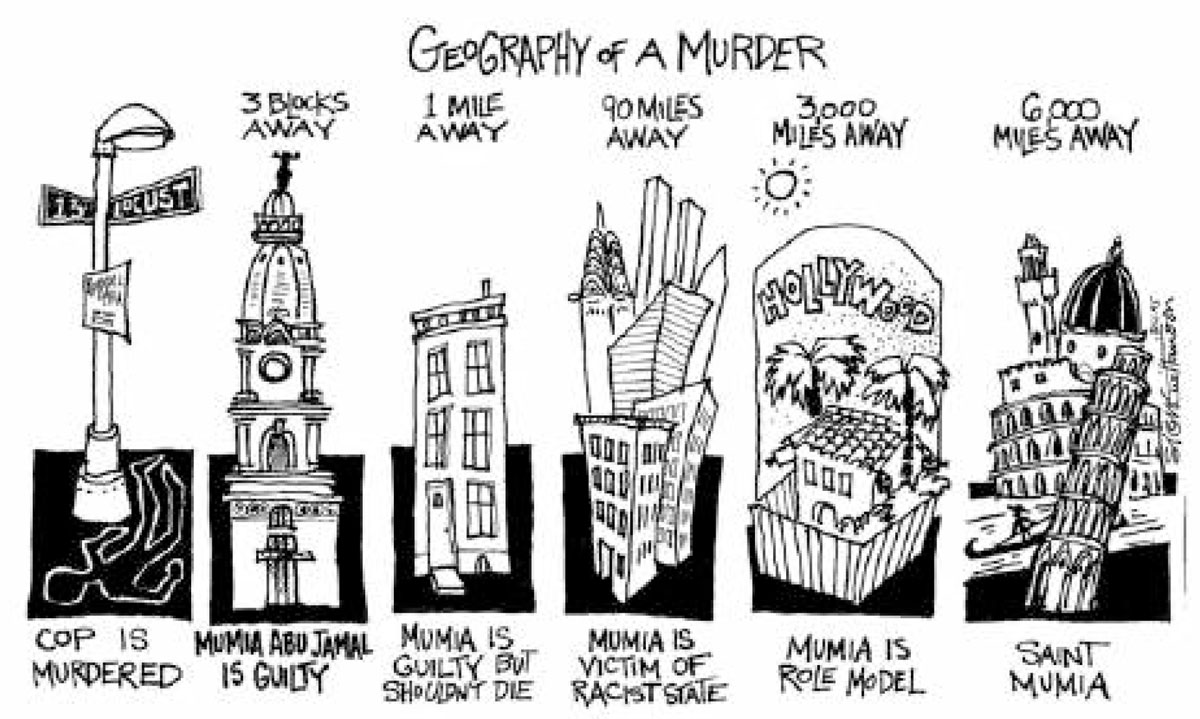
The case of Mumia abu Jamal, the former journalist and spokesman for the radical Philadelphia group Move who was convicted of murdering a policeman, is an example. While I firmly believe the state should not execute abu Jamal and have done cartoons attacking the sinister little judge who has overseen the case, I also firmly believe abu Jamal is guilty of the murder of Officer Daniel Faulkner and have done cartoons that say so. Those cartoons have been a source of comfort and support for Officer Daniel Faulkner’s family and friends while pained pacifists have questioned how I could live with myself when a man’s life is at stake.
The cartoonists I know don’t talk often about their religions. Mostly, they don’t even talk about their politics. They’re too busy cutting down other cartoonists. But most editorial cartooning supposes some kind of moral and political framework. To satirize corruption and greed is, in effect, to defend honesty and generosity even if the cartoonist never expects to witness those virtues in real life. Few of my brethren would say that they are trying to do God’s will, but it seems to me that each has some idea of what a better world, a more perfect union would look like. When a particular player on the public stage falls egregiously short of our ideals, it’s time they saw themselves in a cartoon.
The little blank box we are given each day is our pulpit from whence we spouteth off. We commune silently with our readers. There are more powerful ministers, but our little sermons are the ones that get taped to computer terminals and stuck on refrigerator doors. And the best thing is, no one has to go to church to get them.