
I am not sure what influence my religious faith has had on my journalism. As I think about it, maybe it was the other way around. It may be that journalism helped clear up the doubts and confusion that once clouded my spiritual life. Bear with me as I try to explain.
To be a young Southerner in the ’60’s meant having to come to terms with the failure of the region’s white churches to address the great moral issue of racial segregation. It was a time of division, anger, doubt and fear. The Ku Klux Klan long ago appropriated the cross as a flaming symbol of hate, and too few Christians protested this depravity. Christianity, it seemed to me at the time, had lost its way, if not its meaning.
I have heard it said that the church is like Noah’s Ark: if it weren’t for the flood on the outside, you couldn’t stand the smell on the inside. Some of us could no longer stand the smell and decided to take our chances on the outside. I left the ranks of Southern Baptists before I reached the legal drinking age in Georgia, soured on the church and confused about the relevance of Christianity to the social and political upheaval of the time.
I went off to college and for the better part of a decade rarely set foot in a church except for weddings and funerals. I later became a Presbyterian and then, five years ago, an Episcopalian. Still, people don’t have much trouble figuring out that I grew up in a Southern Baptist church. On my way out the door, I swiped a Baptist hymn book and haven’t stopped singing from it.
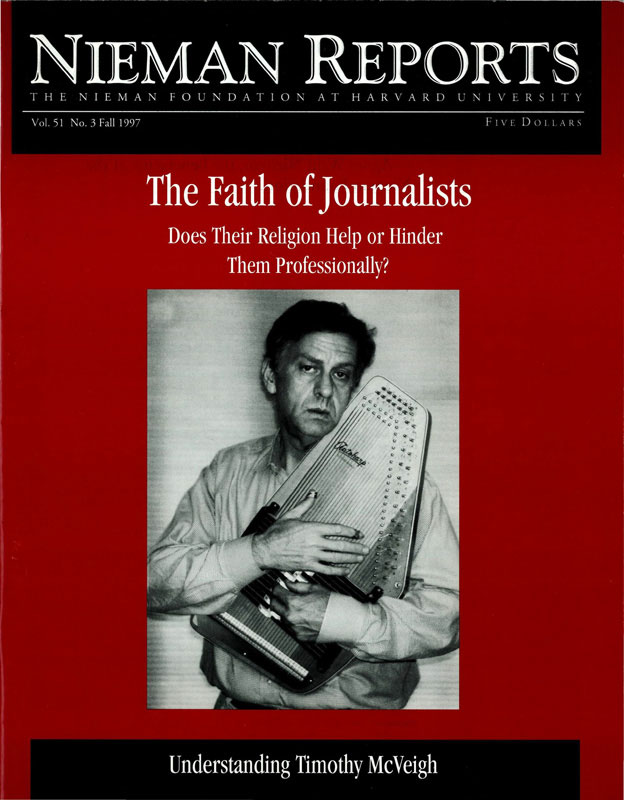
A couple of years ago, at a backyard party at my house in St. Petersburg, Fla., I cradled my auto harp and accompanied a small choir of Pulitzer Prize-winning journalists — Mary McGrory and William Raspberry of The Washington Post and Eugene Patterson, the retired Editor and Chairman of The St. Petersburg Times. Like me, they can’t resist topping off a good party with a hymn sing, and some of their favorite gospel songs are right out of the Baptist hymnal of my youth. They understand that a good hymn is good writing. “My strongest trials now are past, my triumph has begun,” goes one line in “Oh Come Angel Band.”
On these happy occasions, when neighbors must suspect that I am conducting a revival meeting on my patio, the years roll back in my mind to Sunday morning at the Silver Shoals Baptist Church, a few miles up a dirt road from Homer, Ga. (pop. 600). The church was a one-room, white clapboard structure. The preacher was required to make a cotton crop on the three acres behind the church to supplement the meager collections. (One preacher who let the grass take over the cotton was flogged by a group of deacons.) The preachers were local men, farmers or textile workers like most of the men in the congregation, with no theological training and little formal education. They were “called” to the pulpit. They paced, shouted, flailed their arms and sometimes foamed at the mouth as they preached against the sins of television, whisky, Elvis and even lipstick.
I later discovered that in the big Baptist churches in the city there was more decorum and theology but not any more Christianity than in the primitive rural church I had fled.
After graduating from the University of Georgia, I landed my first job as a reporter at The Atlanta Constitution at a time when the region was convulsed by the civil rights revolution led by the Rev. Dr. Martin Luther King Jr., a Baptist preacher who set out to emancipate white Southerners, slaves to hate and fear, a hundred years after Abraham Lincoln emancipated black slaves.
I didn’t realize it at the time, but reporting this story was, in a strange sort of way, a religious experience for me. The church figured prominently in the civil rights story. Black churches provided the infrastructure for the civil rights movement; most white churches provided a refuge for the racists and haters who perverted the meaning of the cross. Both worshiped the same God, read the same Bible, sang from the same hymnbook. Yet, here they were following their Christian faith in opposite directions, one side committed to nonviolence and redemption, the other preaching defiance or more often remaining silent. Sermons preached in white churches were irrelevant or superficial or worse. With few inspiring exceptions, the South’s Protestant churches placed themselves on the sidelines of that great moral struggle. To many white Christians, God was “up there” somewhere; Dr. King and his followers drew strength from their conviction that He was “down here” — the ultimate “outside agitator” leading them out of bondage.
It was during this time that I came to know two men — both heroes of mine — who taught me to distinguish between the church, which reflects the best and worst qualities of the people within it, and Christianity, a set of values that crosses denominational lines and transcends the mysteries of religion.
One was Ralph McGill, whose front-page column in The Atlanta Constitution was a beacon to people struggling against the racism and fear that poisoned Southern life, including the church. The other was Clarence Jordan, a Southern Baptist theologian who established Koinonia Farm outside Americus, Ga., less than 10 miles from Jimmy Carter’s home and place of business. Both men were reviled and hated by “God-fearing people” who considered them agents of the communist agenda and traitors to their race.
Although they didn’t know it, they were my rabbis. They believed that if man had faith in God he would better steer his life. I learned more about the meaning of Christianity from McGill and Jordan than from all the Sunday morning sermons I had ever heard. McGill, known around the world as the conscience of the South, spoke the terrible truth Southern Christians did not want to hear. Even as far back as the late ’40’s and early ’50’s he was preparing his readers for the day of reckoning on race he knew was coming.
“The Yellow Rats of Unadilla” read the headline over his column on April 11, 1950. A small black church outside Unadilla, Ga. planned to honor its 87-year-old pastor, who had been preaching more than 50 years, on Easter Sunday. A program, including a dinner, was planned. Two local white ministers were invited and agreed to attend. There were phone calls, and the black congregation sent word to the white ministers the event had been canceled. One of the ministers showed up anyway and learned the truth: there had been threats against the church.
McGill thundered: “A few yellow rats had cast their shadow over that of the cross and its meaning. We can forget all the pretty hats — the fine sermons, the eloquent testimony to the meaning of the cross and the empty tomb — until we somehow mobilize the strength of Christianity so that any person who wishes to worship Christ is not afraid of the Ku Klux Klan or anything like it. When Christians are afraid to be Christians — especially on Easter Day — then the cross and the empty tomb have lost their meaning.”
That was a sermon that needed to be preached, and it took extraordinary courage for a big-city newspaper editor to confront the good church people of Unadilla, Ga. with the true meaning of Christianity four years before the U.S. Supreme Court struck down school segregation. I came across that column a decade after it was written and realized how little had changed.
One Sunday morning in 1963 a dynamite bomb exploded in a black church in Birmingham. Four little girls died in their Sunday school room. The city’s churches began a program of noon-day tolling of bells to call people to prayer. McGill wrote: “Those churches that did hear of the murders of the children paused for a minute of silent or spoken prayer. This was done in several Southern cities. The repelling humor of this exhibition was that almost without exception, those who offered such prayers were churches which ruthlessly, and sometimes physically, had refused admission to Negroes appearing for worship.” In those churches, he added, “modern Christianity has become chiefly a civic club ethic, not as well spelled out or promoted as that of Rotary.”
McGill, an Episcopalian who left his own Atlanta church, the Cathedral of St. Philip, after it resisted integration and found another that was open to worshippers of all races, was not what you would call a religious man. But he had a deep and abiding faith in the God of love and believed Christianity should be a force for racial healing and social harmony. That it had largely been a force for division and racism in the South saddened him deeply. Many young ministers, including some who had been ejected from their pulpits for calling for tolerance, sought McGill’s advice and counsel. He urged them to stay in the ministry and helped them find new forums from which they could speak out.
In the course of reporting the civil rights story in Georgia I came to know Clarence Jordan, who was the closest thing to a true Christian I have ever known. In the 1940’s Jordan founded Koinonia, a racially integrated farm commune that exemplified his vision of a Christian community. Over the years it survived drive-by shootings, dynamite bombings and the boycott of its harvest by local merchants. Jordan was such a pariah that not even Jimmy Carter would go near Koinonia. On Sunday mornings, Jordan would lead an integrated group of farm workers to the front door of local white churches, where they would be turned away.
This gentle man’s Christian perspective sometimes made even his friends uncomfortable. Millard Fuller, his understudy at Koinonia, tells the story of a Baptist minister from Atlanta who went to Jordan with a problem. The minister was concerned that his church was paying its janitor only $80 a week. The man had eight children and commuted a long distance to work. The minister had pleaded with the deacons to increase the janitor’s salary, but they said there was no extra money in the church budget.
“What can I do?” he asked Jordan.
Jordan asked a few questions. After establishing that the minister had only two children and was paid a substantially higher salary than the janitor, Jordan said, “Well, why not just swap salaries with him? That wouldn’t require any extra money in your budget. You live right here by the church, so you don’t have any commuting expenses, and you only have two children while he has eight. Surely you could live more easily on his salary than he can.”
Sensing his friend’s discomfort, Jordan asked what was wrong with that solution from a Christian perspective.
“There’s nothing at all wrong with it, Clarence, from a Christian point of view,” the minister replied. “That’s why it upsets me.”
A few years before his death, Jordan, appalled by the housing conditions in Sumter County, came up with the idea of building low-cost homes for poor black tenant farmers, including some who lived in shot-gun shacks on Carter’s farm. The modest houses, the first of which went up in a pine thicket on Koinonia Farm, were sold at cost, with no interest. The buyers, if physically able, were required to help with the construction.
After Jordan’s death, Millard Fuller took the seeds of Jordan’s “Partnership Housing” and sowed them around the world. From those seeds came Habitat for Humanity, which has become the world’s most inspirational housing program for the poor. Today, its most famous volunteer carpenter is Jimmy Carter, a former president of the United States who still teaches Sunday School at his Baptist church in Plains, Ga.
Clarence Jordan and Millard Fuller, unwelcome in local Christian churches, felt that God had called them not to judge others but to preach brotherhood and to build houses for the poor. They had the courage to act on their understanding of Christianity and make a difference in the world.
I was privileged to know Ralph McGill and Clarence Jordan all too briefly. I do believe I am a better journalist — and perhaps even a better person — because of their examples. They restored my faith. Now, let us open the hymn book “ ... once blind, but now I see.”