
In the first 100 days of the second Trump administration, as the federal government was being rapidly remade — with mass layoffs underway, funding freezes disrupting programs, and agencies like USAID being forcibly dismantled — Washington Post reporter Hannah Natanson set out to understand what was happening from the inside. She began, as many reporters do, with a tip. What followed quickly grew into something much larger: a vast, informal tip line powered by a publicly shared Signal number, and sustained through repeated, transparent engagement with an online community of federal workers on the user-driven discussion platform Reddit. Soon, her phone became what she described as a “fire hose” of information, as messages poured in from staffers at numerous agencies.
Natanson shared these tips with the newsroom and collaborated with colleagues across beats to make sense of that flood of information, ultimately sharing bylines with more than 130 journalists. The reporting ranged from urgent scoops to broader examinations of how policy changes were unfolding inside the government.
The reporting garnered notice, including from government officials. On Jan. 14, 2026, federal agents raided Natanson’s home, seizing her electronic devices as part of an investigation prosecutors claim is tied to a government contractor who allegedly leaked classified materials. The move, which press freedom advocates say is rare and overly aggressive, has raised alarm around issues of source protection and the boundaries of government authority. A federal judge issued a ruling in February barring the Justice Department from directly searching Natanson’s devices. The government is appealing. Natanson said she is not able to discuss the case due to the ongoing litigation.
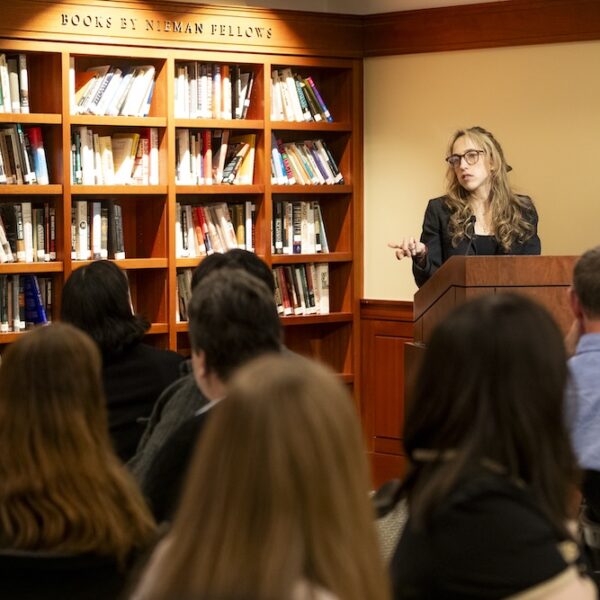
Natanson, who as a student journalist was managing editor of The Harvard Crimson, was the keynote speaker at the Nieman Foundation’s 2026 Christopher J. Georges Conference on College Journalism in March. Following the conference, she spoke to Nieman Reports about her methods for verifying and protecting vulnerable sources, the emotional strain of working on high-stakes stories, and her work documenting the human consequences of policy decisions as they unfold.
This conversation has been edited for length and clarity.
Q: How did you begin reporting on the transformation of the federal workforce, and what tools proved essential to your reporting?
A: I started last year as an education reporter. I was hoping to check out a story tip, and I went to this [Reddit] forum called r/fednews, which is a popular forum for, at one point, 500,000 federal workers posting there, trying to figure out what was happening and what changes might be coming for their agencies. I saw a lot of fear, anger, and anxiety. Someone had written a post along the lines of, “I don’t want to be a tool used by the media,” and I really didn’t want anyone to feel used by me either. I tried to write a post that spoke to what we were pursuing in broad terms. I listed my and my colleague Lisa Rein’s contacts on Signal. The next morning, I opened my phone and had more than 100 message requests.
A lot of them said things like, “I’ve never done anything like this before, but things are so out of control.” These people were really risking everything to talk to me — their livelihoods, their family’s incomes, a very real concern of retribution. I made it a practice to go back to the Reddit forum every time I [published] a story and post it there. I’d write, “This is Hannah Natanson, thank you to all of you who spoke to me.” I posted the first eight to 10 paragraphs, and then at the bottom I’d say, “I’m continuing to report on this. If you want to reach me, this is my Signal.”
In terms of which reporting tools were most crucial, it was really my phone and Signal, and transparently returning to Reddit again and again. It was nothing more than that, which turned into a fire hose of information, which turned into hundreds of stories.
Q: How do you evaluate risk — for both you and your sources — when dealing with sensitive information?
A: I would walk sources through my methods. I would say, “This is how I gather information, this is how I store information, this is how I communicate.”
I couldn’t trust that someone who came into my Signal was necessarily who they said they were, so I had to go through a verification process with them. I would seek a copy of their government ID. Signal lets you send a “view once” photo, where you can view it one time, then it deletes. Or they would send the photo and then we’d both delete it, or they’d hold up the ID during a video call. I’d also verify who I was by whatever means we agreed on.
I had a handful of people who decided this was too risky. I was never going to push someone beyond what they felt comfortable doing. You can’t make that decision for them.
From the beginning, I was hyperaware that this was a time where I needed to be extremely careful. I renamed everyone … by their agency. When I took notes on conversations, I did it in an encrypted cloud service. I took very minimal notes. I understood the risks, and I did everything I possibly could to try to protect my sources and my reporting.
Q: How has the federal investigation affected your reporting and your ability to gather sources?
A: I used to get between dozens and hundreds of messages on some days, probably even extending over a thousand in a back-and-forth conversation. I don’t get that anymore. My reporting has been completely chilled. I have not published an article with original reporting since Jan. 9. That tip line of sources has completely dried up.
Viscerally understanding for the first time what it’s like to have your story taken out of your own hands has been so humbling, so instructive.
Q: How did you approach documenting the real-world consequences of federal policy changes?
A: I was really busy last year, but I wanted to make at least one trip to somewhere in the country where I could show the direct consequence of a funding or a staff cut. I ended up traveling to Lander, Wyoming, to explore what it was like in one part of land managed by the U.S. Forest Service. The land was falling into disrepair because they had cut staff and funding, and three elderly retirees who had been longtime Forest Service employees were coming out of retirement. They stepped up to volunteer and try to turn things around because they were so worried about the hazards springing up in their forest, from eroding roads to docks slipping into lakes to downed signs on steep mountain roads. One 82-year-old was cleaning five bathrooms a day. That was a really important story to me, because it viscerally showed people this is what it means when you axe a program or funding in Washington.
Q: What stories or angles remain underreported as these changes continue to unfold?
A: In general, there was a lot of chaos last year. But now, if you have the time and the resources and the staff, I’d find ways to take a step back and dive into the consequences of what they’ve done to the government.
It’s been more than a year, some of these cuts are solidifying. Some are getting reversed. I’m most excited about the deeply human stories, where I can illuminate an issue through someone’s individual saga, life, or situation. It’s the stories that get at not only what the consequences are, but also understand how these decisions are being made, who the players are, what systems are functioning to bring Trump administration policies to bear, who it benefits, who’s left out. I think just how America is being reshaped in front of our eyes, in ways that are easy to see and in ways that are harder to see.
Q: Since the FBI searched your home, your name has been in the headlines. Usually, you’re the reporter, not the subject. Has that changed the way you think about reporting?
A: It’s been so strange being the subject of the news instead of recording the news. It’s not something I ever wanted. I’ve never really — certainly not for this sustained period of time in such a high-profile way — been on the other side of things. There’s an incredible feeling of powerlessness. Viscerally understanding for the first time what it’s like to have your story taken out of your own hands has been so humbling, so instructive.
In my own reporting, it’s informed my approach when I’m reaching out to people who got caught in high-profile events. The gift of the new role I’m in — narrative enterprise reporter — is that I get to spend a lot of time, and hopefully a lot of space, on any story to really try to get those little details right that will matter to the accuracy of the story.
Q: You’ve written about the emotional toll of this reporting, particularly working with sources in mental health crises. Your colleague William Wan gave you advice, reminding you that reporters aren’t trained therapists. How did you manage that toll, and what did you learn about sustaining yourself?
A: It was difficult last year at times. My sources were suffering so much more than I was, and risking so much more than me. I always felt guilty about being bothered about the fact that I was not sleeping very much or working every weekend.
Absorbing that much stress, pain, fear, anxiety, and thoughts about death from other people was really wearing. It taxed my relationships with my closest family, my then-fiancé, and my parents. And William Wan’s advice about remembering that you aren’t a therapist, you’re just a reporter, you can try to help, but this isn’t what you were trained to do — I needed that.
Many different great colleagues, including the wonderful John Woodrow Cox, would say things like, “If you just work all the time and burn out, the work will start suffering.” Using that to force myself to try to take some of Saturday or Sunday off last year, I did ultimately arrive at a healthier balance of managing the workload. I did learn if you completely run yourself down, the work starts to suffer. And if you completely disregard your family and your own life, then you won’t have a family or a personal life anymore either. Luckily, I didn’t have to learn those lessons the worst way.