Two Palestinian journalists have been honored for their exceptional courage and outstanding work in the face of challenging circumstances as Gaza-based reporters throughout the Israel-Hamas war.
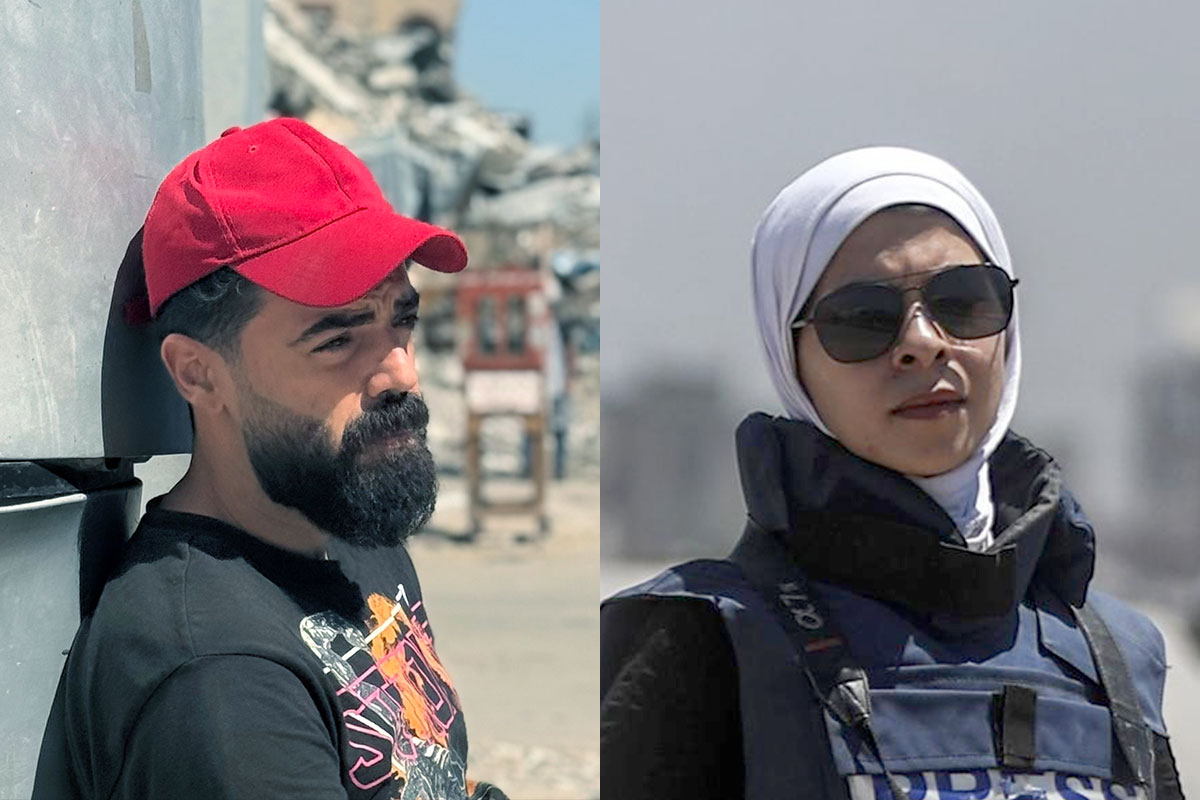
The 2026 class of fellows at the Nieman Foundation for Journalism at Harvard has chosen Anas Baba of National Public Radio and multiformat journalist Shrouq Aila as this year’s recipients of the Louis M. Lyons Award for Conscience and Integrity in Journalism, an honor named for a former head of the Nieman Foundation who was a forceful press freedom advocate.
The class of 22 Nieman Fellows said Aila and Baba stood out not only for their compelling work, but also for their steadfast commitment to reporting about the reality on the ground in Gaza, which foreign journalists are barred from entering without an Israeli military escort.
At least 209 Palestinian journalists and media workers in Gaza — including some that Aila and Baba described as cherished colleagues — have been killed by the Israeli military since October 7, 2023, according to the Committee to Protect Journalists (CPJ). Also, two Israeli journalists were killed in Israel by Hamas, and one Palestinian journalist was killed by an armed group in Gaza.
In presenting the Lyons Award during a virtual ceremony on March 9, Irene Caselli, a member of the Nieman Class of 2026, described Aila’s and Baba’s work as putting “names and faces to what is too often reduced to numbers.”
“Day after day, these journalists continue to report while being displaced, while mourning loved ones, while searching for food and safety for their families,” Caselli said. “Yet, they keep documenting. They keep bearing witness. Because they do, the rest of the world cannot say it did not know.”
Aila, 31, is a photographer, producer and filmmaker who has reported for a variety of international media organizations, including Noosphere, Evident Media and ABC News. She continues her work despite profound personal loss following the death of her husband, journalist Roshdi Sarraj, who was killed while trying to shield Aila and their then-infant daughter during an Israeli aerial bombardment in Gaza shortly after the start of the war in October 2023. Since Sarraj’s death, Aila has temporarily taken over Ain Media, an independent local production company her husband co-founded, while raising their now-3-year-old daughter alone.
Baba, 32, is a reporter for National Public Radio. Born and raised in Gaza, he remains one of a few Palestinian journalists in the enclave who are employed full time by a U.S.-based news organization. Baba said he began working in journalism in 2014, when his dissatisfaction as an engineering student made him realize, “This is not my path in life … I wanted to shift my career to something that I truly love.” That led him to follow in the footsteps of several relatives who were journalists, including his father, who Baba said had worked for Agence France-Presse for 25 years.
Below are excerpts, edited for length and clarity, from the awards ceremony conversation between the Nieman Fellows and the Lyons Award recipients.
On receiving the Lyons Award
Shrouq Aila: Thank you all. They told me that I have to say something about myself, and sometimes, I feel that it’s better not to say what you have done, just to show, and this is what we have learned in journalism.
Documenting during the genocide is never a thing that we can put it in words. Never. Not a person on earth deserves to live a second during this hell.
In a time that we were unable to feed ourselves, our families, in a time that my daughter was asking for food, I myself was not having food; in a time with no transportation because of the shortage of fuel, as the Israeli army blocked the entry of the fuel trucks, [and] at the same time, being displaced — running from one place to another for your safety. Yet, I continue the coverage, and this is not a thing to be proud of, because I feel this is such a commitment. It turned out to be an ethical commitment toward my country, my beloved husband, and my people.
It turned out to be, and it is still ongoing, actually, sometimes when you have that capacity of anger, and that capacity of, of depression, I just try to transfer it into something, into work, the work that now you are recognizing me for.
I’m so honored. … This is not a personal recognition. I consider it as a recognition for all of the journalists in Gaza, especially those who lost their lives to tell the truth, for the world that never wanted to see the truth.
I’m not dealing with this as a personal thing, because what matters here is that the world is seeing us, and giving us the platform and the recognition. This is actually what is more important for me — to feel that we are seen.
I consider it as a recognition for all of the journalists in Gaza, especially those who lost their lives to tell the truth, for the world that never wanted to see the truth.
— Shrouq Aila, co-recipient of the Louis M. Lyons Award for Conscience and Integrity in Journalism
Anas Baba: To be honest, we, in Gaza especially, and in general as journalists, we don’t like to speak about each other, or ourselves, more than speaking about what exactly is the reality on the ground, what exactly [is] the truth.
As journalists in Gaza, we can say that we were suppressed, and the suppression is still ongoing, as the international journalists are not allowed to enter Gaza yet, which is another load on our shoulders, just to tell the world and to tell everyone outside what’s happening in Gaza.
On covering war in your homeland
Baba: In most of parts of the world, reporters travel to cover a story. But in Gaza, the story is where we live. … The places we report [from] are often the same streets that we’ve lived in, we grew up in, but we’ve reached a time [after extensive destruction in Gaza] that we can’t recognize exactly if these streets are the same or not. We lost even our geographical map inside of our heads, [even though] we were born, raised, and grew up in this city.
To be honest, we lost too many things as journalists, but the only thing that we couldn’t, and we will never, lose is the transparency, and our word, that we do need an honorable journalism.
Shrouq lost her own husband, some of her family members. For me, I lost most of my family members. Only a few are still alive. [Baba added that some members of his immediate family were able to leave Gaza, but that not being able to see them for nearly two years has been painful.]
That proximity creates a complicated responsibility on us. As journalists, we try to observe events with clarity and accuracy. But as human beings, that’s the hard part. We are also part of the same reality we are documenting, which makes it a little bit soul-taking day by day. It consumes our souls.
I reported in Egypt before. … I know what’s the feeling of being a reporter that reports from outside his own country, not about himself or about his population. When it comes to the fact that the [Gaza] population themselves are dying day by day, asking you just to tell the world, after 12 months of the war, they started to tell us: “We don’t care about you. We don’t care about journalists. We don’t care about the world. No one is going to stop this.”
We are also part of the same reality we are documenting, which makes it a little bit soul-taking day by day.
— Anas Baba, co-recipient of the Louis M. Lyons Award for Conscience and Integrity in Journalism
This is where those people, those innocent citizens who lost their lives, their houses, the amount of loss that the Gaza people went through, again, it’s not new.
As journalists and reporters, we can say that we are lucky that we are still alive, and we are lucky that we are able to speak with you today, while we hope that one day you will all be able to come to Gaza and witness everything with your own eyes, and write about that with your own words and pens.
We want our children to grow up. We want the trees and the desert that came all over Gaza to become green again. We want houses. We want lives and we want the future. Mostly, we want to keep our journalism honest and accurate.
On reporting in conditions of constant grief and danger
Aila: Well, basically, under genocide, there is no luxury of grief. There is no way to break down, as the circumstances around never give you the space.
We live with the lack of privacy, because you are displaced with many people and running for your safety, being displaced multiple times, running for securing water, food, and all of those daily sufferings. In addition to this, the hardships of being a journalist, because we [are] working …. We don’t have electricity, regular electricity. Those lucky ones are having access [to] it.
So, sometimes, you better use that anger and stress in a way that never burns you inside, so this is the mechanism that I used during this [war] because I had no time to break down, and also had no time to grieve or also to pay a proper farewell [to] my husband. I had to use this anger as a power station, to produce more work.
On the war’s impact on children
Baba: We can’t say that there are children in Gaza anymore, to be honest. Our children in Gaza are now literally experts on what we call DIYs [“do it yourself”].
They are experts in how to fill water jugs, how to go to food charity kitchens, how to run the streets looking for any wood, between the scavenged wood from the rubble or the debris from the houses that are bombed.
[Since the start of the war], that’s three years of non-education for the children. That means one generation is being totally uneducated.
The children in Gaza now, they lose that dreamy childhood that we [had]. Every time we go to the morgue, there [are] dead bodies on the ground, blood everywhere, the smell itself. We found children staying and standing there, looking at all this. Once, I asked one of them why. She was a little girl. She told me: “I came here to fill my water from the hospital. Every morning, I see this, and I start to look and ask myself: ‘Am I going to be next? Is my family going to be next?’”
We have children that they started to work in the streets as street vendors. We have children that they spend all of their lives now, all of their days, just trying to grab the basics for the family. Because when you are living in a tent, that means that you’re living in nothing, so every single person in the family needs to have a task. The children are the ones, to be honest, they are the ones that lost their own future here, because there is no home, there are no schools, nothing that they can rely on. When you ask them about what they recall about the school, they recall one thing: that there was a school, and now it has turned into a shelter.
Aila: I’m going to tell you about the reactions of my daughter. She’s using the [surprised] reaction all the time, with everything that she’s seeing recently. After the declaration of the ceasefire, we [started to see] clothes available at the market, because we have been deprived of having decent clothes. When I bought her a dress, she was like: “Mama, what is this?” I explained to her that this is a dress, this is for girls, because she used to wear [only] boys’ clothes because at that time, that was the only available thing.
In terms of clothes, and in terms of entertainment places, we don’t have any green areas, they are not existing any longer. What we are seeing is just a desert of rockfall. It’s just grayness everywhere.
I’m so sorry sometimes, I feel guilty as a parent, that your daughter is living under such circumstances, and she doesn’t know what [things] look like. She’s 3 years old, and she spent more than half of her life within such genocide. What she’s reacting over, and what she’s seeing, is just the first time, first impression. She doesn’t know play yards. She doesn’t know green areas.
On the current situation in Gaza
Baba: The reality on the ground. … There is more food that enters [Gaza], thank God. There is a ceasefire, but we don’t know exactly what are the rules of the ceasefire, and when the amendments of the ceasefire are going to be implemented. The bombs stopped [from] being dropped heavily, to being dropped every day or two. The drones are there. The displacement [is] there. Every single day, when we talk about the reality on the ground, there is nothing changed.
We still live [under] the same conditions. No electricity. The internet is limited. We have displacement everywhere. And unfortunately, the Israelis, [during] Phase 1 of the ceasefire, were supposed to retreat or withdraw to what we call the “yellow line.” But every day, the Israelis [are] expanding the yellow line into Gaza itself.
Aila: The situation is so foggy. Literally, it’s so gray. And it feels like half peace, half war. We cannot be totally satisfied that this is a lasting ceasefire … till this moment, we can say, this is no real ceasefire. Yesterday, several attacks happened inside the city, not in the yellow area, which is the area that is completely controlled by the military. Those attacks that happened yesterday caused the killing of children, and also of other innocent people.
In terms of the aid trucks, in terms of the humanitarian situation, it is so devastating. The aid trucks entering Gaza [are] still so limited, and it is such a drop for the needs [of] the people. The majority of the population is financially broken. Wars are consuming; we are talking about two years, almost, of not having sources of income for the vast majority of the Gazans here, and losing our homes — losing, for some of us, our workplaces, etc. All of these things, for sure, affect our ability to live a decent life in such circumstances.
What is happening here is just so inhumane, and this is not a proper life that I wish for anybody.
Since the start of the Iran-U.S.-Israel war, nobody has left Gaza. The border for individuals is closed, and we are still having problems in terms of the medical supplies, in terms of the food, in terms of water, all of these things. We are living in a collapsed city with a collapsed sanitation system with zero infrastructure.