The Fall 2025/Winter 2026 edition of Nieman Reports represents the magazine’s final print issue as it transitions to an all-digital format. A combination of factors — many of which are affecting the wider media industry — has resulted in the move to online-only following a nearly 80-year run in print.
There’s much to think about and enjoy in this new print edition of Nieman Reports, and even more online. The issue examines challenges and trends in the news industry in the United States, France, Myanmar, Nepal, and Sudan, while our cover story looks at the evolution of Nieman Reports.
The same great journalism about journalism that readers have come to expect from the magazine will continue at niemanreports.org. In fact, it’s been appearing there for years already, including stories that don’t make it into print. Despite the changing format, our commitment to global media coverage remains as strong as ever.
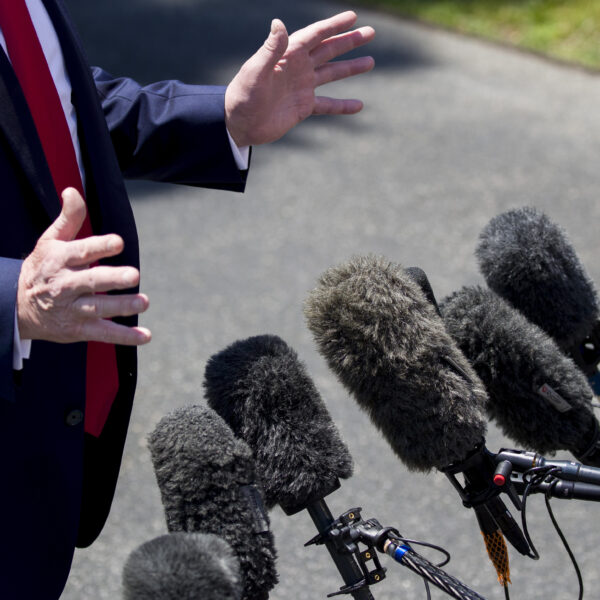
When a reporter asked Saudi Arabia’s Crown Prince Mohammed bin Salman about journalist Jamal Khashoggi’s 2018 murder, President Donald Trump used the opportunity to launch another broadside against the U.S. news media.
Sitting beside Salman in the White House during the prince’s November visit, Trump defended his guest — whom the CIA has concluded approved the Washington Post columnist’s assassination — and disparaged Khashoggi, saying, “A lot of people didn’t like that gentleman that you’re talking about, whether you like him or didn’t like him, things happen.”
Later in the news conference, Trump returned his attention to Mary Bruce, the ABC News reporter who had asked the question, calling her “a terrible reporter.”
Insulting journalists, both alive and dead, is nothing new for Trump — animosity toward the mainstream media has been central to his persona since he first ran for president — but what’s changed in his second term is how those threats have been followed by action.
In his exchange with Bruce, he added that ABC’s network broadcast license should be taken away on the basis of her questioning, “because your news is so fake and it’s so wrong.”
The exchange, particularly the president’s dismissive conclusion that “things happen” when referring to a journalist’s murder, garnered substantial attention, but it was not an isolated incident. Trump spent the first year of his second term showing no hesitancy to leverage the full weight of the government, as well as the legal system, to punish media organizations he feels are biased against him.
“I don’t think it is an exaggeration to say that what we’re seeing from the Trump administration is an unprecedented level of hostility towards the press,” media law scholar and attorney Amy Kristin Sanders said.
The attacks have been widespread and, often, nuanced in approach, as government actors have leveraged financial threats, weaponized the legal system, and limited access to news organizations. Each of these efforts has found success as news organizations, or in many cases the corporations that own them, have buckled under government pressure.
“We’re enduring a multifront assault unlike anything experienced in the modern history of American journalism, with the exception of the Black press in the segregated South,” said Bruce Shapiro, executive director of the Global Center for Journalism and Trauma. “You have to go back there to find the combination of legal threats, stigmatization, and violence.”
Meanwhile, a public whose news consumption habits are increasingly fragmented has looked on with apparent disinterest as, in Shapiro’s words, “the idea of the trusted vehicle for shared understandings of community events, of tragedies, of politics, of wars is being systematically undermined.”
Shifting norms
RonNell Andersen Jones, a First Amendment scholar who specializes in media legal issues, emphasized that the setbacks for press rights over the past year have come as many of the conditions that guided the relationship between journalists and the government have shifted.
“A lot of what has happened in the press freedom space over the arc of the entirety of the modern media era has been norm-based and not rule-based,” Jones said. “It’s a soft law and agreements, and a sort of careful dance between the press and the government, and an appreciation on both sides that the other has an important role in democracy.”
The fragility of that agreement was highlighted when, a few weeks before Trump’s comments on Khashoggi, dozens of reporters covering the Pentagon for major media outlets turned in their press credentials after refusing to sign an agreement promising they wouldn’t gather or report information that wasn’t authorized by the Pentagon. Some of their places were soon filled by outlets with clear right-wing biases. The New York Times filed a lawsuit in December contending the new rules violated the First Amendment.
The norm-breaking also was apparent last spring, when the White House revoked the Associated Press’ press pool credentials because the organization declined to refer to the Gulf of Mexico as the Gulf of America in its reporting. The organization has sued for its access to be restored.
“We assumed that the Associated Press would always have a place in White House briefings, in the Oval Office, and that’s simply not an assumption we can make anymore,” said Sanders.
Shapiro identified similar concerns but framed them differently. Remembering when Univision journalist Jorge Ramos was removed from a Trump press conference in August 2015 after he repeatedly pressed the then-candidate about his immigration policy, Shapiro said losing access to spaces, threats toward journalists, and other attacks on the press take a toll on journalists and democracy.
“It was a physical ejection of a journalist, which kind of got the ball rolling, which showed that the spectacle of physical violence could work,” he said, emphasizing that physical altercations with journalists have escalated recently, during Immigration and Customs Enforcement operations in Chicago and Los Angeles.
Threats to broadcasters
The saga of late-night talk show host Jimmy Kimmel shone a spotlight on an increasingly popular practice — leveraging or threatening a corporation’s financial interests to exert pressures on unpopular ideas and information shared through its media properties.
About a week after the death of right-wing activist Charlie Kirk in September, Federal Communications Commission Chair Brendan Carr told a conservative podcaster that comments Kimmel made about Kirk and Trump’s followers were “truly sick.”
Kimmel had quipped during his monologue, “We hit some new lows over the weekend with the MAGA gang desperately trying to characterize this kid who murdered Charlie Kirk as anything other than one of them.”
Carr went beyond criticizing Kimmel’s comments; he threatened government action, telling the podcaster, “We can do this the easy way or the hard way. These companies can find ways to change conduct and take action, frankly, on Kimmel, or there is going to be additional work for the FCC ahead.”
He continued by encouraging corporations that hold broadcast licenses to pressure Walt Disney Co. not to air Kimmel’s show.
While the statement included warnings regarding potentially unpopular, but generally First Amendment-protected expression, they seemed aimed less at Kimmel than at broadcast license holders and Disney, which owns ABC, the network that airs Kimmel’s show.
Carr’s message was directed at companies like Nexstar Media Group, Tegna Inc., and Sinclair Broadcast Group, which are among the largest owners of broadcast television licenses in the U.S., said Chris Terry, a media law scholar whose research focuses on broadcast policy and media ownership. Terry noted that Carr and the FCC have little power to force networks to censor programming in any way.
What they can affect are mergers that require FCC approval. At the time of the Kimmel controversy, Nexstar was seeking to acquire Tegna, and Sinclair was pushing the FCC to loosen the rules that limit the numbers of stations companies can own in a single market.
“If Carr has any power here, it’s to hold up these mergers,” Terry said. “Carr can stick his finger right on the scale of those and just slow that process down.”
Nexstar, which operates roughly 30 ABC affiliates, announced it would pull Kimmel’s show the same day that Carr made his comments, and Sinclair followed suit with its more than three dozen stations. ABC suspended Kimmel’s show across its entire network just hours later, though it was reinstated within a week. Importantly, the network did not suspend the show because the government directly threatened to fine or censor content, which would face substantial First Amendment hurdles.
A similar tactic worked with Trump’s lawsuit against CBS News, which its parent company, Paramount, settled for $16 million in July. The president sued CBS News for $20 billion for the way the news program “60 Minutes” edited an interview with Democratic presidential candidate Kamala Harris before the 2024 election. The lawsuit put Paramount in a difficult position because it was awaiting FCC approval for its $8 billion merger with Skydance Media.
Legal experts found the case had no merit. Nevertheless, Paramount settled. The FCC approved a merger between Paramount and Skydance a few weeks later.
Sanders, the media law expert, pointed out that news operations like CBS’ have become small parts of massive corporations, which allows government actors to jeopardize financial concerns in other areas of the firm’s holdings to get desired results in the news divisions.
“The regulatory reach covers these mega-media corporations in ways that it wouldn’t have 30, 40, 50 years ago,” she said. “It’s much more of an effective tool now, given the small number of companies that can control the mainstream media.”
See you in court
Trump’s multibillion-dollar lawsuit against CBS News and another against ABC News weren’t aberrations. He sued The New York Times in September, seeking $15 billion in defamation damages. After the lawsuit was dismissed, he refiled a new version in October. Similarly, he sued The Wall Street Journal in July for $10 billion for its reporting about his relationship with Jeffery Epstein. Trump sued the BBC in December, contending that the way a documentary about the Jan. 6 riot at the Capitol edited his speech that day was defamatory. All three cases are ongoing.
Lawsuits such as these represent another increasingly potent tool for threatening the press — weaponizing the court system. Government officials and others with financial means can file lawsuits that, even if they have little chance of achieving a legal victory, drain news organizations’ resources, increase stress and trauma for journalists, and chill factual reporting.
“Defending lawsuits always takes time and resources — and adds stress,” Shapiro said. “And the stress becomes even greater when so many institutions are capitulating. Universities and law firms are capitulating, and journalists are left wondering, ‘What’s going to happen when they come for my newsroom?’”
Government officials and others with financial means can file lawsuits that, even if they have little chance of achieving a legal victory, drain news organizations’ resources, increase stress and trauma for journalists, and chill factual reporting.
Trump alluded to the types of harms these lawsuits threaten after filing his lawsuit against The Wall Street Journal, saying, “I hope Rupert [Murdoch] and his ‘friends’ are looking forward to the many hours of depositions and testimonies they will have to provide in this case.”
Sanders said such lawsuits raise concerns beyond the large national news outlets. They threaten local journalism.
“Not everyone has the resources of The New York Times or Wall Street Journal,” Sanders said. “Smaller news organizations are going to be pressured to settle, to try and get out of things quickly, even in instances when they have a really strong case.”
These types of cases force organizations to weigh the robust First Amendment protections news organizations have traditionally experienced in the U.S. with financial and political pressures.
“Not everyone has the resources of The New York Times or Wall Street Journal. Smaller news organizations are going to be pressured to settle, to try and get out of things quickly, even in instances when they have a really strong case.”
— Amy Kristin Sanders, media law scholar at Pennsylvania State University
“When news organizations settle suits that are winnable or capitulate on demands that could be fought against,” Jones said, “they are not misunderstanding law or constitutionalism. They are making an educated guess that the United States is moving into a space in which law and constitutionalism will no longer be important.”
The trend, Jones said, is concerning for the future of press freedoms in the U.S.
“It isn’t enough to have doctrine on the books that respects or defends press freedom if we have a structural system in which that press freedom cannot, or cannot be, or is not meaningfully, invoked,” she added.
Defamation lawsuits aren’t the only avenue the administration has used.
The Des Moines Register, its parent company Gannett Corp. (now USA Today Co.), and veteran pollster J. Ann Selzer have not capitulated. They are fighting an Iowa Consumer Fraud Act complaint Trump filed in December 2024 after the presidential election. The lawsuit contends the news organization took part in “brazen election interference” by reporting that a poll just days before the election showed that Harris was leading Trump among Iowa voters. Trump wound up winning Iowa by 13 percentage points, and the complaint argued that the poll was false information that was used to try to influence the election’s outcome.
Sanders said the lawsuit was particularly concerning because it targets a source, Selzer, as well as the news organization.
“It makes nearly everyone think twice about whether or not they want to speak to the press,” she said. “She [Selzer] has a bulletproof reputation in terms of the work that she has done and so, to see her targeted, makes other experts, I think, nervous about sharing information with the press.”
A call for solidarity
When President Barack Obama sought to limit Fox News’ access to the White House in 2009, after claims that the organization was biased in its coverage of his administration, major broadcast and cable news networks stood in solidarity against the efforts. News organizations exerted a united front of pressure on the administration, and it relented.
“Everyone stood up for them and that did it,” Sanders said. “Solidarity won the game there.”
Sanders contrasted the episode with the AP’s experience in March, when few news organizations backed up the news cooperative after the Trump administration removed it from the White House press pool. Experts said solidarity within the news media will be crucial for the future of press rights.
“Solidarity is the answer,” Terry said. “If major news organizations like CBS and ABC settle lawsuits that they could win, it only empowers bullying tactics against other news organizations.”
Terry said larger news organizations must stand up against threats, lawsuits, and access limitations, because smaller operations don’t have the same resources to defend themselves.
“If major news organizations like CBS and ABC settle lawsuits that they could win, it only empowers bullying tactics against other news organizations.”
— Chris Terry, media law scholar, associate professor, and Cowles Fellow of Journalism, Law and Policy at the University of Minnesota
Similarly, Jones characterized discussions about press freedom on two levels. She emphasized that First Amendment protections for press rights in the U.S. remain strong. However, those rights are only valuable if they are claimed by news organizations.
“We’re operating on a question about what the law needs to be in order to protect the press,” she said, describing one level. “And then, in a very concrete operational level about whether those existing rights can be, or will be, invoked by the parties who could use them to defend themselves.”
Sanders said the collective approach also applies to speaking against false rhetoric and attacks on reporting.
“We need to do more in our stories to explain what we do,” she said, “to be transparent with our audience about how we gather our information and to have other people help tell our audiences, ‘Yes, this is important. It doesn’t matter that President Trump calls the press the enemy of the people. They aren’t, and here’s why.’”