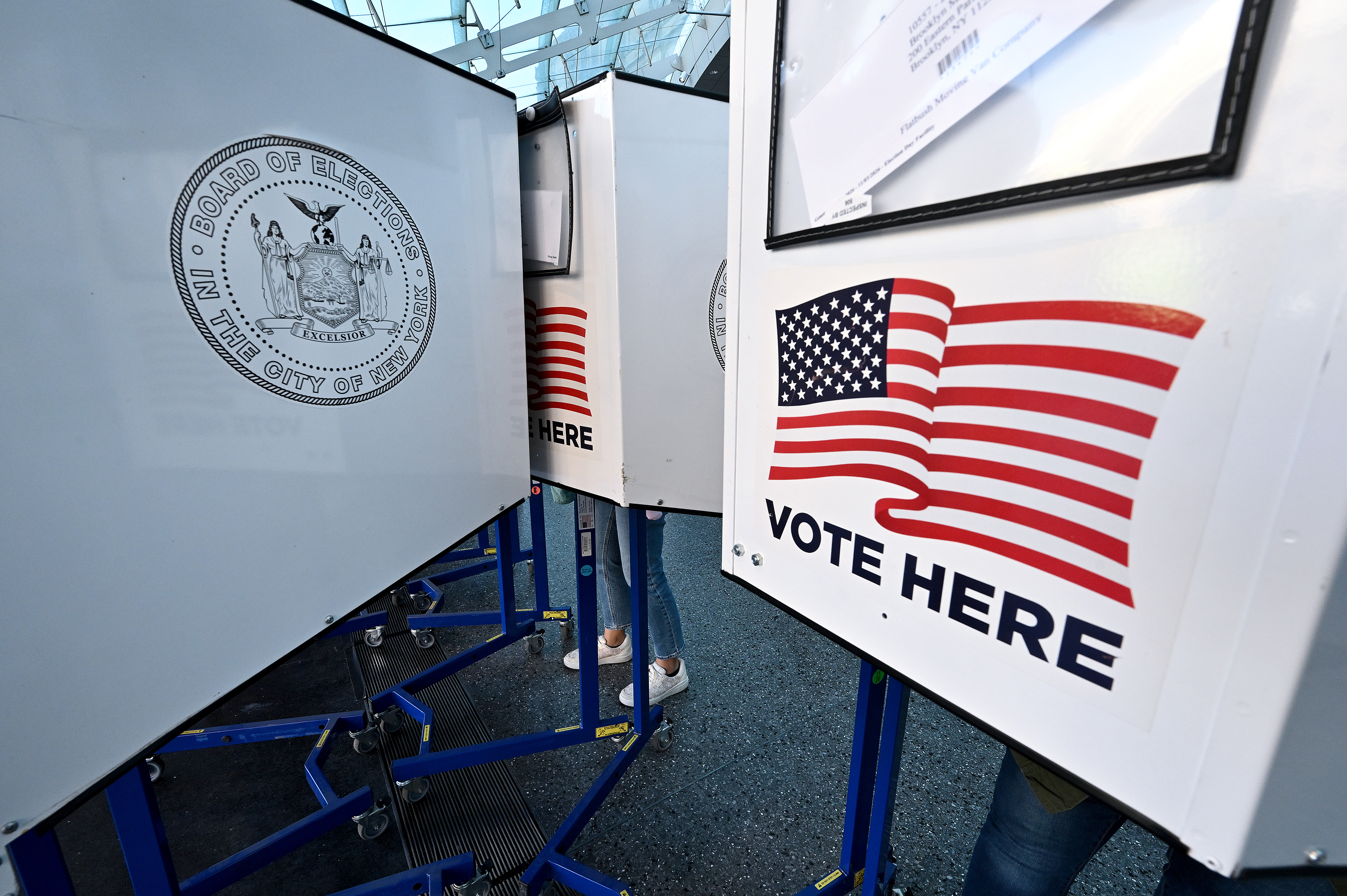
With the first U.S. midterm elections since President Donald Trump’s return to the White House approaching, voters will be weighing in on a range of issues, from the economy and rising cost of living, to the administration’s foreign policy and the future direction of both major parties. At a recent virtual Nieman-to-Nieman seminar, a group of Nieman alums who cover politics discussed what they’re hearing from voters with regards to key Senate races, the growing influence of younger voters drawn to progressive candidates, and the political implications of conflicts involving Iran, Ukraine, and Russia.
Moderated by Austin Bogues (NF ’21), news desk editor at USA Today, the discussion brought together James Barragán (NF ’24), political anchor for Spectrum News in Austin, Texas; Bill Barrow (NF ’22), national politics reporter for The Associated Press in Atlanta; and Ines Pohl (NF ’05), Washington bureau chief and White House correspondent for Deutsche Welle, Germany’s international public broadcaster.
They explored what the midterms could reveal about voter sentiment, Trump’s influence on down-ballot races, and the future of U.S. domestic and foreign policy.
Edited excerpts:
Austin Bogues: What will the 2026 midterms reveal about President Donald Trump’s political standing and the future of the Republican and Democratic parties?
Bill Barrow: It’s true that all midterm elections, after the White House changes hands, are viewed broadly as referendums on the sitting president. Though Trump has won two presidential elections, he’s always at his most effective as a campaigner when he’s an outsider throwing bombs to the inside. Once he’s in office and he’s governing, Republicans’ electoral fortunes aren’t nearly as good.
Ines Pohl: From an international perspective, a big question is: Will Donald Trump’s power be limited after the elections? How limited will his power be — even if he might lose both houses [of Congress]. What is going on with the United States if [voters] won’t punish Trump for what he has been doing [over the past] two years?
If the Democrats do not at least win the House, then the world would really wonder if the U.S. ever will be a reliable partner again. If the Republicans come out as winners and not defeated, as many are hoping, then I think our alliances are in huge trouble.
James Barragán: There’s uncertainty about whether the president is going to be effective in rallying his base. There’s uncertainty over the economy, about how aggressive immigration enforcement has become.
There’s this uncertainty in deep red states, like Texas here, about whether perhaps the president and his allies have gone too far and pushed people too far to the edge. Now there are questions about Texas potentially turning blue and electing a Democratic senator [candidate James Talarico] for the first time since 1988.
Barrow: Even though the president is deeply unpopular, the Democrats aren’t much better. Their brand isn’t selling that well either. I don’t think [this election] will be a resounding endorsement of the Democratic Party. It will just be a reflection that people are unhappy with the way the country is currently going.
Bogues: Polling has come under scrutiny in recent elections. What are you watching as you assess the polls and their reliability?
Barrow: It’s very hard to defend the polling industry, especially as fewer people use [telephone] landlines, which polling depended on for generations.
Every president has to put together a new coalition. Trump’s shook up the traditional Republican and Democratic coalitions, and there’s evidence he’s lost some of that support. But by how much? In Texas, the uptick that he got among Latino men, among Black men, those marginal increases that made a difference in a presidential election — where does that go?
I don’t want to say it’s impossible, even for the best pollsters and statisticians, to build their models. But they’re having to make some guesses about what this electorate is going to look like.
Bogues: In politically conservative states like Texas, what are voters’ concerns about the economy telling you about the political landscape?
Barragán: I’ll give you one example. There’s a guy who runs the South Texas Builders Association. He is a guy who voted for President Trump in 2024, and he has now come out and spoken not only against President Trump, but against Republican incumbent [Rep.] Monica De La Cruz.
Construction has slowed down in South Texas because there is no labor force, [since that industry] largely relied on the immigrant workforce.
If a guy like that who said, “I’m going to take a chance on President Trump,” in 2024, and two years in, he’s saying, "Well, my workforce is gone, my bottom line is [being] affected, and my cost of living is going up,” I’m not so sure that they’re going to vote for the president and his party again. That’s why you see the president coming again to Texas, one week before the election, in what really should be a deep red, safe state for them.
Pohl: Trump is able to spread a lot of lies through his own networks, to the radio shows. People still believe that the elections are rigged and whatnot. But where his narrative doesn’t work is the cost of living. It’s the gas prices. That is really weakening him the most. I think that will be the make or break thing in this election.
Barrow: We can objectively identify the widening wealth gap and the stagnation of wages in the United States. … I think we’re in the middle of a long arc of a second Gilded Age and a populist era independent of Trump. He exacerbates it with some of his policies. I don’t want us to lose sight of that overall dynamic that Trump is representative of, but did not create.
Bogues: There’s so much discussion about the impacts this midterm elections could have for the rest of the world. Ines, from your standpoint, what are the important storylines to monitor?
Pohl: It’s of course Ukraine and the new love between [Vladimir] Putin and Donald Trump. That’s definitely something Europe will be monitoring very closely. I’m sure we’ve all heard the news that Benjamin Netanyahu and Donald Trump have a plan for after the midterms regarding Iran. The Strait of Hormuz will be opened up sooner, rather than later, to bring down oil prices. Not to mention the human cost. Then over and over again: NATO. [That] and Iran, Ukraine, and Russia, are the major topics.
Bogues: There’s been a lot of speculation about a wave election in which many incumbents lose their seats. Are those kinds of sweeping electoral shifts still possible in the United States, or has the electorate become too polarized for a broad political realignment?
Barrow: Looking at the House map, we have fewer and fewer competitive districts, especially because of more sophisticated gerrymandering that the Democratic and Republican legislatures do after the census.
Going back to the 1994 wave, when Republicans gained more than 60 seats, that was a combination of less sophisticated gerrymandering and historical ties. There were still a lot of conservative Democrats in the South. That election was the last one that swept them out.
Younger generations are less partisan. … The electorate age 35 and under is always a real wild card in midterms.
Are big shifts still possible? They are. You cannot gerrymander state lines. Kansas has not elected a Democratic U.S. senator since 1932, during the Great Depression. If this [election cycle] is a wide wave, you could even see Mississippi elect Scott Colom, a Black Democrat, to the U.S. Senate. If you’re seeing those kinds of dynamics, I think it still qualifies as a wave and a fundamental shift. Are we ever going to see, in our lifetimes, the kind of Democratic majority Franklin Roosevelt wielded in the ’30s? No.
Bogues: How are campaign spending and outside money shaping the midterms?
Barragán: The richest man in the world, Elon Musk, is essentially bankrolling [Texas Republican Senate candidate] Ken Paxton’s PAC. He has donated $158 million to the Senate Leadership Fund, which then gives to Texas PAC to run pro-Paxton, anti-Talarico ads. On top of that, he’s giving money from his own PAC, America PAC, to oppose Talarico and other Democrats down the ballot. So even with Talarico’s advantage in campaign fundraising, Republicans have been able to basically even that out.
What we’ve learned from recent FEC filings is that basically all the money for Paxton-supportive or Paxton-aligned PACs is coming from Elon Musk, and that may push Paxton over the top. But it’s also become an issue on the campaign trail because Talarico has said this is not a race between Democrats and Republicans, but [between] the top and the rest of us. He’s saying, “Elon Musk wants to buy this U.S. Senate race. We are not going to let him.” In the next week and a half, I’ll be curious to see if that message resonates with voters.
Bogues: Abdul El-Sayed’s Michigan Senate campaign has drawn attention as a test of the Democratic Party’s progressive wing. If he wins, what could that mean for the party’s future?
Pohl: If El-Sayed really wins, of course, this will give the left-wing part of the Democratic Party a huge push after [Mayor Zohran] Mamdani in New York.
Let’s face it, it will be very difficult for the Democratic Party to come up with policies over the next two years. Now they have Trump as the big enemy and as a motivator to get people to the polls. But once he is not on the ballot anymore, what do the Democrats really have?
Barrow: The reason the left flank is rising is because we built an economy where it’s hard. I talk to young voters here in Atlanta who pay rent in my neighborhood that’s more than my mortgage. … These are young American professionals that see a warped economy.
Whoever emerges as the Democratic Party nominee in 2028 is going to have to speak to those people while also managing the context of how they are perceived and labeled, whether they openly identify with the Democratic Socialists of America or not, or openly criticize the DSA.
Bogues: How is the White House responding to the possibility of Republicans losing control of Congress?
Pohl: It’s super chaotic. It’s actually been really difficult to get any information other than just the daily schedule.
If [Trump] really loses both houses, he will be in a very bad mood. Maybe he starts bombarding Iran or something. That’s just my little speculation. I wouldn’t be surprised if something big would happen just to distract us from the outcome. That would be my guess.